The National Art Museum of Catalonia overlooks Barcelona from the top of Montjuïc Hill. The neoclassical building, created as architecture for the 1929 World’s Fair, houses a late 19th-century collection joined by recent acquisitions of works from Catalan modernism, Novecentism, communism, and republicanism.
The most impressive part, however, is the important section of Catalan Romanesque painting. It consists of wall paintings of 12th-13th century churches, torn apart and then brought back to the museum recreating apses and naves to recall the original architecture and the measurements of spaces and volumes. The colors of the original paintings stand out against the neutral grayscale background of the reconstructed walls, and give an impressive and overwhelming feeling. The historical issue is central: bishops, chaplains, conservators setting up detachment and reconstruction practices in the museum: they are the ones responsible for this massive centuries-long effort to protect the paintings from abandonment, sales, expatriation and civil war. Rural churches are stripped but museums are born and populated.
And the question of their presence in the museum is central: their connection to their site of origin has been destroyed, but their placement in precise structures that recall their original location serves to stitch up this narrative, to not turn these paintings into paintings with only aesthetic value, to keep them in touch with their liturgical and religious essence.
Seeing these large reconstructed apses is a unique thrill: Catalan Romanesque in a museum is too important an experience for museology to go unnoticed.

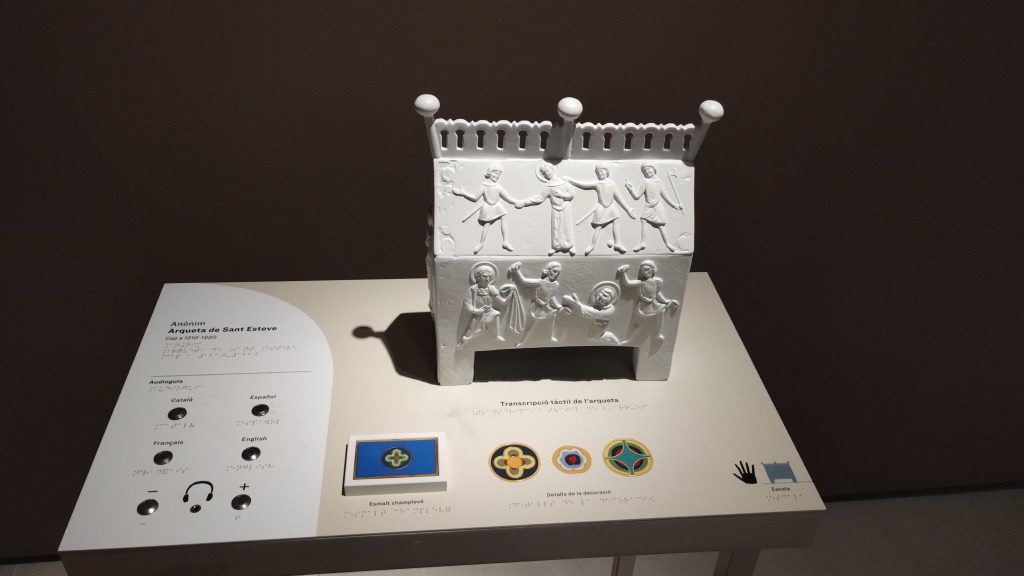
Even the didactic and explanatory apparatus is impressive. First of all, the process is explained, which is what is surely of most interest, and which is explained in a rotating three-language video, with the procedure divided into four sections for each of the three phases-tear, restoration, new support-showing original images of a 1978 intervention. In the tour there is the possibility to see the back of the structures of the apses, thus understanding the chronological and technical difference between the various specimens. The windows are closed with evidently removable slabs. To show the ancient graffiti on the paintings, a lighting system is set up to highlight and magnify them in rotation. An educational workshop with music and puppets is provided for children, and there are indeed many children drawing in front of the apses. Also notable are the educational aids for the blind: panels of the right height, reconstructions in three dimensions, braille, plaques with surveyed contours, beautiful indications of scale and techniques (e.g., the reconstructed enamel plaque).
Absolute contemplative pleasure of polychrome wooden sculpture, not as lively, varied and numerous as at Vic’s Episcopal Museum but of the highest level. Some 12th-century crucifixes in pure art nouveau style, marvelous on their white backgrounds, the light directed on them and, behind, the stark and despairing shadow of the crucifixion. There are also many altar fronts, displayed on the wall as paintings or reconstructed with their own cross and canopy.
 Catacombs rediscovery