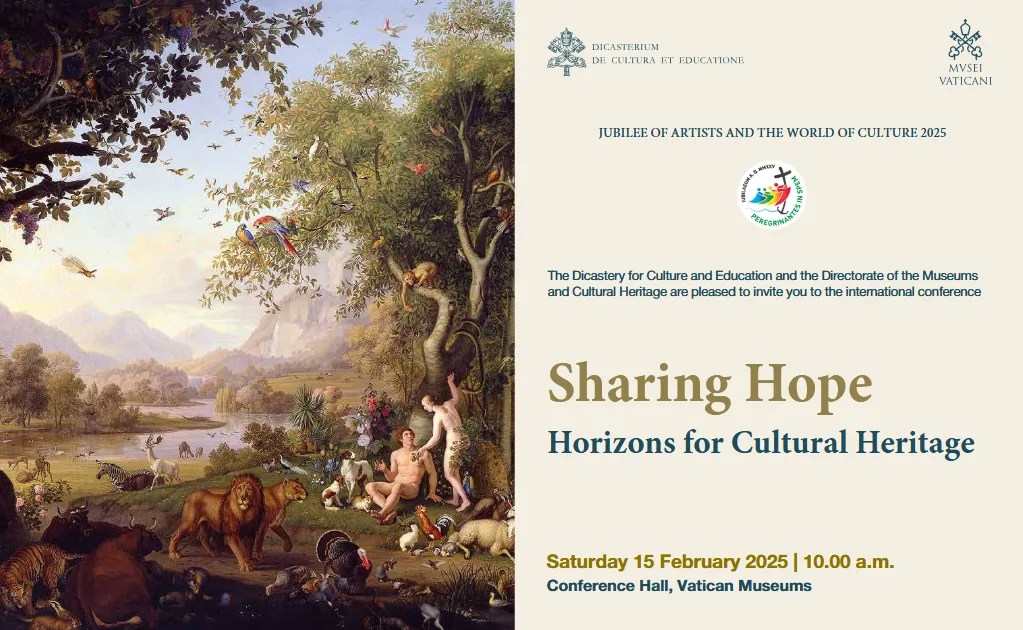
Last weekend I had the opportunity to take part in some of the events of the Jubilee of Artists and the World of Culture, which was held in the Vatican on 15-16-17 February 2025. Among the various religious celebrations, there was an international congress at the Vatican Museums, organised by the Museums themselves and the Dicastery for Culture and Education. The event aimed to bring together cultural workers from the Vatican State and various international representatives of institutions related to culture, the arts, research and teaching, including an important group of speakers chosen for their roles within the main Italian museums and universities.
The morning session was an important opportunity to reflect on the present, conceived as an analysis to understand what future awaits cultural heritage, as expressed by the title of the meeting ‘Sharing Hope – Horizons for Cultural Heritage’. The target was clearly the cultural heritage inherent to Christianity, but with a necessarily universal focus, if one thinks of the impact Christianity has had on European art. This is a subject very close to some of my recent studies and that is why attending this meeting was extremely inspiring.
In general, the experiences brought to the table were all of great interest, and all focused on the need to address a new cultural horizon so that Europe’s heritage does not become mute in the face of the growing backwardness of religious culture. I will not go into the details of the individual interventions, but I will report what for me were the most important points of reflection of the morning:
– The cultural code of the monotheistic religions can be considered as an indispensable iconographic volume to understand European art, a sort of manual through which to understand scenes and references. Much of European art is art born in churches, and therefore born to enliven faith: to forget this is to consider only the aesthetic aspects of a work, risking emptying it of its soul.
– The codes of understanding, however, are neither univocal nor fixed in time, and the sense of the sacred in all civilisations is made up of stratifications. Museums must always take this into account when communicating, increasingly moving towards an anthropological approach to monotheistic religions as well. In this sense, it is good to think of museums as two-faced beings: they look at both the past and the future at the same time, while remaining firmly anchored in the present.
– In the process of communication and valorisation, one has to take into account that cultural heritage is always an extremely contested point in societies and between generations. Doing culture in a museum or in research and educational institutions involves thinking about investing in the future: in a museum, when we conserve and enhance, we are responsible for a dialogue between generations, in which we must aim to meet and overcome the sense of superiority we have towards younger people.
The second part of the meeting included the presentation of the ‘Manifesto on the transmission of the religious cultural code’. Such initiatives are not new for Vatican cultural institutions: one example is the ‘Circular Letter on the pastoral function of ecclesiastical museums’, published in 2001 to become an important vademecum on how to manage ecclesiastical museums in the contemporary world.
The new Vatican manifesto is a declaration of intent focused precisely on a generational pact that has religious cultural heritage at its centre. It is composed of seven parts that briefly condense the focal points of the contemporary debate in international museology (1. Accessibility and codification; 2. Inclusion and innovation in cultural languages; 3. Education for active and deep involvement; 4. Artificial intelligence and bridges to the future; 5. Awareness and re-contextualisation; 6. Custody and transmission in times of crisis). It is the result of shared reflections, according to more universal ideas of peace, hope and dialogue, i.e. the themes of the current Jubilee.
The text in general presents a little bit of paternalism, a naïve vision of the “power of Beauty”, and presents a concept of inclusion that is extremely limited to a communicative rejuvenation. But beyond this, the manifesto is interesting for its focus on issues of communication, education and access to museum content.
I highlight just a few points:
Point 1, Accessibility and codification: it enhances the concept of accessing and understanding information through various media, very close to the indications given by the International Council of Museums in the new 2022 definition of museums.
Point 3, Education and involvement: it is assumed that learning happens in various forms, with interaction and involvement on various levels not only through passive actions of listening and reading information shared in a unidirectional way, with the top-down approach typical of museum curatorship in the past.
Point 5, Awareness and re-contextualisation: at every communicative moment, it is necessary to be able to critically question the meaning of the works, their historical context and the ethical issues related to their provenance. Here is where the question of the critical meaning of things arises, against any kind of simplified narrative.
These are very important seeds in a horizon of disorientation in which museums need to keep straight in order to continue their work of dissemination and inclusion without losing the direction themselves. It starts from the Vatican’s main museum with the ambition to reach all Christian and Catholic museums around the world, as well as all those who deal with religious heritage.
 Catacombs rediscovery