Visual sources for catacombs explorations in the 16th century – pt. II

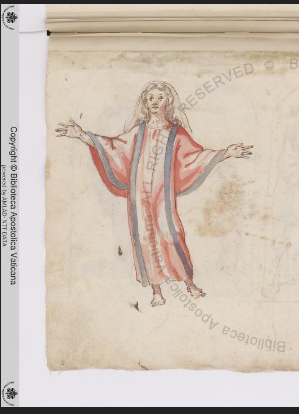
In order to continue on analysing the topic of visual sources for the exploration of the Roman catacombs in the 16th century, we present today the manuscript G6, kept in the Vallicelliana Library in Rome.

This is an archival unit of extraordinary importance, which remains unpublished to this day. It consists of 25 sheets, mostly drawn on both sides, and contains late 16th- and early 17th-century copies of some of the paintings in the catacombs of Rome (in particular from those of Domitilla and the Appian Way district), intended for reproduction in Antonio Bosio’s Roma Sotterranea. In addition to these, there are some sheets added later at the time of binding, but evidently of property of Bosio and his editor Giovanni Severano: among these, there is a pen sketch of the full decoration of the so-called niche of the Virgin in the Catacomb of Priscilla, with notes by Severano, discussed here.

(From C. Cecalupo, Giovanni Severano da Sanseverino prete dell’Oratorio e le catacombe romane, in Rivista di Archeologia Cristiana, 95, 2019)

These reproductions in watercolour of some of the paintings of the catacombs were evidently commissioned by Bosio to derive copper basis for the engravings, with the aim of illustrating his Roma Sotterranea. Its structure is not easy to understand and little can be said about the identity of the artists/copyists, who evidently worked in the catacombs without the direct supervision of Bosio. Among the authors, the famous copyists of Bosio are currently considered plausible, Giovanni Angelo Santini (better known as Toccafondo) and Sante Avanzini (for the both of them, more information can be found here).
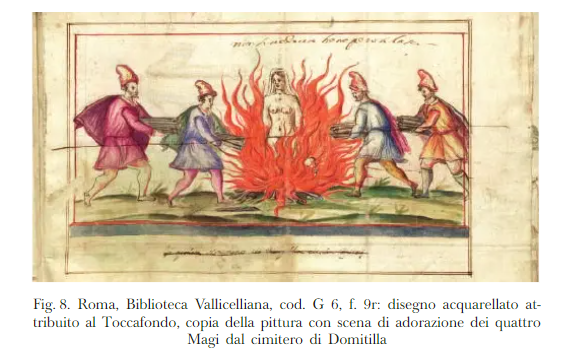
(From M. Ghilardi, I copisti della Roma sotterranea nel primo Seicento. Nuovi dati da ricerche d’archivio, in ATTI DELLA PONTIFICIA ACCADEMIA ROMANA DI ARCHEOLOGIA (SERIE III) RENDICONTI, LXXXVII, 2015)

Textual sources for the rediscovery of the catacombs – pt. I

In the process of historical reconstruction of the discoveries of the Roman catacombs between the sixteenth and nineteenth centuries, the available sources are many and of very different types.

It is actually very convenient to know some alternative textual sources which are useful for a correct historical reconstruction of the events. Among these are obviously newspapers, which report the news ‘in real time’ and with exact dates. In the contemporary press, one can find various references to the discoveries of the catacombs, especially in Rome, accompanied by numerous social and cultural information.

The Diario Ordinario -also known as “Chracas” after the family that printed it, and from 1808 as Diario di Roma- was a periodical newsletter printed in Rome from 1716 to 1848. It was published weekly or bi-weekly, usually on Saturdays. The first part of each issue contained all the main news of the city of Rome, especially concerning papal engagements; the second part offered news from correspondents in the main European cities.

The Diario Ordinario is full of detailed information about events in the city of Rome, and it is not uncommon to find references to discoveries made in the catacombs. In particular, it is very useful for tracing extractions of bodies or relics and similar events with both historical-archaeological and religious implications.

Such an interesting and useful source is actually long in consultation. The complete series is available to scholars in the Sala Stampati of the Vatican Library and, recently, in a new online version on the website of the Biblioteca Casanatense in Rome, at this link.

Here is a small sample of how information about the catacombs of Rome can be found in a volume of the Diario Ordinario:

Visual sources for catacombs explorations in the 16th century – pt. I

As is often mentioned on this site, the importance of visual sources (signatures, drawings, maps, watercolour copies of ancient paintings) in the history of the discovery of Christian catacombs is incredible.
These sources assume greater weight especially for the initial centuries in the history of Christian archaeology, before the advent of photography.


Among the most famous scholars who proceeded massively to copy the paintings of the catacombs they saw in their explorations is the Andalusian Alonso Chacón (1540-1599).

Chacòn can certainly be considered an important ‘chronicler’ of the state of catacomb paintings in the period in which the scholar lived in Rome (1567-1599).This rich heritage of early Christian iconography can be found in the manuscripts of the Vatican Library Vat. lat. 5409. This work, which has never been published, contains precious drawings of catacomb paintings commissioned by the Dominican to several artists and referable to the pictorial apparatuses of the cemetery of via Anapo and the catacombs of Priscilla, Domitilla and the complexes of the via Appia.

From an artistic point of view, the watercolour copies of the paintings commissioned by Chacón do not reflect the original style of the paintings, as they are totally executed in a strongly Baroque style. Even the scenes are sometimes misrepresented.
In spite of these objective limitations, Chacón’s drawings remain a fundamental archaeological testimony (also for their descriptions and captions), as well as an absolutely enjoyable artistic work.

The Vat. lat 5409 manuscript is fully available in digital format on the Vatican Library website, on this page, which we highlight because of the usefulness of having such sources available digitally worldwide.

Two essays on Giovanni Severano, explorer of the Christian catacombs in Rome

Among the many personalities involved in the study of the Roman catacombs in the first half of the 17th century, Giovanni Severano (priest of the Oratory of San Filippo Neri) is one of the best known but at the same time least understood.

Recently, some studies have been carried out to re-evaluate his figure. Over the centuries he has in fact been considered only as the editor who completed Antonio Bosio’s Roma Sotterranea, left unfinished at the author’s death in 1629 and published by father Severano only in 1634.
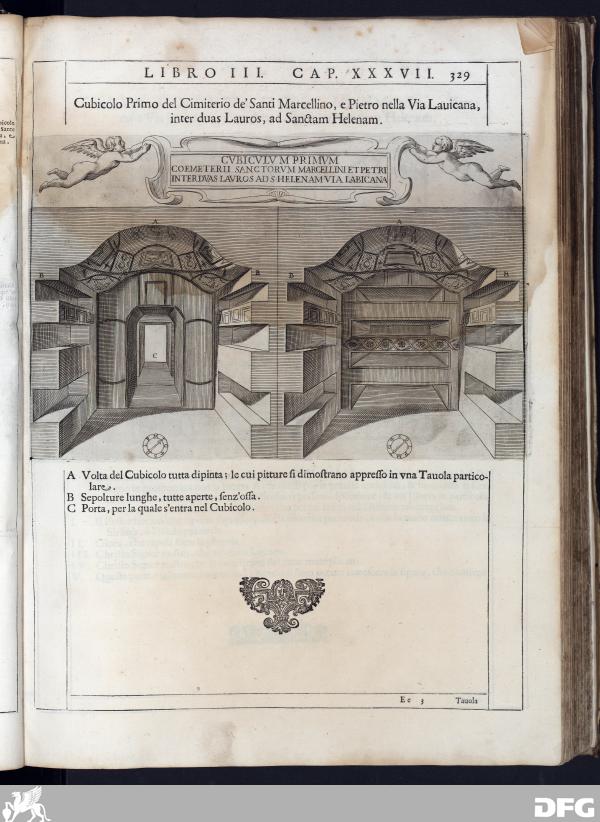
Extensive studies have shown that, in the process of completing Roma Sotterranea, he personally explored many areas of the Roman catacombs to confirm and expand Bosio’s descriptions. For example, there is ample evidence of his explorations of the catacomb of Saints Marcellinus and Peter on the Via Labicana. Here, he explored many areas that had not been recorded by Bosio.

Some traces of his explorations and, in particular, some drawings of Christian antiquities commissioned by Severan can be seen here.

The most up-to-date biography of Giovanni Severano can be found here.

An unknown explorer of the Roman Catacombs in 1596

When recounting the history of the first explorers of the Roman catacombs at the end of the 16th century, the first names that come to mind are those of the great scholars whose discoveries initiated the exploration of Christian antiquities in the first place, for example Alonso Chacòn, Philip van Winghe and, above all, Antonio Bosio, the founder of Christian archaeology and discoverer of the majority of Roman Christian cemeteries. One can assume that in addition to the famous figures, there were others who moved in the same historical-social environment. About these men little is known and many of them have been almost completely forgotten.

There are some sources that provide us with information about these unknown explorers. We have, for example, literary and archival sources, in particular great works such as Antonio Bosio’s Roma Sotterranea, that inform us about the explorations of people about whom we know nothing else.

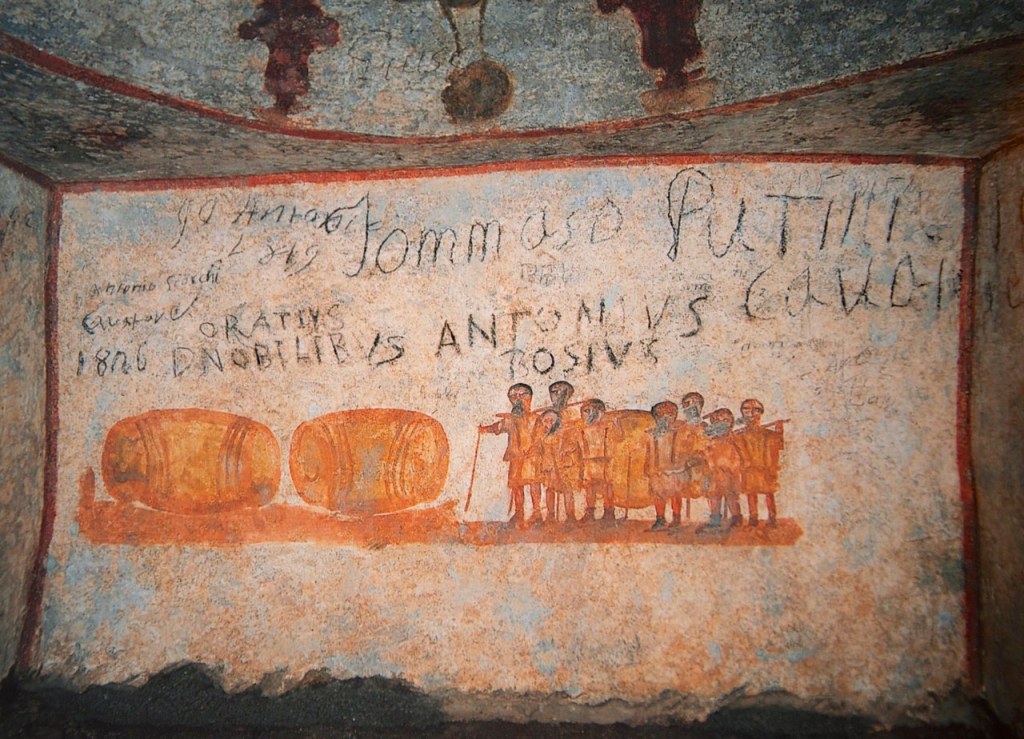
Primary and direct sources, however, are the signatures left by these explorers on the walls of the catacomb galleries.

Signatures of explorers in the Catacomb of Priscilla (ph. from romapedia)

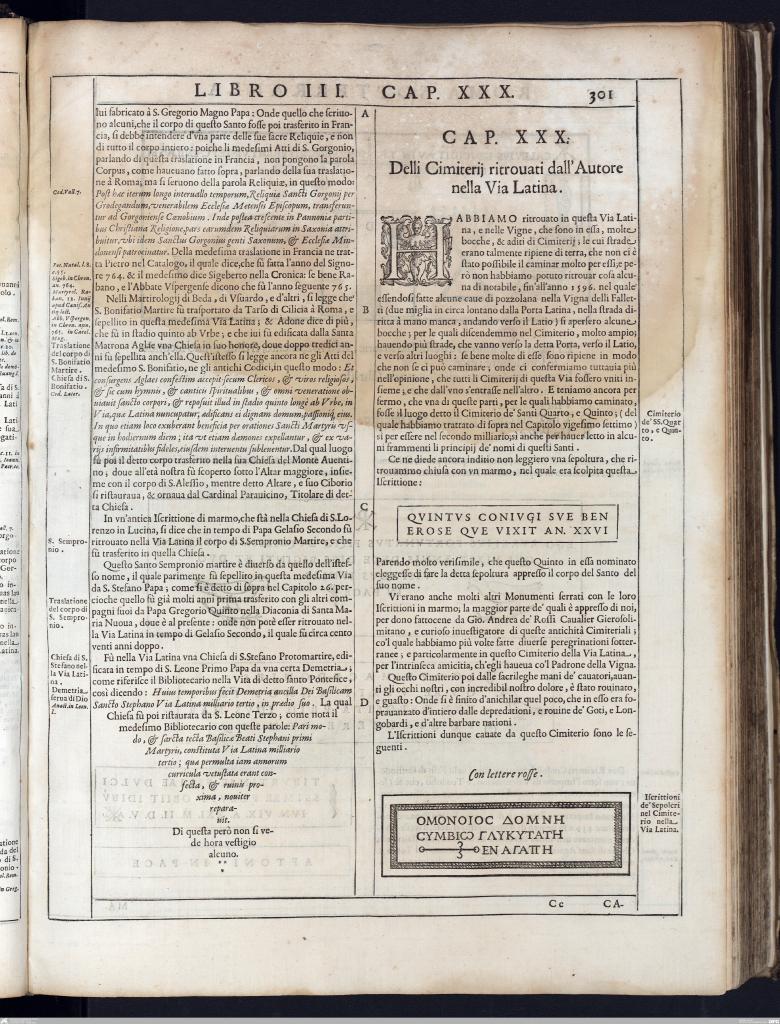
A special personality in this is Giovanni Andrea Rossi, described by Bosio as his colleague in the underground researches.

A. Bosio, Roma Sotterranea, Roma 1632, p. 301

Brother of the very well-known scholar Giano Nicio Eritreo, Giovanni Andrea was born in Rome around 1578. He was a friend of Antonio Bosio and often accompanied him on his catacomb explorations. However, we know with certainty that Giovanni Andrea also explored the catacombs of Rome on his own.

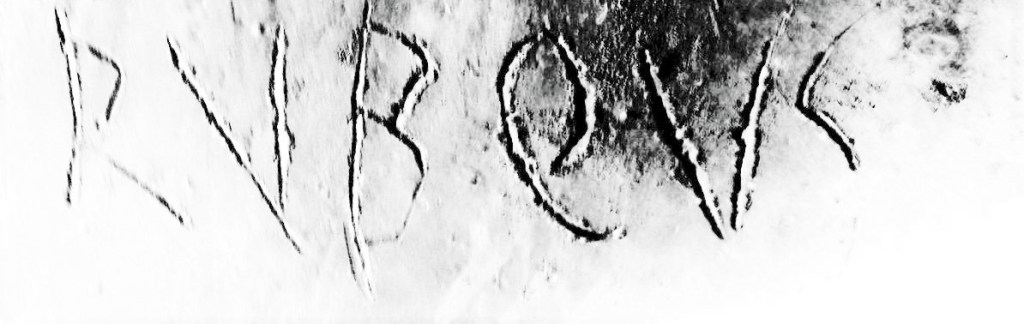
There are valuable proofs of his catacomb visits, and probably many others are to be discovered. These are the signatures (with the latinised version of his name Io. Andreas Rubeus) he left on the walls of the galleries of Priscilla and Domitilla Catacombs.

Drawing and graphic elaboration one of Rossi’s signature

Many of these signatures bear the date 1596, written directly by Giovanni Andrea under his own name. This allows us to date his explorations precisely to a fairly early period. Moreover, some of his signatures are found in areas that were probably not known nor explored by Bosio (such as the cubicle of Lazarus in the catacomb of Priscilla).

This shows us how independent Giovanni Andrea was in his explorations. And without these signatures, we would know almost nothing about him and his activities.

For more information: C. Cecalupo on Römische Quartalschrift