The “Relazione” by Marco Antonio Haxach: the Maltese catacombs in 1610

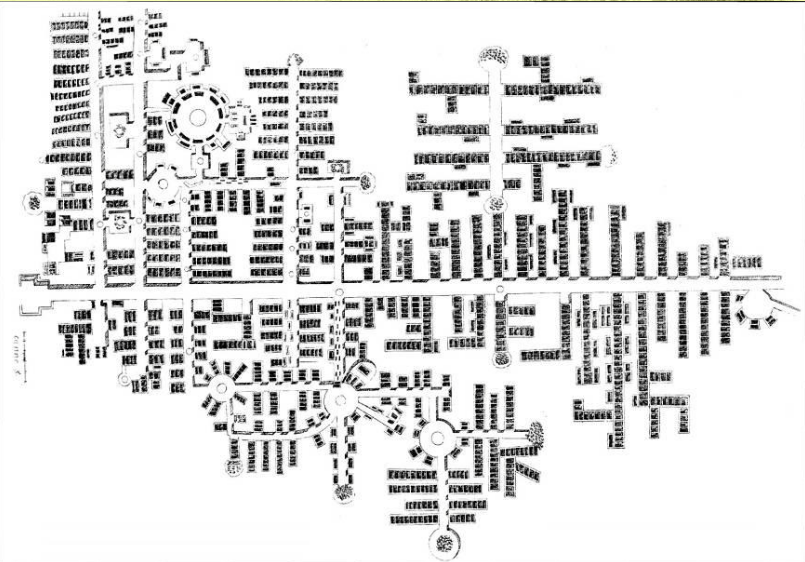
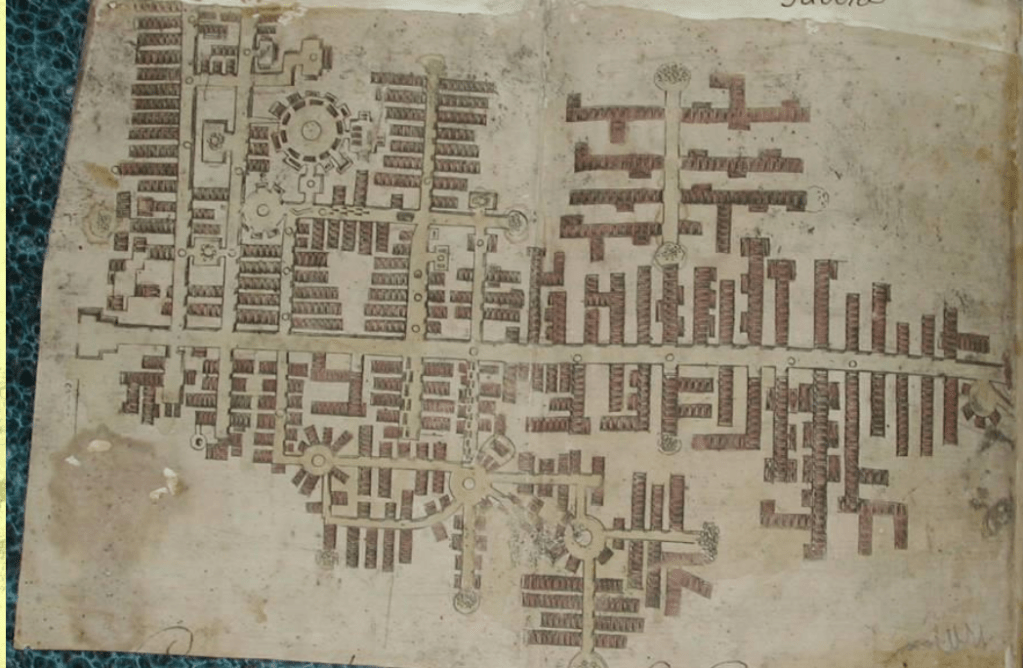
Anyone interested in the state of the Christian catacombs in Malta at the beginning of the 17th century should read Marco Antonio Axiaq’s ‘Relazione della nuova e grandissima divotione’ (Report on the new and great devotion). Axiaq was a Maltese surgeon who wrote a long description of the island in 1610, divided into several parts, of which only three handwritten copies of different chronologies remain today, addressed to various notable figures.

Axiaq provides the first descriptive mention of the Maltese catacombs, saying that they were somewhat frequented by locals in the early 17th century, although they remained completely misunderstood. He saw them first-hand and interpreted them above all as historical proof of the “victory” of the Christian religion over paganism.

Axiaq was the first to provide the names of five Christian hypogea on the island (St Paul, Madonna della Virtù, Madonna della Grotta, St Agatha, St Venera), but he also hinted at the presence of many other sites scattered throughout Malta.

Given the importance of the text and the difficulty in finding it, we transcribe below the part on the catacombs as contained in the manuscript version of the National Library of Malta (NLM, Lib. 515).

Relazione della nuova e grandissima divotione introdotta nella Santa Grotta di San Paolo nell’isola di Malta con una breve raccolta delle cose notande et antichità di detta Isola scritta per Marco Antonio Haxach Maltese

NLM 515, ff. 5v-6

Sono in questa Isola oltre l’antiche Reliquie delli grandissimi edifici, grotte sotterranee tagliate con mirabile destrezza, e forma, ed alcune cellule, et altri usci e portine, che d’una grotte s’entrava poi nell’altra con diversi appartamenti e se ne ritrovano alcuni de loro che a questa guisa se scondono da mezzo miglio, e più, considerandole alcune persone curiose stimarono, che anticamente gli abitanti di quest’Isola in quelle habitassero, perché forse li terremoti erano spessi, e grandi, o perché il modo di fabricare case ancor trovato non fosse, non havendo considerato questi tali di quello che nelle grotte si scorge, il che io con dura fatiga molte volte ad alcuni di loro ho disingannato con mostrargli manifestamente esser sepolture, e non ad altro fine fatte, ancorché così belle, e con diversi lavori abbellite fossero poiché si vede, che nella maggior parte di loro nella medesima pietra vi è il cavo, quanto può stare il corpo umano, e d’altri cavi piccoli per li figliuoli, nelle quali per insino al dì di hoggi ossa e teste umane si ritrovano, ed alcune ancora con balate di pietra coperte, e dentro alcuni vasetti, piattini, lucerne d’ogni, fatti di creta, di diverse forme all’uso antico per il che io ho sempre giudicato, che gli habitanti antichi, come Gentili l’opinione di Pitagora avessero avuto della trasmigrazione dell’Anime, cioè che uscendo da  un corpo qual’all’ora moriva, inanzi che un altro s’introducesse visitando quelli corpi, nelli quali prima era stata cossì errante andava trovandoli cossì bene acconcie, e di quelle antiche ceremonie, che far si solevano, si compiaceva, tenevano che questa era la sua gloria, se bene poi questa, e tutte le altre vane et erronee opinioni di Gentili, non solo de’ Maltesi ma da tutti i fedeli furono abolite et annichilate mediante il lume della S. Fede Cattolica dal Nostro Redentor Gesù Christo imparata, e dai suoi SS. Apostoli e Ministri della S. Chiesa predicata, colla quale come suoi figli, e seguaci Cattolici ci confirmiamo.

11r

Ad imitazione di questa S. Grotta già Chiesa consecrata dal Glorioso S. Paolo successivamente li Christiani altre grotte coltivorno, che più comode gli parevano tanto in nome della SS. Madonna, come ce n’è intorno a questa Città Notabile alcune insin al dì d’oggi, com’è la Madonna della Virtù, la Madonna della Grotta incorporata poi dalli Padri di S. Domenico dove già fabricato lor Convento, così anche d’alcuni altri Santi, che di mano in mano dalla S. Romana Chiesa sono stati Canonizati, come S. Agata, S. Vennera e molti altri sparsi per questa Isola.

An account of an excavation diary from 1915

One of the most important tasks of an archaeologist on an excavation is to keep a diary in which to record daily work and eventual discoveries, a diary that thus becomes the main source of facts and details of an archaeological exploration of any kind. Keeping an excavation diary is a sort of obligation towards both the past that unfolds before us and the present and future generations that expect us to take care and attention to preserve the discoveries. Even the archaeologists of the past have not shirked this obligation: there are some diaries of excavations from centuries ago that are extraordinary texts (such as, for example, the eighteenth-century diaries of the discoveries of the Vesuvian cities, which take us by the hand on a tour of wonders to places that are still mythical today), but all of them, even the lesser-known ones, maintain a charm that those objects that act as a bridge between us and the thinking of our ancestors know how to have.

One of the most interesting diaries for catacomb archaeology is the excavation diary of the Swiss Paul Styger, archaeologist and scholar of Christian antiquities in Rome, professor of archaeology and religious arts in Poland and one of the protagonists of the potpourri of nations that was the horizon of archaeological science in Rome in the early 20th century.
Due to a series of fortunate circumstances (in particular, his proximity to the German circles in the Vatican that a century ago were carrying out archaeological research and museographic experiments in the Eternal City), Styger found himself -between 1915 and 1917- directing the excavation of the church of San Sebastiano on the Via Appia in Rome. This is a very important site: an ancient church that later became a Baroque jewel, but set on an extensive cemetery area.
Styger’s excavation is particularly concerned with investigating the area directly underneath the nave and the Platonia, with the intention of also tracing the tomb where, according to a tradition invented in the Middle Ages, the bodies of Peter and Paul extracted from their original tombs in the basilicas of the same name would have been temporarily protected.

Source: P. Styger – Archaeologist at Rome and Professor at Warsaw
By Elzbieta Jastrzebowska

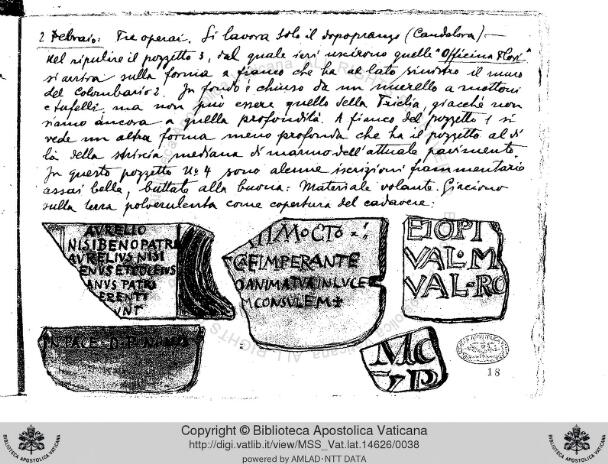
The diary is a little gem. It starts on 8 February 1915, ends on 27 February 1917 and is a mixture of text and pen illustrations, later coloured in watercolour. It is a true snapshot of what it must have been like to manage an excavation at the time, with constant inspection visits by the Ministry of Education and the Commission of Sacred Archaeology, fluctuating relationships with the workers, and more or less long interruptions for various reasons. The most beautiful feature are of course the drawings, not only of the individual objects found, but also of some of the structural situations found during the excavation.


The diary arrived in its current location in the Vatican Library after Styger’s death in 1939, by his own will, after having been missing for a while. This is confirmed by a letter pasted at the end of the manuscript, in which his sister refers to a certain Gerke who will help her find this diary and donate it to the library. At the end of this letter, an anonymous hand adds, in pen, that he received the diary on 31 May 1939 and adds: ‘And Gerke, if I am not mistaken, is the Nazi whom those of the Commission of Sacred Archaeology allowed to examine the excavations of the catacombs with all freedom, while they would have obstructed the Styger’. A small note full of implications, which relates to the strong relations between archaeological bodies and certain authoritarian political parties in the 1930s and 1940s, an issue that archaeological historiography has yet to come to terms with.
As an appendix to the diary, there are some typed sheets, with pencil-drawn illustrations, in which Styger lists pieces found in various catacombs during the 1920s, which were then lost, either because they were left on the site and treated carelessly, or because they were not handed over to the Vatican Museums. This list, too, is a singular evidence the practices of preserving artefacts: not a few objects were damaged by handlers who had ‘tried to tear them off’, or because they were left ‘without any precautions to save them’.

New outcome from the project LIT!

In the last issue of the online Journal of Art Historiography (Number 26, June 2022) the is the most recent output of the Project LIT!

The study and dissemination of an iconography: banquet scenes from the catacombs of Rome to the facsimile catacombs of the nineteenth century

In general, the text traces the discovery and the history of two important banquet scenes from the Roman catacombs (from the Catacombs of Callixtus and from the Catacombs of Priscilla). It focuses on the fortune of these scenes in Europe. this fortune developed in their reproductions found in various churches and chapels up to the middle of the 20th century. This overview helps in understanding how the study and reproduction of a single iconography can contribute to a general reconstruction of the development of the discipline of early Christian art history.

The whole article can be read here: https://arthistoriography.files.wordpress.com/2022/05/cecalupo.pdf

While the issue is fully available at: https://arthistoriography.wordpress.com/26-jun22/


Iconographic echoes of Roman catacombs and churches in some mosaics of the Verano (Rome): the LIT! project at AISCOM 2022

One week ago wee celebrate the XXVIII AISCOM (Italian Association for the Study and Conservation of Mosaics) congress, that is still availabe on the facebook page of the association.

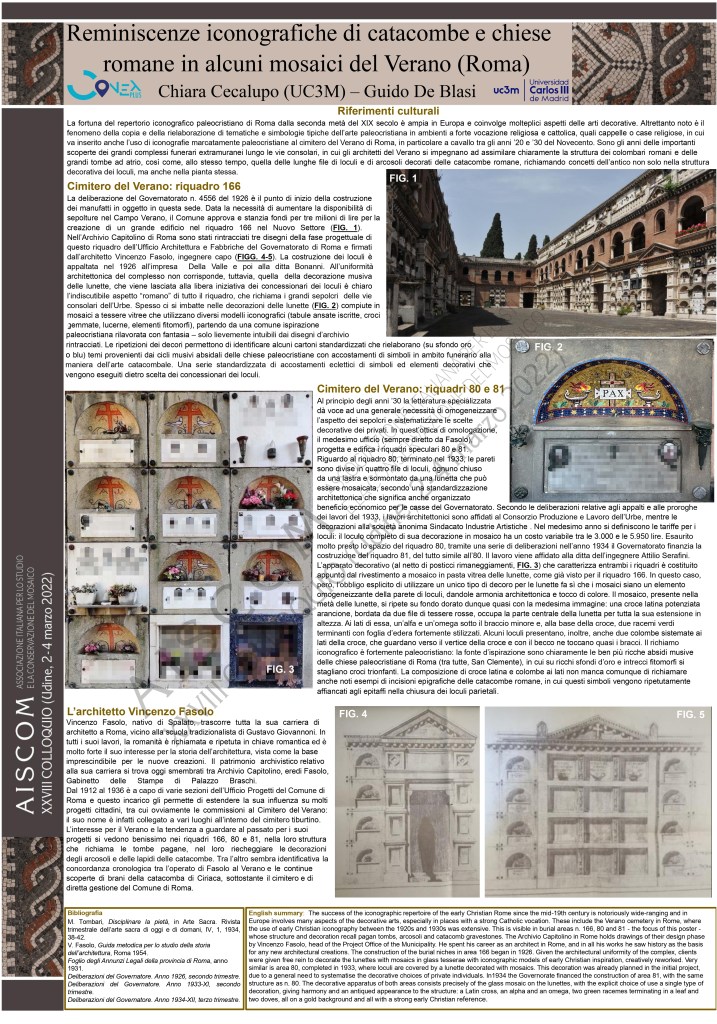
We exposed a poster online some results of project LIT! concerning some mosaics of the Verano Cemetery, dated between 1926 and 1933, that reproduce iconographic themes typical of the early Christian churches and the catacombs of Rome.

The poster is available today here (extended english summary below)

  • English summary

The success of the iconographic repertoire of the early Christian Rome since the mid-19th century is notoriously wide-ranging and in Europe involves many aspects of the decorative arts, especially in places with a strong religious and Catholic vocation. These include the Verano cemetery in Rome, where the use of early Christian iconography between the 1920s and 1930s was extensive. This is visible in burial areas nn. 166, 80 and 81 – the focus of this poster – whose structure and decoration recall pagan tombs, arcosoli and catacomb gravestones. The Archivio Capitolino in Rome held some drawings (figg. 4-5) of their design phase by Vincenzo Fasolo, head of the Project Office of the Municipality of Rome. Fasolo spent his entire career as an architect in Rome, and in all his works, Romanity is recalled and repeated: he saw the history of architecture as the basis for any new architectural creations.

The construction of the burial niches in area 166 began in 1926 (fig. 1). Given the architectural uniformity of the complex, private clients were given free rein to decorate the lunettes with mosaics. These decorations are made in glass tesserae with iconographic models of early Christian inspiration, creatively reworked (fig. 2). Very similar is area 80, completed in 1933, in which the loculi are covered by a lunette decorated with mosaics. This decoration was already planned in the initial project, due to a general need to systematise the decorative choices of private individuals. Once area 80 ran out of space, in 1934 the Governorate financed the construction of area 81, with the same structure as n. 80. The decorative apparatus of both panels consists precisely of the glass mosaic on the lunettes (fig. 3), with the explicit choice of use a single type of decoration, giving harmony and an antiqued appearance to the structure: a Latin cross, an alpha and an omega, two green racemes terminating in a leaf and two doves, all on a gold background and all with a strong early Christian reference.

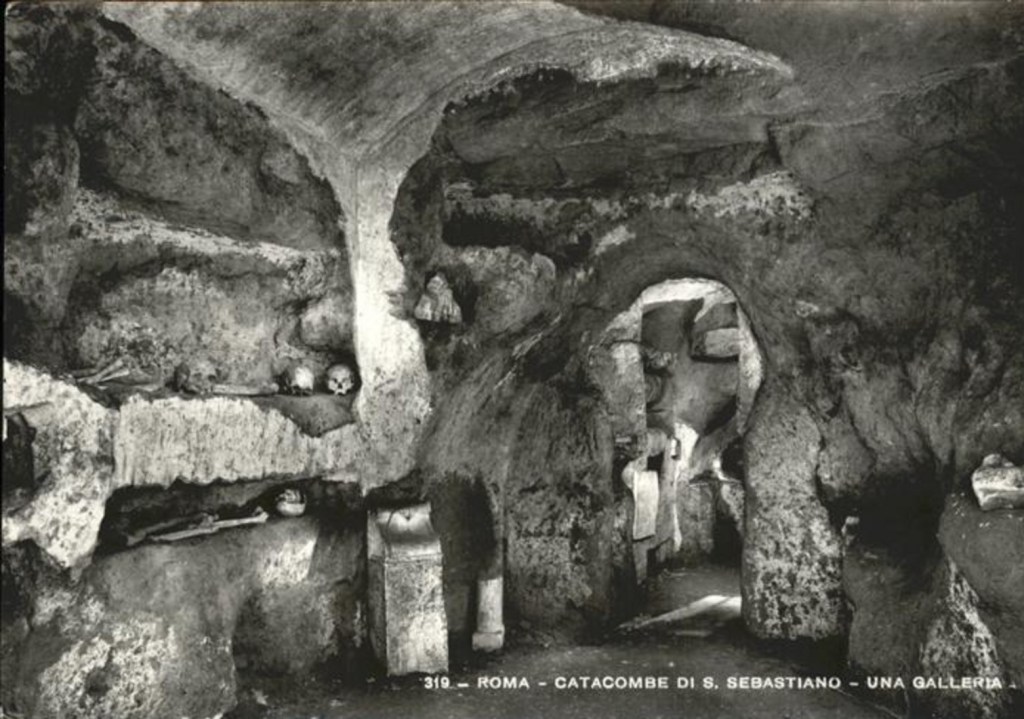
Four postcards of the Roman catacombs by Ernesto Richter

The postcards with vedute of the catacombs of Rome published by Ernesto Richter are among the most important visual sources for the history of Roman catacombs. They were published between the end on the 19th and the beginning of the 20th century.

Ernesto Richter was a Roman publisher set in Via dei Serpenti 170. He was specialised in images of Rome, works of art in Roman museums, views of the Roman monuments and Roman suburbium. These images were taken by various photographers and published as postcards.

Among his work there were many postcards and illustrations of Roman catacombs, especially the most known and visited ones. Actually, the Richter postcards became usual souvenirs for travelers. as testified by all the views of the catacombs of St Callisto and St Sebastiano published by this editor.

Here are four postcards of these two catacombs. Enjoy!

A visitor of Roman Catacombs in 1450

Many European pilgrims visited the Roman catacombs during the Jubilee period of 1450. Some of them left stories about them, and among them the most interesting is “Ye solace of Pilgrimes” by the Augustinian John Capgrave (considered lost until the 20th century).


Capgrave arrived in Rome probably from 1449 for the general chapter of the order and stayed there for a long time. Between 1449 and 1452 he wrote his work, considered to this day the highest point of pilgrim travel literature of the English Middle Ages, a true model for pilgrim books for visitors from northern Europe for the following jubilee years.
The work is structured in three parts. The first part consists of 24 chapters. Capgrave enriched the treatment of each topic with many quotations from past authors and especially with many legends and hearsay, but also with what he saw himself.
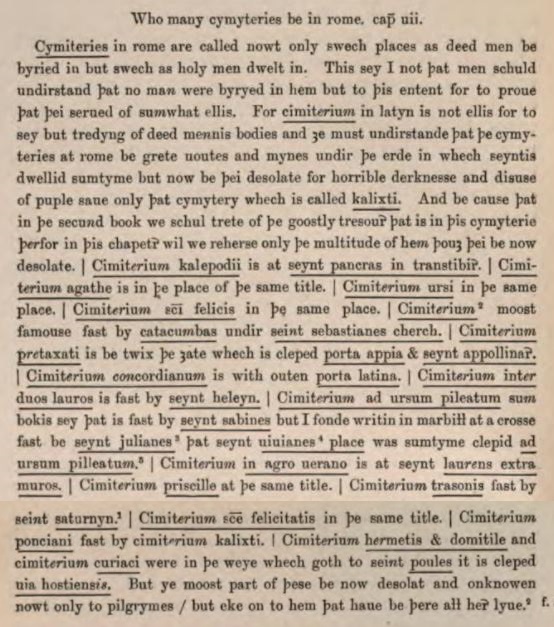
Chapter VII deals with “How in Rome there are many cemeteries”. It is in fact a valuable snapshot of the knowledge of Christian cemeteries held by fifteenth-century pilgrims:

Immagine

«In Rome, are called cemeteries not only the places where the dead are buried, but also those where the saints lived. I say this not because I want people to believe that no one was buried there, but to show that they also served other purposes. In Latin, cimiterium means nothing other than walking over the bodies of the dead, and you should know that the cemeteries in Rome are great underground vaults and tunnels where the saints once lived. Now, however, they are desolate places, because there is a horrible darkness and people no longer frequent them. The only exception is the cemetery of Callisto. Since in the second book we will deal with the spiritual treasures to be found in the cemeteries, in this chapter we will merely enumerate them, even though they are now abandoned. The cemetery of Calepodius is at San Pancrazio in Trastevere. The cemetery of Agatha is near the title with the same name, and so are the cemeteries of Orso and San Felice. The cemetery of Callisto is the most famous, and is near the catacombs, under the church of San Sebastiano. The cemetery of Pretestato is located between Porta Appia and San Apollinare. The cemetery of Concordiano stands outside Porta Latina. The cemetery called inter duos lauros is near St. Helen. The cemetery ad ursum pileatum some books say is near Santa Sabina, but at a crossroads near San Giuliano I found written on a tombstone that the place where Santa Bibiana is located was once called ad ursum pilleatum. The cemetery in Agro Verano is in San Lorenzo fuori le mura. The cemetery of Priscilla stands by the same title. The cemetery of Trasone is near San Saturnino. The cemetery of Santa Felicita is near the same title. The cemetery of Pontian is near the cemetery of Callistus. The cemetery of Hermes and Domitilla and the cemetery of Cyriacus were on the road leading to St Paul’s and called Via Ostiense. Now, however, these cemeteries are mostly abandoned and unknown, not only to pilgrims, but also to those who have lived there all their lives».

The second part of the book deals with the churches of Rome and the spiritual treasures they contain. It describes, in 65 chapters, the main basilicas and all the stationary churches.
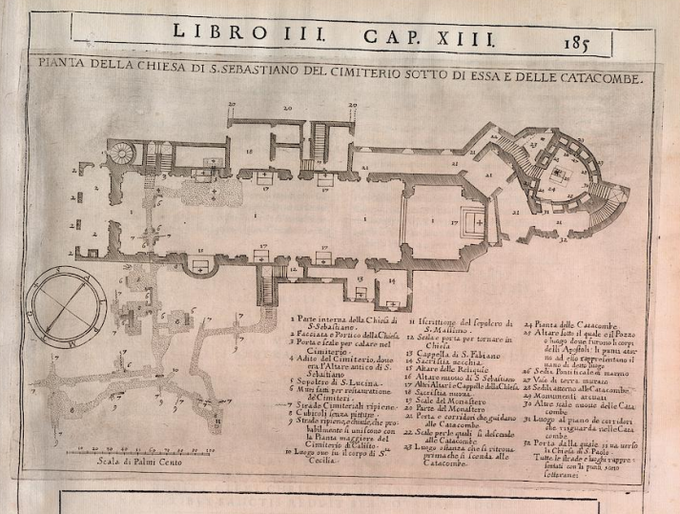
Chapter III (‘Della chiesa di San Sebastiano, in cui Capgrave’) describes his visit to the cemetery galleries beneath the church, thus providing valuable information on how a pilgrim in 1450 visited the cemetery of St Sebastian.

Immagine
The map of church and galleries of St Sebastian on via Appia drawn by Ph. Van Winghe in late XVI century

«The church of St Sebastian is two miles from St Paul’s and more than a mile outside the walls of Rome […]. The cemetery of Callistus is under the church; it is a cave or an underground excavation, made in a ground that seems neither stone nor earth, but something between the two, and has a red colour. There are many caves enclosed with stones, and one is said to have been St Peter’s chapel. Only if you have a torch in your hand can you see anything, because it is very deep underground. In fact, going down one side of the church there are thirty-two steps. And I think there are as many steps to the other side, where the angel served mass to St Gregory. The cemetery is so long that if one does not linger in the chapels, but goes straight ahead, by the time he has said “Miserere mei Deus” four times he will have walked through it. Forty-six popes were buried here, and each of them has given great indulgence to the place; Saint Cecilia was also buried here, and there is still her monument artfully carved in white marble. […] The cemetery was built by Pope Calixtus, and it is said that he did it for two reasons: one is so that the leaders or popes of the Church could dwell here safe from the danger of tyrants, because it was necessary for them to live longer in order to be able to give confirmation to the neophytes; the other is that he wished to bury there the martyrs who died for the love of Christ, and since this could not be done freely, he consecrated this secret place. Next to the church is a large shelter which they call catacomb [now referring to the triclia of St Sebastian]. Catacomb is a strange term, since it is not found in Latin books and no grammarian mentions this compound word. The common people say that cata, pronounced as it is written, means above, or all, and cumbo or cumbas means low or deep. The word therefore sounds like all low, or all deep, for the shelter is very deep underground. At one time it was a great dungeon, and to enter it one descends twenty-eight steps. Some say that this place was the waste dump of the butchers who lived in the area. In fact you can still see many walls of large buildings that were once the slaughterhouses of Rome. It is said that Peter and Paul were thrown here out of contempt, and this account is partly true and partly not, for that this place was a slaughterhouse is true, and that they were thrown here out of contempt by those who killed them is not true. Therefore we will tell the truth about this story. […]. Contradictions like this are always found in the chronicles, but since it does not touch the articles of faith, everyone can choose the version he wants».

Bibliography:
Ye Solace of Pilgrimes : a description of Rome, circa A.D. 1450. Capgrave, John, O.E.S.A; Mills, C. A; Bannister, Henry Marriott. British and American archaeological society of Rome. New York 1911.

May 31: An important day in the history of Christian archaeology

In the annals of the pontificate of Gregory XIII (1572-1585), we read of the discovery -on the 31st of May 1578– of the anonymous catacomb in the Via Anapo, then identified with the cemetery of Priscilla:

Around the same time, outside Porta Salaria, in the excavation of the Pozzolana, the famous Cimiterio di Priscilla, lost since the time of the Goths, was unexpectedly found surrounded by various burials of the Holy Martyrs with inscriptions in different languages. The Pope sent Cardinal Savelli, his Vicar, to certify everything, and many others went there to see the antiquity. Among other things considered worthy of the memory by the French Ambassador Luigi Castegnero, and Marc Antonio Moretto, both men of great learning, was the sepulchre of Leonidas, Father of Origen, deceased more than one thousand three hundred years ago, was recognised“. (Vatican Library, Vat. lat. 12214, Annali di Gregorio XIII, libro VII, tomo II, f. 66).

Even we cannot speak of a true discovery of Christian antiquities (see here for more information), the historical and social importance of this event lies in the fact that it reawakened interest in Christian antiquities among large sections of the population: the crowd in the Vineyard was so large that Pope Gregory XIII was forced to close the gates. Equally important is the influence of this discovery on the scholars of the time, that generation of scholars who found themselves moving from theory to practical knowledge of Christian cemeteries in a very short space of time.
It is to some of them (in particular the Spaniard Alfoncso Chacón – see here) that we owe the copies of the paintings in the catacomb of via Anapo, which are now unfortunately lost.

Drawing of the paintings from Via Anapo by A. Chacòn: Vatican Library, Vat. lat. 5409: https://digi.vatlib.it/view/MSS_Vat.lat.5409

Basic bibliography

  • J. G. Deckers, G. Mietke, A. Weiland, Die Katakombe“Anonima di via Anapo”  Repertorium der Malereien , Città del Vaticano 1991.
  • V. Fiocchi Nicolai, Storia e topografia della catacomba anonima di via Anapo, in J. G. Deckers, G. Mietke, A. Weiland, Die Katakombe“Anonima di via Anapo”  Repertorium der Malereien , Città del Vaticano 1991, pp. 1-23.
  • M. Ghilardi, Le catacombe di Roma dal Medioevo alla Roma sotterranea di Antonio Bosio, in Studi Romani, 40, 2001, pp. 27–56.
  • C. Cecalupo, Gregorio XIII e la nascita dell’archeologia cristiana: dal cantiere di San Pietro alla riscoperta delle catacombe, in V. Balzarotti, B. Hermanin (eds.), Gregorio XIII. Arte dei moderni e immagini venerabili nei cantieri della nuova ecclesia, Rome, forthcoming.

Visual sources for catacombs explorations in the 16th century – pt. II

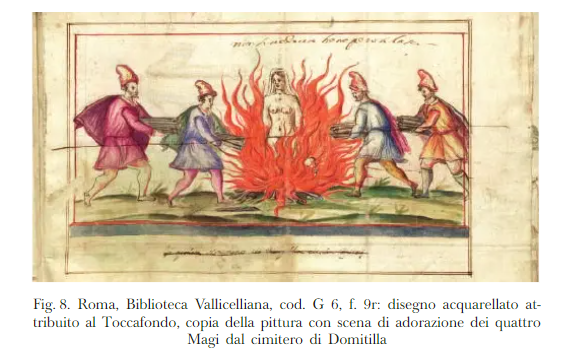
In order to continue on analysing the topic of visual sources for the exploration of the Roman catacombs in the 16th century, we present today the manuscript G6, kept in the Vallicelliana Library in Rome.

This is an archival unit of extraordinary importance, which remains unpublished to this day. It consists of 25 sheets, mostly drawn on both sides, and contains late 16th- and early 17th-century copies of some of the paintings in the catacombs of Rome (in particular from those of Domitilla and the Appian Way district), intended for reproduction in Antonio Bosio’s Roma Sotterranea. In addition to these, there are some sheets added later at the time of binding, but evidently of property of Bosio and his editor Giovanni Severano: among these, there is a pen sketch of the full decoration of the so-called niche of the Virgin in the Catacomb of Priscilla, with notes by Severano, discussed here.

(From C. Cecalupo, Giovanni Severano da Sanseverino prete dell’Oratorio e le catacombe romane, in Rivista di Archeologia Cristiana, 95, 2019)

These reproductions in watercolour of some of the paintings of the catacombs were evidently commissioned by Bosio to derive copper basis for the engravings, with the aim of illustrating his Roma Sotterranea. Its structure is not easy to understand and little can be said about the identity of the artists/copyists, who evidently worked in the catacombs without the direct supervision of Bosio. Among the authors, the famous copyists of Bosio are currently considered plausible, Giovanni Angelo Santini (better known as Toccafondo) and Sante Avanzini (for the both of them, more information can be found here).

(From M. Ghilardi, I copisti della Roma sotterranea nel primo Seicento. Nuovi dati da ricerche d’archivio, in ATTI DELLA PONTIFICIA ACCADEMIA ROMANA DI ARCHEOLOGIA (SERIE III) RENDICONTI, LXXXVII, 2015)

Textual sources for the rediscovery of the catacombs – pt. I

In the process of historical reconstruction of the discoveries of the Roman catacombs between the sixteenth and nineteenth centuries, the available sources are many and of very different types.

It is actually very convenient to know some alternative textual sources which are useful for a correct historical reconstruction of the events. Among these are obviously newspapers, which report the news ‘in real time’ and with exact dates. In the contemporary press, one can find various references to the discoveries of the catacombs, especially in Rome, accompanied by numerous social and cultural information.

The Diario Ordinario -also known as “Chracas” after the family that printed it, and from 1808 as Diario di Roma- was a periodical newsletter printed in Rome from 1716 to 1848. It was published weekly or bi-weekly, usually on Saturdays. The first part of each issue contained all the main news of the city of Rome, especially concerning papal engagements; the second part offered news from correspondents in the main European cities.

The Diario Ordinario is full of detailed information about events in the city of Rome, and it is not uncommon to find references to discoveries made in the catacombs. In particular, it is very useful for tracing extractions of bodies or relics and similar events with both historical-archaeological and religious implications.

Such an interesting and useful source is actually long in consultation. The complete series is available to scholars in the Sala Stampati of the Vatican Library and, recently, in a new online version on the website of the Biblioteca Casanatense in Rome, at this link.

Here is a small sample of how information about the catacombs of Rome can be found in a volume of the Diario Ordinario: