Two 17th-century images from the Catacombs of Priscilla (Rome)

The “Cubicolo della Velata” (Cubicle of the Veiled Woman) is one of the most famous burial chamber in the catacombs of Rome, known since the 16th century and much loved by all scholars of the past. It is located in the central core of the Catacombs of Priscilla in Rome, and its name derives from the presence of a ‘Veiled’ woman painted in the bottom lunette in a praying attitude. The scenes, dated to the late 3rd century, are interpreted as the important moments in the life of the deceased: her marriage (left), motherhood (right) and her admission among the blessed (in the middle).

It was one of the very first places to be investigated by explorers in the 16th century. In fact, we have two original drawings reproducing the cubicle, preserved inside two important manuscripts in the Vatican Library.

The first, Vat. lat. 10545, f. 187r, dates from around 1590 and was executed by a draughtsman from the circle of the Flemish scholar Philip van Winghe, who is also known for having executed the first extant plans of the Roman catacombs.
The style of the copy is very simple and straightforward, almost childlike, but close to the original, a typical feature of copies of catacomb paintings in this manuscript.

The volume can be viewed in full here: https://digi.vatlib.it/view/MSS_Vat.lat.10545

The second, Vat. lat. 5409, f. 24r, belongs to the rich set of images of the Roman catacombs in the work of the Spanish Dominican Alonso Chacon, and dates to the late 1590s.
The drawing is completely different from the previous one, the original early Christian painting is copied in a very baroque manner, with reminiscences of Michelangelo and a richness that does not belong to the style of the catacomb art. In addition, the inconographic reading is also misinterpreted, creating images of Christ and Mary that do not correspond to the original work.

IThe volume can be viewed in full here: https://digi.vatlib.it/view/MSS_Vat.lat.5409

New outcome from the project LIT!

In the last issue of the online Journal of Art Historiography (Number 26, June 2022) the is the most recent output of the Project LIT!

The study and dissemination of an iconography: banquet scenes from the catacombs of Rome to the facsimile catacombs of the nineteenth century

In general, the text traces the discovery and the history of two important banquet scenes from the Roman catacombs (from the Catacombs of Callixtus and from the Catacombs of Priscilla). It focuses on the fortune of these scenes in Europe. this fortune developed in their reproductions found in various churches and chapels up to the middle of the 20th century. This overview helps in understanding how the study and reproduction of a single iconography can contribute to a general reconstruction of the development of the discipline of early Christian art history.

The whole article can be read here: https://arthistoriography.files.wordpress.com/2022/05/cecalupo.pdf

While the issue is fully available at: https://arthistoriography.wordpress.com/26-jun22/


Exposition “Una postal de las catacumbas”: Press coverage

In this post we will share links and pictures of the international press echo of the exhibition

 Una postal de las catacumbas. Exposición de tarjetas postales artísticas de las catacumbas romanas de 1890

(18 March-1 April 2022; Library of Humanities, Communication and Documentation. Campus Getafe, Universidad Carlos III of Madrid).

Update in progress

Social Media

Iconographic echoes of Roman catacombs and churches in some mosaics of the Verano (Rome): the LIT! project at AISCOM 2022

One week ago wee celebrate the XXVIII AISCOM (Italian Association for the Study and Conservation of Mosaics) congress, that is still availabe on the facebook page of the association.

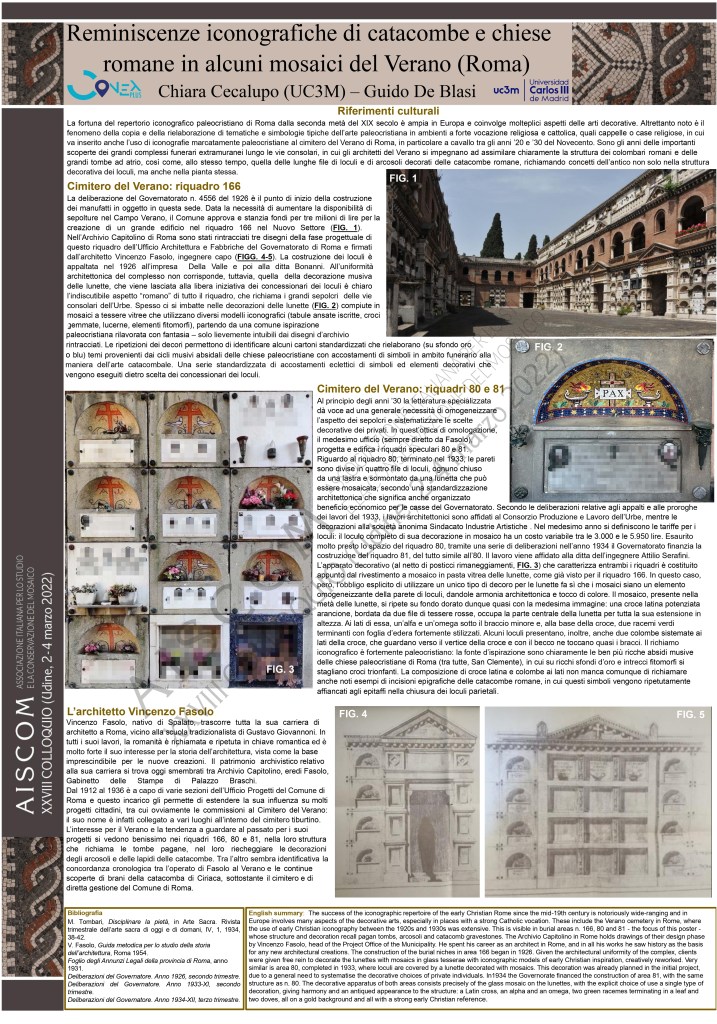
We exposed a poster online some results of project LIT! concerning some mosaics of the Verano Cemetery, dated between 1926 and 1933, that reproduce iconographic themes typical of the early Christian churches and the catacombs of Rome.

The poster is available today here (extended english summary below)

  • English summary

The success of the iconographic repertoire of the early Christian Rome since the mid-19th century is notoriously wide-ranging and in Europe involves many aspects of the decorative arts, especially in places with a strong religious and Catholic vocation. These include the Verano cemetery in Rome, where the use of early Christian iconography between the 1920s and 1930s was extensive. This is visible in burial areas nn. 166, 80 and 81 – the focus of this poster – whose structure and decoration recall pagan tombs, arcosoli and catacomb gravestones. The Archivio Capitolino in Rome held some drawings (figg. 4-5) of their design phase by Vincenzo Fasolo, head of the Project Office of the Municipality of Rome. Fasolo spent his entire career as an architect in Rome, and in all his works, Romanity is recalled and repeated: he saw the history of architecture as the basis for any new architectural creations.

The construction of the burial niches in area 166 began in 1926 (fig. 1). Given the architectural uniformity of the complex, private clients were given free rein to decorate the lunettes with mosaics. These decorations are made in glass tesserae with iconographic models of early Christian inspiration, creatively reworked (fig. 2). Very similar is area 80, completed in 1933, in which the loculi are covered by a lunette decorated with mosaics. This decoration was already planned in the initial project, due to a general need to systematise the decorative choices of private individuals. Once area 80 ran out of space, in 1934 the Governorate financed the construction of area 81, with the same structure as n. 80. The decorative apparatus of both panels consists precisely of the glass mosaic on the lunettes (fig. 3), with the explicit choice of use a single type of decoration, giving harmony and an antiqued appearance to the structure: a Latin cross, an alpha and an omega, two green racemes terminating in a leaf and two doves, all on a gold background and all with a strong early Christian reference.