Some of the results of the project have just been published in open access on Histories:
Cecalupo, Chiara. 2026. “Catacomb Rediscoveries in the Central Mediterranean (16th–20th Century): An Overview” Histories 6, no. 1: 22. https://doi.org/10.3390/histories6010022
The article focuses on the rediscovery of catacombs in the central Mediterranean and explores some of this historiographic heritage through different kinds of documents in order to present some interesting results regarding human and cultural connections among Tunisia, Malta and Italy. It presents an overview of the history of the rediscovery of the catacombs without focusing on the details of individual explorers or events but rather by identifying some key points that reveal a trend among scientific research, antiquarianism and confessionalism. These points are crucial elements in defining a broad international and interdisciplinary phenomenon, one that goes way beyond the rediscovery of every single catacomb. This article begins with an archaeological point of view to explain what was a catacomb between the 2nd and the 7th centuries and then offers a brief history of catacomb exploration through the centuries, from the late 16th to the early 20th century. The central part of the text is dedicated to the development of the main pillars that identify the process of catacomb rediscovery: the political frame, cultural circulation and the movement of people.
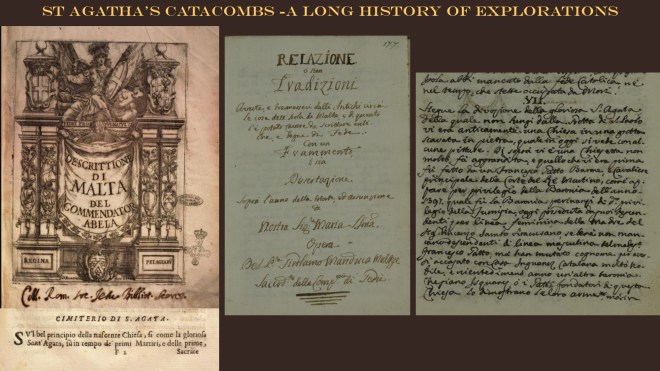
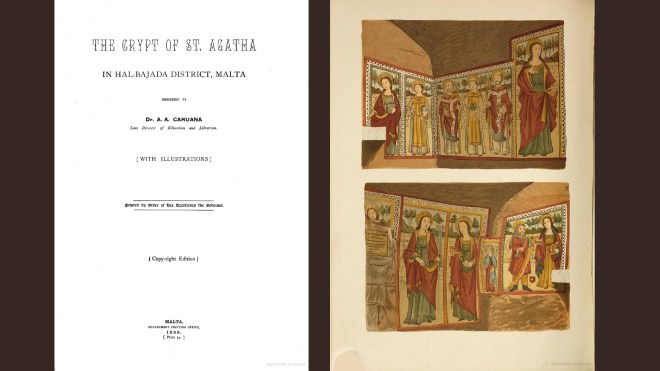
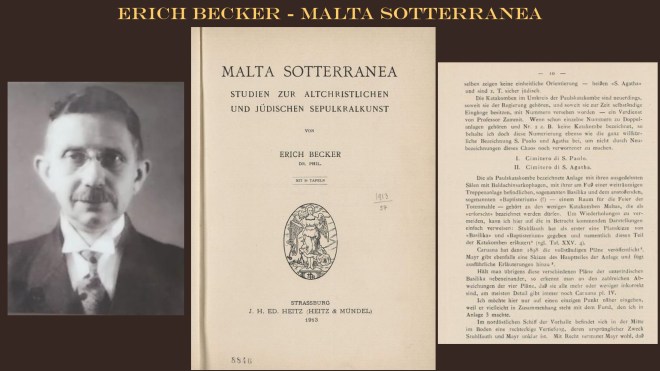
The “Rediscovering Agatha” was a success! It was organised at St Agatha’s Museum, with the cooperation of the Istituto Italiano di Cultura. During the conference, we offered an overview of the rediscoveries that took place in St Agatha’s catacombs during the last centuries and then the rebranding of the catacombs and museum was presented. After a light refreshment, attenders had the possibility to visit the crypt with a special guided tour.
Next weekend we will celebrate European Researchers’ Night and the project UndergroundMed will be presented in two different events.
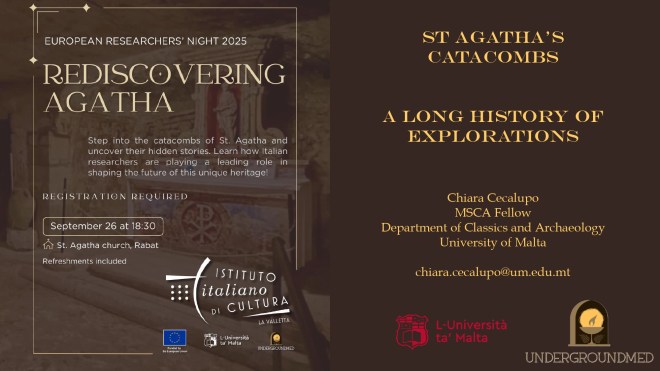
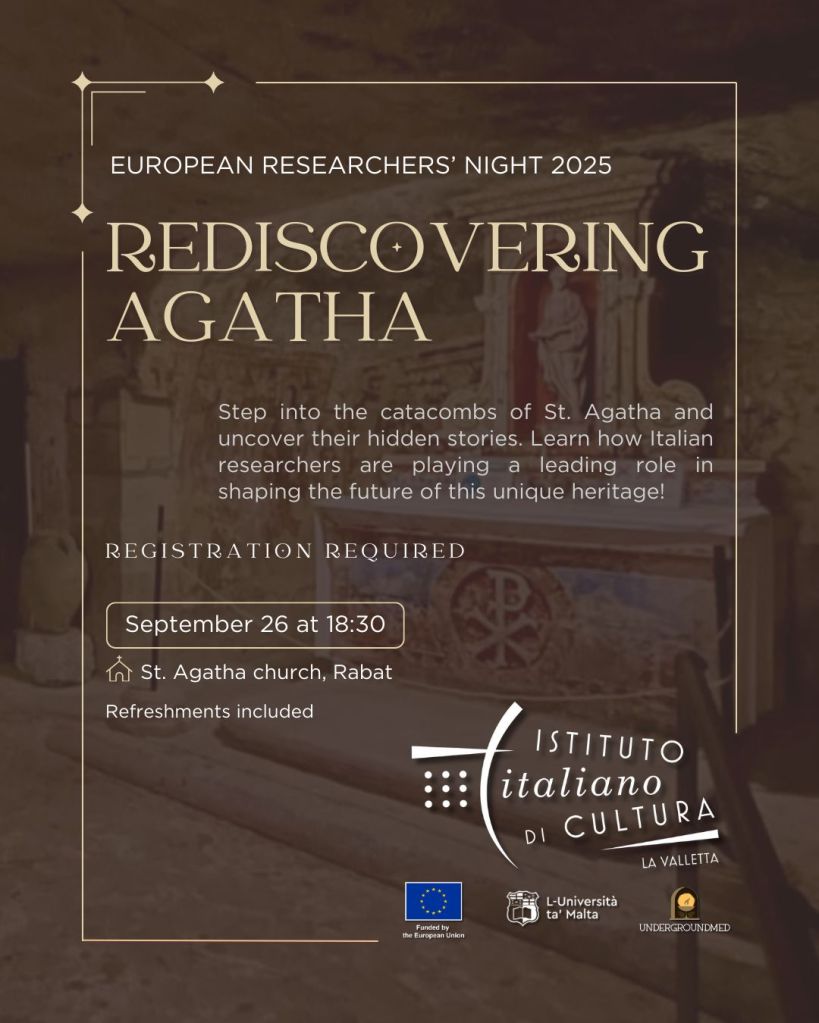
On the 26th of September, let’s join together at st Agatha’s Catacombs in Rabat for Rediscovering Agatha!
The catacombs of St Agatha in Rabat have been a topic of interest since the 17th century. The tunnels, crypt, and paintings from different periods have always attracted the attention of scholars, travellers, curious individuals, and devotees.
Rediscovering Agatha, organised as part of the European Researchers’ Night 2025, will retrace the stages of the rediscovery of the catacombs of St Agatha and the role of foreign archaeologists in the investigation process. The research currently underway and the future of the site will also be presented.
On the 27th of September, instead, I will showcase the project at the EU Corner in the big fair Science in the City in Valletta!
The project UndergroundMed was presented among the on-going research project at the University of Malta Research Expo 2025 held in Valletta on 28 May 2025.
Abstract and presentation
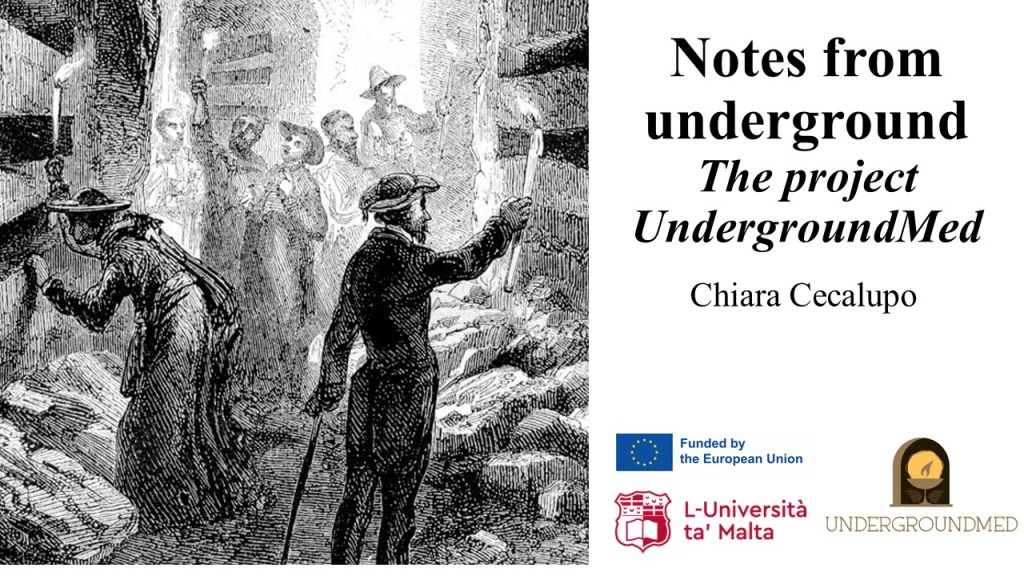
Notes from Underground: the project UndergroundMed
The MSCA project UndergroundMed traces the history of the rediscovery of ancient catacombs between the 16th and 20th centuries across the Mediterranean, in particular Italy, Malta, and Tunisia. It analyses the topic from a broad European perspective, through studies conducted on travel routes, explorations, archive and museum collections, and it enhances the role of European scholars in creating an international and multicultural research-network while travelling across the shores of the Mediterranean in search for catacombs. I will share some preliminary results of this systematic analysis on catacombs rediscovery, to illustrate how UndergroundMed defines the role played by catacomb archaeology in building a European common culture.
[This is part of the text read during a public lecture at the Royal Netherlands Institute of Rome on 30 April 2025]
From the mid-sixteenth century, the discovery of many Christian catacombs in Rome spread knowledge about early Christian art throughout Europe, and made catacombs a popular subject. This process took place through promotion of academic studies, vast numbers of copies, and museum displays, all supporting the progress of archaeological discoveries. This phenomenon from the sixteenth through the twentieth centuries is obviously connected to political key events occurring in the Papal States.
One can say that the history of Christian archaeology cannot be divorced from the political and confessional use of the the catacombs. This use constantly characterised the work of many researchers and scholars, in periods when Christian archaeology was perceived as an official, national, catholic and papal discipline. They mostly fostered this relation between catacomb archaeology and politics through their scholarly publications and the production of copies of catacomb paintings. What is certainly evident is the key role of the papacy, which from time to time finds a political and cultural reason to reassert its authority through its most ancient past and claiming authority and exclusive control on it over the centuries, and playing a pivotal role in the process of dissemination of Christian art.
Catacombs for the Counter-Reformation agenda
Knowledge of the catacombs and the artistic treasures they contained was never totally ignored or forgotten contrary to long-standing assertions made by questionable but influential twentieth-century historiography. Records of pilgrims visiting the catacombs as part of the Christian-Rome cult circuit are numerous from the Middle Ages to the early modern age. Renaissance humanist scholars were the first to analyse the art of catacombs, often based on first-hand knowledge acquired during visits to the sites themselves. The scholarly impact of the construction of New St. Peter’s throughout the whole sixteenth century, an intervention that required extensive and lengthy excavations, was very important too: on that occasion, a significant number of sarcophagi, epigraphs and artefacts came to light, representing the first major contact for the modern world of Rome with early Christian art.
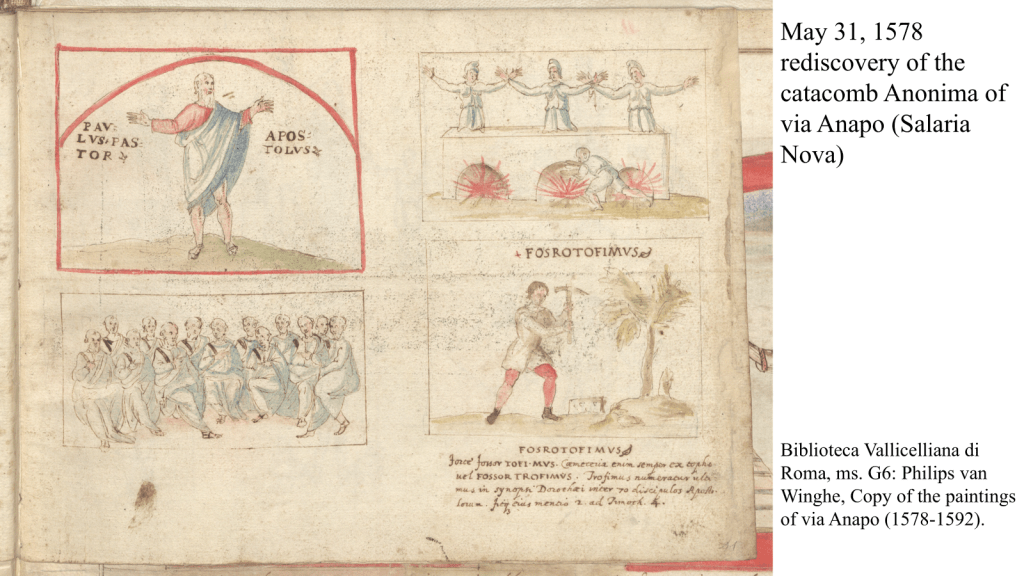
A crucial event happed on 31 May, 1578, during the pontificate of Gregory XIII: the accidental discovery of a Christian catacomb within the Sanchez vineyard on the Via Salaria Nova (at that time identified as the catacomb of Priscilla, but later in the late twentieth century as the Anonymous Catacomb of Via Anapo), with its impressive set of wall paintings. This is considered to be the moment when Christian archaeology began. However questionable that narrative is, this discovery nonetheless represented a real novelty involving sections of Roman population of the countryside, hitherto excluded from the rediscovery of and appreciation for Christian antiquities. These underground tunnels, marvellously decorated with paintings, totally unknown and extraordinary, attracted an incredible number of people, so much so that Gregory XIII decided to fence off the area (and then that the fence was torn down by eager groups of visitors), including not only clerics, scholars, and antiquarians, but also, and perhaps above all, ordinary people. This novel attention to of ancient Christian art is extremely interesting for the political and confessional use of catacomb art, because it appeared to have a great appeal for common people everywhere and could be used to convey Catholic messages in Italy and beyond. The first discovery of a catacomb also stimulated the search for more underground cemeteries throughout the Roman countryside, archaeological forays led by scholars, ordinary citizens, and different religious groups.
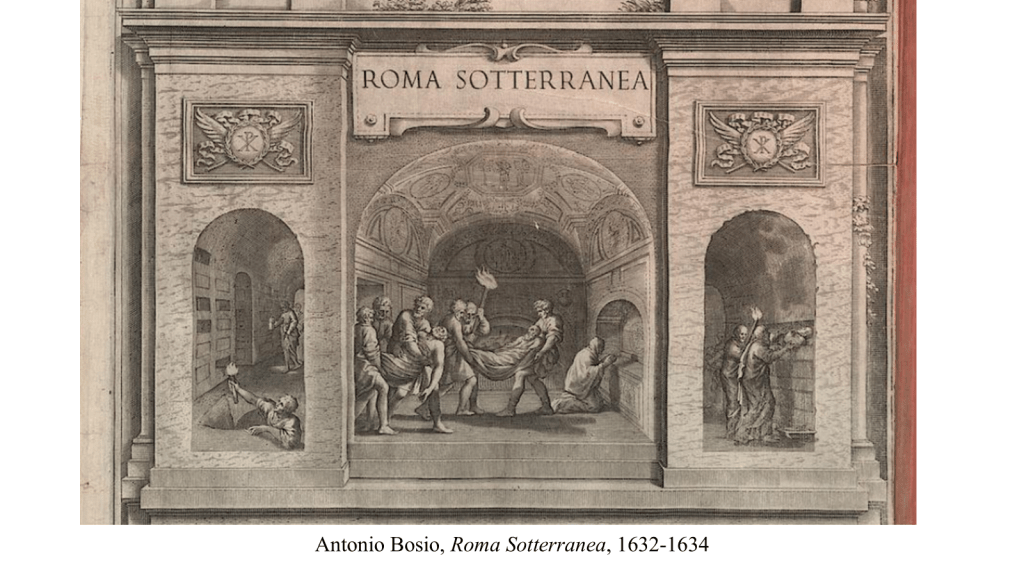
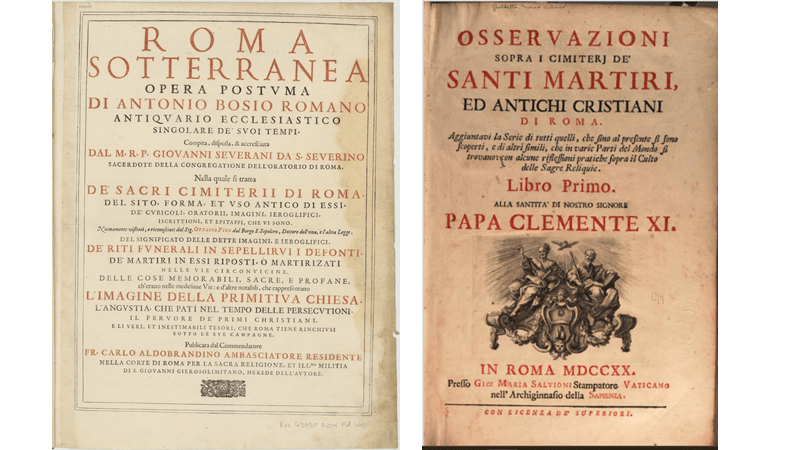
That feverish research culminated in 1634 with the publication of the first monograph on the Roman catacombs, Antonio Bosio’s Roma Sotterranea. This work and the explorations of catacombs led by Bosio increased indeed the international interest in the catacombs. While Christian cemeteries had already attracted the attention of scholars during the fifteenth and sixteenth centuries, after 1578, scholars or artists from all over Europe and Italy flocked to Rome with the intention of drawing and describing the paintings found in the catacomb galleries.
In a cultural context generally dominated by the new Tridentine needs in developing a new, unique artistic discourse controlled and directed by the Catholic Church, we must recall clear links between a genuine interest in Christian antiquities and the Catholic Counter-Reformation, with sacred antiquaria and apologetics in support of Catholic historiography. In fact, Roman and other European Catholic scholars of the second half of the sixteenth century were very keen to render service to the Catholic Church. Certainly, the findings, and in particular the paintings of the catacombs, could corroborate knowledge derived from literary and historical sources, and both could be used to legitimize a Catholic position against Protestant divisions. The most immediate interest was to record the paintings that were being gradually discovered during the sixteenth and seventeenth centuries in various Roman cemeteries. This was due to the intrinsic wonder aroused by the sight of such unknown, mysterious and yet so well-preserved Christian paintings, and to their clear link to scriptural episodes narrated in the early times of the new religion, but well known to contemporary Catholics and Protestants. These ancient paintings conveyed familiar religious stories and concepts, moreover in an easily understood visual language.
It was precisely the memory of a heroic era of the Church, of which the stories of saints and martyrs represented the main legacy, that produced a particular interest in the catacombs. In fact, a revival of early Christian themes and symbols, like palm as a sign of martyrdom, were used in all the arts to translate into images the Tridentine needs to create a set of iconographies to develop new resources for the faithful and new devotions to foster popular piety. This revival was translated into new styles, and tastes, as proven, for example, by the widespread diffusion of paintings with early Christian saints (Caecilia above all) in churches and private houses in the early seventeenth-century. Even the grandly Baroque architecture sought to make ancient Christianity present through the monumental recreation of early Christian liturgical spaces, which was one of the main aims of the great reconstructions of Roman churches financed by the various popes.
From a political point of view, the discovery, study, and recreation of early Christian art found in the catacombs therefore had a broad cultural role, expressed into two main directions. First, early Christian pictorial art was presented as incorrupt, pure, severe, and spiritual, thus the perfect vehicle for a process of artistic and figurative renewal of Catholicism that was to serve to counter Protestant criticism . Second, it is precisely the discovery of early Christian art and its clear message that served to convey and promote unbroken continuity of the Roman Church from apostolic times to the present. The catacomb images were very old; but in a certain sense, they were new too because they were reinterpreted as living images, models to be imitated, and a source of artistic inspiration.
Christian archaeology din late nineteenth century
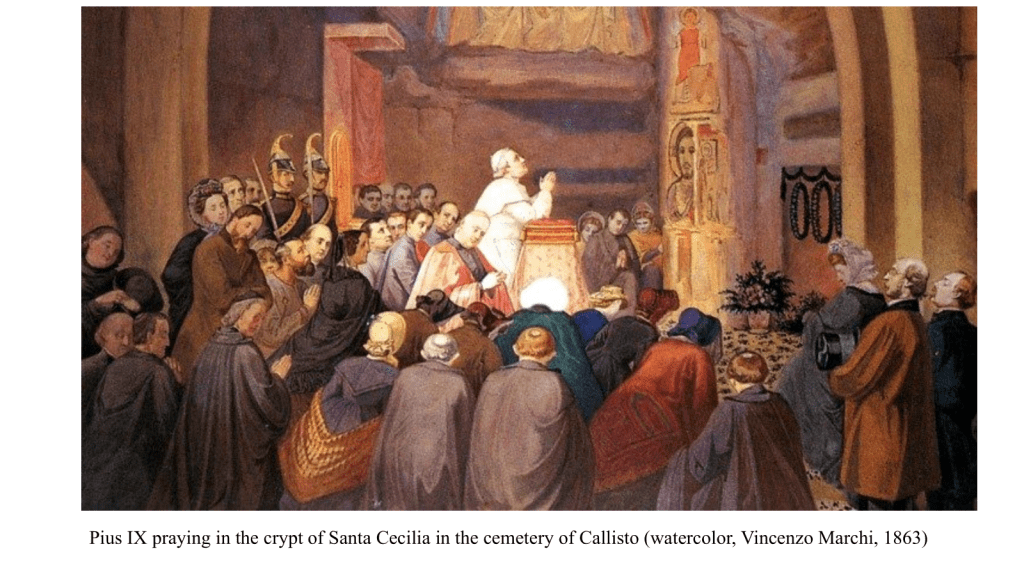
One has to wait until the 1850s for the next great change in the history of Christian archaeology to take place. Under the pontificate of Pius IX (1846-1878), in particular, the promotion of the excavation and study of Roman catacombs became extensive and more explicitly political. The Roman Republic (1849), the exile in Gaeta in the Bourbonic Kingdom and the return to Rome were the initial act of a pontificate characterised by perennial conflicts with the emerging kingdom of Italy that culminated in the end of the Papal States and thus of the popes’ political power in 1870. Given such political turmoil, unique in the history of the papacy, Pius IX was called upon to promote the papacy’s temporal power and Catholic Christianity with self-assertive policies at both the local and international level. Until the end of his pontificate, Pius IX insisted on the self-exaltation of Christian culture and the centrality of Rome in an international culture with ancient apostolic roots. Christian antiquity therefore assumed a key role in the cultural policy of Pius IX, who financed important initiatives for the development of the discipline of Christian archaeology. The Roman catacombs were proposed as a symbol of the times of persecution and thus a material embodiment of the martyrial narrative with which his pontificate was cloaked.
Events that supported this objective occurred in the first years of Pius IX’s pontificate. In 1860 Europe was in the midst of numerous social transformations, revolutionary uprisings and wars of independence due to nationalistic drives hostile to the great empires reformed after the Congress of Vienna. These upheavals resulted in the emergence of nation states, particularly in Italy, where the papacy lost its territory. In a slow political and cultural process culminating in the capture of Rome in 1871, Pope Pius IX (1846-1878) saw his temporal dominion reduced to the Vatican City. We were thus facing the most radical geopolitical change on the continent, in which the political as well as the cultural definition of nations played a very important role.
Under the cultural point of view, the pope made use of the work of the Jesuit Giuseppe Marchi (1795-1860), who is considered one of the founders of Christian archaeology as a scientific discipline, and Giovanni Battista de Rossi, who was then his young assistant. The two were put in charge of excavations in countless catacombs and were also entrusted with the dissemination their discoveries in textual and visual reports/accounts. They were also the protagonists of Pius IX’s major institutional foundations dedicated to Christian archaeology. The Commission of Sacred Archaeology (1852) oversaw the study and protection of the catacombs and other Christian monuments while the Lateran Christian Museum (1854) included a lapidary section to provide a proper place to display the many works of art found in the catacombs. It functioned, in effect, as an appendix to the visit to the catacombs, replete with didactic intents designed to advance the understanding Christian antiquities . Here, then, we are in front of a real state archaeology, scientifically conducted, but in the overt service of a political agenda. If that were not enough, there were large construction and restoration campaigns that became more customary as the situation became more complicated: think of the large investments for the restoration of the great early Christian basilicas such as S. Lorenzo fuori le Mura, Santa Maria in Trastevere, or even St Paul’s outside the walls after it was destroyed by a huge fire in 1823; as well as the celebration of the papal soldiers defeated in the battles against the Reign of Italy, who in the contemporary narrative rose to the rank of martyrs of the faith and received a monument in St John Lateran, the city’s cathedral.
The mosaic heritage in catacombs is very limited and concerns ‘three species of mosaic works’: the floors, the slabs (marble or fictile) closing the tombs decorated with series of tesserae, and finally the wall mosaics decorating the arcosolii or the walls and vaults of the cubiculi. I will not refer to catacomb mosaics in general, but focus on a few cases and their collecting fate.
The history of mosaics in museums for the first centuries of the Modern Age has some shadows. For the 16th century, for example, we have little information on pieces of Roman floor mosaics in collections, but I would like to point out that in Chapter VI of Giorgio Vasari’s Vite, Del modo di fare i pavimenti di commesso, in the chapter on architecture (and not on painting…) he comments on the way Roman mosaics were executed ‘come se ne vede in Parione in Roma, in casa di messer Egidio e Fabio Sasso’. Moving on to the 17th century, in the collection of Cardinal Maximus, there was a ‘Stanza ultima de Musaici’, there was a special room adjoining the library, dedicated precisely to the mosaics in the collection. Even in the library itself, however, there were mosaics.
During the 17th century, coinciding with the extensive underground discoveries, the existence of mosaics in the catacombs was noted, and they too entered collections and the antiquities market.
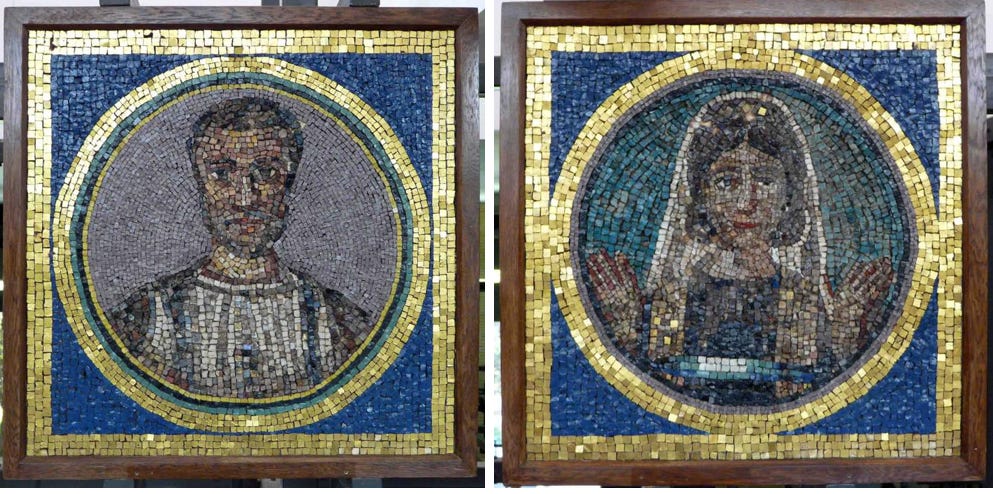
Following a ‘translation of saints’ bones’ in 1656 the mosaic portraits of Flavio Giulio Giuliano and Simplicia Rustica were discovered in the cemetery of Ciriaca, detached between 1656 and 1677 from a tomb with their epigraph and acquired by the collection of Agostino Chigi. They were placed, as was the custom at the time, on the wall in the staircase leading to the Library, according to a design by Pietro da Cortona Chigi and in a pattern not unlike the one we have mentioned for the Massimo collection. An interesting contiguity, therefore, between mosaics and libraries. It was not until 1918 that the mosaics were detached and acquired by the Lateran Christian Museum, where they were again restored.
In the 18th century, the century in which mosaics made their entry into museums and collections, we find several testimonies of mosaics in the catacombs, without precise topographical references, by the Custodian of the Cemeteries Marc’Antonio Boldetti in 1720. He testifies of mosaic decorations on lithic or fictile supports, and is the main source on the topic for that century.
A couple of examples: Boldetti describes a brickwork from the cemetery of Ciriaca, on which there was a monogram between alpha and omega in mosaic tesserae. It is now lost, but at the time it ended in Gaetano Marini’s private collection. I do not think it is a coincidence that a mosaic artefact of this type, i.e. more epigraphic than artistic, aroused the interest of the leading epigrapher of the time, who was also the Vatican Librarian. Secondly, Boldetti draws a direct connection between some mosaics found in the catacombs and the Carpegna Museum: these are mainly ‘several birds and flowers formed on terracotta boards with non-ordinary artifice, and of minute workmanship’, i.e. emblemata, found between the Appia and Ardeatina roads, in particular at Callisto, used as closures for burial niches. All these pieces were later transported to the then Carpegna Museum in the Rione Sant’Eustachio in Rome, of which no further information is available afterwards.
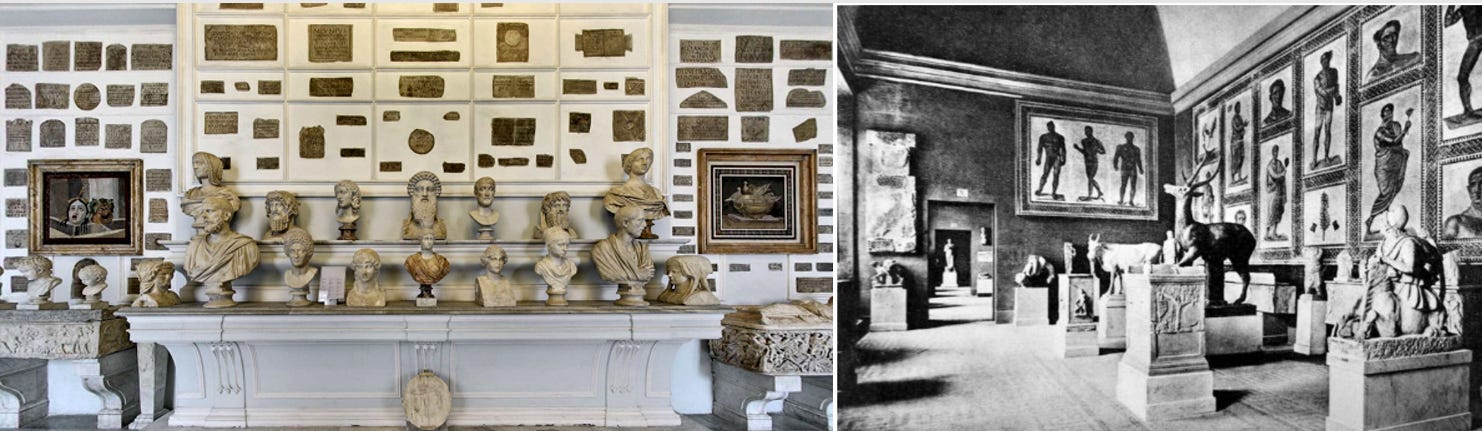
In general, mosaics in collections in the 18th century had to be tear out and cut up to make more artefacts, for immediate placement in an antiquarian market. The 19th century in Rome marked the beginning of massive systematic excavations in the catacombs, the founding of the first institution for the protection of these monuments and above all the opening of a large museum dedicated to them in 1854 at the Lateran Palace, where the discovered mosaics were directly brought. In the Lateran Museum, they are displayed into the wall, following a practice that has been going on for centuries, inaugurated in papal museums by the display of the Dove emblema of Villa Adriana. Indeed, in the Lateran Palace hosted the important museum experiment of displaying the mosaic of the athletes of the Baths of Caracalla, discovered in 1824 and then placed in the museum in 1836, first in an imaginative reconstruction of the floor and then set into the wall, had been developed.
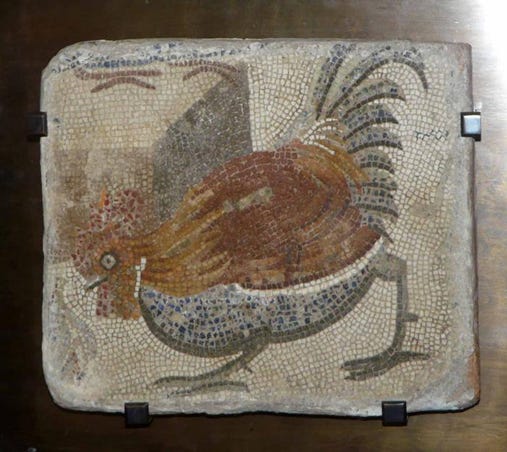
For our theme, an emblematic case is the brick with the mosaic image of a cock, a pavement emblem probably reused to close a niche. It was discovered in 1837 during the works of Virginio Vespignani in the cemetery of Verano, as stated in the sixth volume of Louis Perret’s disputed Catacombes of 1852, which places the mosaic to cover an unspecified martyr’s grave. Upon its discovery, it was sent straight into the Lateran Museum, where it was slightly restored and placed on the wall, in the large gallery of sarcophagi, along with all the other ‘sculptural works’, as noted in the catalogues of the time.
During the 20th century, the museum housed both mosaics previously housed in private collections (as the one in the Chigi Library which passed to the Laternanense Museum and then to the Pio Cristiano in the Vatican) and new discoveries, such as the two fictile slabs decorated with polychrome glass mosaic tiles from the Aproniano catacomb depicting three episodes from the biblical story of Jonah. They were discovered on 1 February 1938, the Pontifical Commission of Sacred Archaeology donated them to the Holy See and they immediately entered the Vatican collections, also becoming part, in 1963, of the new Pius Christian Museum opened in the Vatican after the closure of the Lateran Museum. Perhaps the most linear path in our little story.
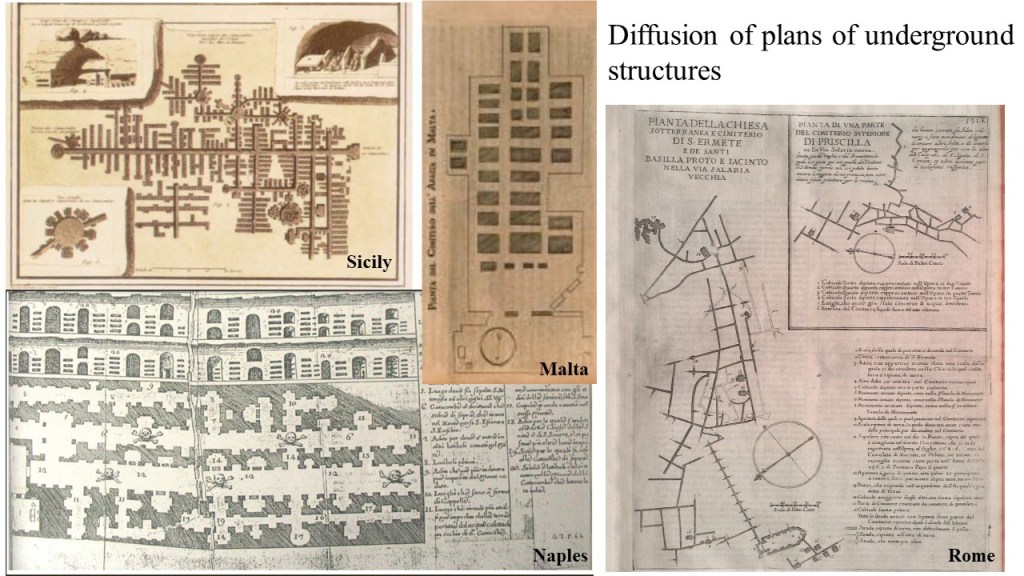
Having briefly looked at how the catacombs were explored in early 17th century, let us consider why they were explored, apart from walking to encounter new areas of the monument. The activities that took place underground tended to be that of registering the monument and extracting finds from it. Registering the monument involved drawing the plans, an activity for which there were specialised people, of whom we know some names and some products, in particular those published in several books.
Plans of the catacombs on Via Nomentana in Rome published in 1632 in Bosio’s Roma Sotterranea
Alongside these, however, there were also more private, “homemade” maps, used by explorers for their personal exploration, which were never published but were used for underground visits. Of this maps, obviously, we have very scarce information.
Specialist artists were employed to copy the paintings seen in cemeteries. Copyists accompanied explorers on underground expeditions. The copying phase in catacombs was the most uncomfortable working situation, with insufficient light and space conditions. The subsequent stages of drawing arrangement and colouring took place in the studio.
Early 17th century copy of a painting from the Domitilla catacomb in Rome. Vallicelliana Library of Rome
Another of the occupations of the groups of explorers was the extraction of archaeological objects, especially epigraphs, as well as anthropological remains excavated with the intention of making relics. The majority of archaeological finds ended up in the private collections of the explorers and the main collectors in Rome: sometimes explorers became a sort of merchant of antiquities for the antiquarian market. In particular, sarcophagi and inscriptions from the catacombs ended up since the beginning of the 16th century, as decorations in private houses.
The second group of objects found within the catacombs and removed from them are the anthropological artifacts, extracted from the tombs specifically to create holy relics. But that is another story….
Exploration of Christian catacombs was a widespread and very fashionable practice in Rome between the sixteenth and eighteenth centuries. It involved Roman population, regardless of their social classes, as well as scholarly and ecclesiastical groups from outside Rome, generating a huge wave of interest in Christian catacombs that revolved in a “race” for catacomb exploration.
From a technical point of view, the ways of exploring the catacombs remain the same throughout the centuries. And the problems due to the architecture of the catacombs also remain the same: the darkness, the inconvenience of access, the labrinthic structure. The theme is, therefore, universal and serves a reconstruction of catacomb explorations over the centuries.
An answer to the question “how were the catacombs explored?” was given during an interesting conference in Rome in November 2024 (Here is the link: https://www.velociproject.org/en/events/rome24 )
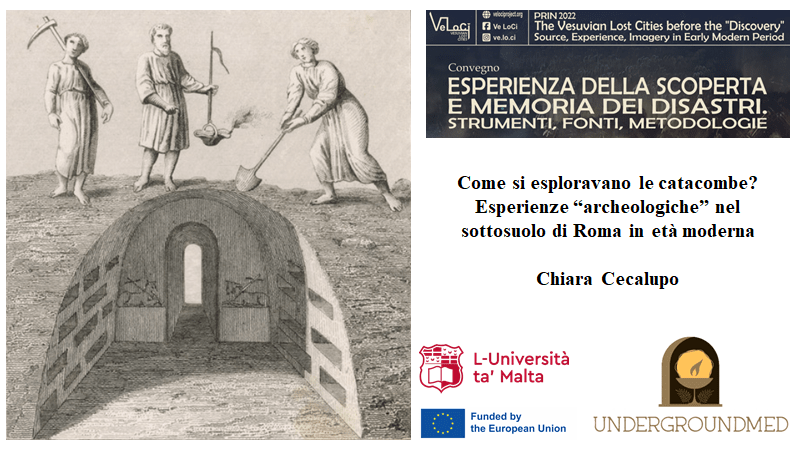
The catacombs were accessed through random openings in the countryside, or specially dug ones, from which one descended and from which one exited along with the finds recovered underground. It was therefore necessary to make them wider; hoes and spades were used, as well as ladder. To make one’s way through the tunnels without fear of losing one’s way, long ropes were used that were tied to the entrances and then uncoiled as one went along, or one could mark the points at which one turned at each fork in the road. Then of course one had to use flashlights and candles, in such quantities that they could last for days.
Once inside the catacomb, therefore, one proceeded mostly on all fours, or by crawling, or enlarged passages by excavating the tufa.
“Roma Sotterranea” (1630) and “Osservazioni sopra i cimiteri de Santi Martiri” (1720) are the main sources of information for this topic.
Then, once inside the catacomb, one would proceed to walk around to find new areas and discover new parts of the monument, especially galleries with closed tombs.
But aside from basic exploration, what was being done in the catacomb? Coming soon…
On Saturday 27th, we presented the new project UndergroundMed during the Science in the City festival in Valletta. It was a special occasion to meet our collegues at the EU Corner and share some insights on the project with visitors in Valletta!
On the 30th June 2023 I joined the technical meeting on the future of the necropolis of Tarragona in the year of the 100th anniversary of its discovery, organised by the director of the National Archaeological Museum of Tarragona.
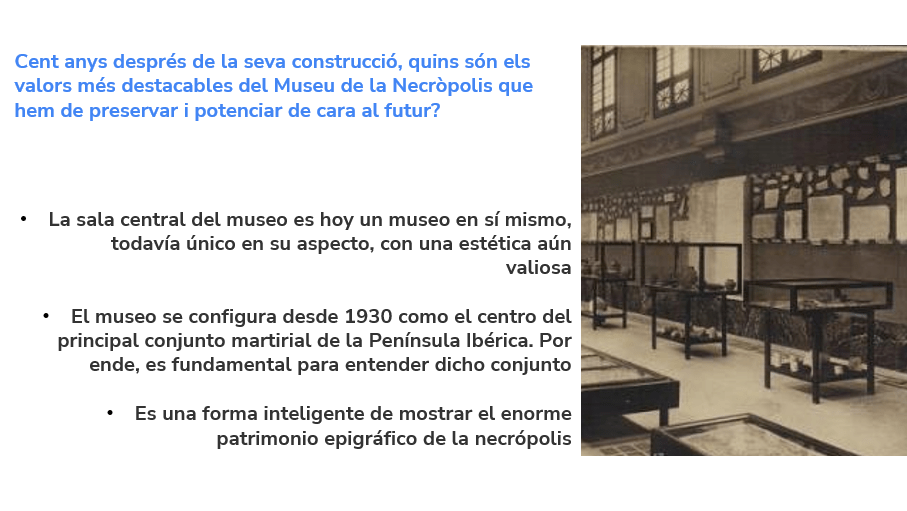
The necropolis has awarded seven million euros from the EU Next Generation funds, in the fSpanish “Plan de Recuperación, Transformación y Resiliencia” for its restoration and reopening. In light of this news, a panel of interdisciplinary professionals and the heads of the cultural organisations of the city of Tarragona (full programme here) got together to ask ourselves: One hundred years after its discovery, what are the most outstanding values of Necropolis that we must preserve for the future? And what needs to be done to transmit and enhance these values?
My role wwas to provide answers under the museologial point of view. In a full morning of work I presented some results of the study carried out during my secondment in 2022 (more info here). the answers are about to be developed more deeply in a pubblication, but this is the core of my presentation:
The day aimed to exchange points of view, offer a dialogue and reflection on this site and was open to the public, both in a presencial format and online, and is fully available online:



















 Catacombs rediscovery