New book is out!

Finally my latest book is here:
An Archaeologist in Rome at the Service of the Order: Letters from the Hospitaller Grand Master to Antonio Bosio (1604–1629), Routledge: New York and London, 2025.

I wrote my doctoral thesis, about ten years ago now, on Antonio Bosio, a seventeenth-century archaeologist and scholar who, the illegitimate son of a knight, was brought as a child from Malta to Rome and spent his entire life discovering and exploring the catacombs of Rome. The studies on Bosio, and all those that came in connection, have been the important basis on which I built my researcher portfolio and led me to my current job, which I truly love.

At the time when I finally published -in June 2020- the volume based on my doctoral thesis (Antonio Bosio e i primi collezionisti di antichità Cristiane, Piac: Vatican City, 2020), I did not really think it would end there. In fact, when in February 2022 I signed the contract with Routledge for the publication of the Grand Master’s letters to Antonio Bosio, it seemed to me that I was doing exactly what I was supposed to be doing: picking up the theme again but focusing on Antonio’s political life, on his work for the Order of Malta and, at the same time, working on unpublished materials preserved in my place of the heart: the National Library of Malta.

Brief description of the book

This volume is part of “The Military Orders Project” series and provides the original texts of the Grand Masters’ letters to Antonio Bosio in Rome, preserved in the National Library of Malta, together with a biographical study on Antonio Bosio, carried out over the years and now expanded with new information and research.

The volume opens with a historical presentation of the Bosio family within the Order of Malta. This is followed by a complete biographical profile of Antonio Bosio, compiled from the Order’s official sources and from archive documents found in various locations.

A short chapter is then dedicated to the presentation of the various archive collections in which Antonio Bosio’s private documents and autograph manuscripts are found, to offer a complete panorama of Bosio’s figure, although I focussed more on the biographical aspects inherent to the Order and his work at its service.

The core of the volume is obviously the letters of the Grand Masters to Bosio from 1604 to the time of his premature death in September 1629. The letters are presented in a simple transcription of their original form, and then their translation into English.

I believe that the task of this book is to offer a set of sources that will be useful to scholars on the international scene for years to come. The aim is to make public as widely as possible material that is not widely accessible, both in geographical (because it is preserved in Malta and so far not public in digital form) and linguistic terms (with these being handwritten in seventeenth-century Italian).

A general, critical reflection on the letters and the role of the Order’s Agent in the early seventeenth century is then proposed in the final two chapters. Here, the texts and their recurring questions are taken as a starting point for further comments, but above all to present the role and prerogatives of the Agent of the Sacred Religion on the basis of what is revealed in the Bosio epistolary.

Work in progress: map of the project UndergroundMed

Please note that the homepage of the UndergroundMed project now hosts the map of the catacombs, archives and museums under study in the project.

The map is being continuously implemented as the research progresses, and will contain a lot of data and information regarding the rediscovery of catacombs in Italy, Tunisia and Malta between the 16th and 20th centuries.

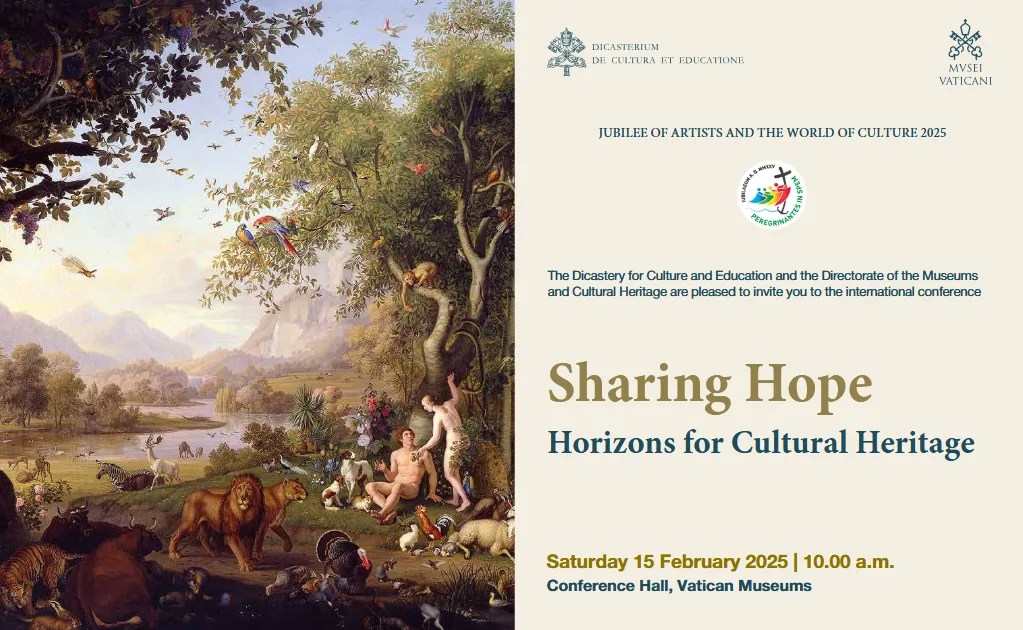
Saturday morning at the Vatican Museums

Last weekend I had the opportunity to take part in some of the events of the Jubilee of Artists and the World of Culture, which was held in the Vatican on 15-16-17 February 2025. Among the various religious celebrations, there was an international congress at the Vatican Museums, organised by the Museums themselves and the Dicastery for Culture and Education. The event aimed to bring together cultural workers from the Vatican State and various international representatives of institutions related to culture, the arts, research and teaching, including an important group of speakers chosen for their roles within the main Italian museums and universities.

The morning session was an important opportunity to reflect on the present, conceived as an analysis to understand what future awaits cultural heritage, as expressed by the title of the meeting ‘Sharing Hope – Horizons for Cultural Heritage’. The target was clearly the cultural heritage inherent to Christianity, but with a necessarily universal focus, if one thinks of the impact Christianity has had on European art. This is a subject very close to some of my recent studies and that is why attending this meeting was extremely inspiring.

In general, the experiences brought to the table were all of great interest, and all focused on the need to address a new cultural horizon so that Europe’s heritage does not become mute in the face of the growing backwardness of religious culture. I will not go into the details of the individual interventions, but I will report what for me were the most important points of reflection of the morning:

– The cultural code of the monotheistic religions can be considered as an indispensable iconographic volume to understand European art, a sort of manual through which to understand scenes and references. Much of European art is art born in churches, and therefore born to enliven faith: to forget this is to consider only the aesthetic aspects of a work, risking emptying it of its soul.

– The codes of understanding, however, are neither univocal nor fixed in time, and the sense of the sacred in all civilisations is made up of stratifications. Museums must always take this into account when communicating, increasingly moving towards an anthropological approach to monotheistic religions as well. In this sense, it is good to think of museums as two-faced beings: they look at both the past and the future at the same time, while remaining firmly anchored in the present.

– In the process of communication and valorisation, one has to take into account that cultural heritage is always an extremely contested point in societies and between generations. Doing culture in a museum or in research and educational institutions involves thinking about investing in the future: in a museum, when we conserve and enhance, we are responsible for a dialogue between generations, in which we must aim to meet and overcome the sense of superiority we have towards younger people.

The second part of the meeting included the presentation of the ‘Manifesto on the transmission of the religious cultural code’. Such initiatives are not new for Vatican cultural institutions: one example is the ‘Circular Letter on the pastoral function of ecclesiastical museums’, published in 2001 to become an important vademecum on how to manage ecclesiastical museums in the contemporary world.

The new Vatican manifesto is a declaration of intent focused precisely on a generational pact that has religious cultural heritage at its centre. It is composed of seven parts that briefly condense the focal points of the contemporary debate in international museology (1. Accessibility and codification; 2. Inclusion and innovation in cultural languages; 3. Education for active and deep involvement; 4. Artificial intelligence and bridges to the future; 5. Awareness and re-contextualisation; 6. Custody and transmission in times of crisis). It is the result of shared reflections, according to more universal ideas of peace, hope and dialogue, i.e. the themes of the current Jubilee.

The text in general presents a little bit of paternalism, a naïve vision of the “power of Beauty”, and presents a concept of inclusion that is extremely limited to a communicative rejuvenation. But beyond this, the manifesto is interesting for its focus on issues of communication, education and access to museum content.

I highlight just a few points:

Point 1, Accessibility and codification: it enhances the concept of accessing and understanding information through various media, very close to the indications given by the International Council of Museums in the new 2022 definition of museums.

Point 3, Education and involvement: it is assumed that learning happens in various forms, with interaction and involvement on various levels not only through passive actions of listening and reading information shared in a unidirectional way, with the top-down approach typical of museum curatorship in the past.

Point 5, Awareness and re-contextualisation: at every communicative moment, it is necessary to be able to critically question the meaning of the works, their historical context and the ethical issues related to their provenance. Here is where the question of the critical meaning of things arises, against any kind of simplified narrative.

These are very important seeds in a horizon of disorientation in which museums need to keep straight in order to continue their work of dissemination and inclusion without losing the direction themselves. It starts from the Vatican’s main museum with the ambition to reach all Christian and Catholic museums around the world, as well as all those who deal with religious heritage.

«Los orígenes de la arqueología cristiana de Tarragona y la figura del Dr. Pere Batlle Huguet (1907-1990)».

The exhibition «Los orígenes de la arqueología cristiana de Tarragona y la figura del Dr. Pere Batlle Huguet (1907-1990)» is intended as a tribute to Dr. Pere Batlle, an important figure for the protection of the archaeological and artistic heritage of the city of Tarragona, who wrote the first scientific work on the Christian epigraphs of the Roman-Christian necropolis of Tarragona.

It is also an opportunity to deepen and disseminate some important findings about his person and his work and finally to transfer knowledge about the genesis of Christian archaeology in Tarragona.

The exhibition is part of the UC3M Conex Plus project “LIT! Living in the catacombs! Reception of catacomb art in European culture and architecture between the 19th and 20th century”. It was born from an idea of Chiara Cecalupo and the director of the Museum Andreu Muñoz, with the cooperation of their collaborators, but also from the contribution of the Historical Archive of the Archdiocese of Tarragona and the Library of the Pontifical Seminary, in particular the director Enric Mateu. Other entities such as the Catalan Institute of Classical Archaeology and Tarraco Viva, the Roman Festival of Tarragona, as well as the Pontifical Institute of Christian Archaeology of Rome also played an important role. This harmony of local and international collaboration has therefore been a good opportunity to create a link between people and institutions that enhances Tarragona, its heritage and history, and which hopefully will continue in the future in other activities and with the same spirit.

The exhibition is structured in the following sections:
1. Christian archaeology and the first art of the universal Church.
2. Christian archaeological heritage of Tarraco.
3. Christian archaeology in Catalonia between the 19th and 20th centuries.
4. Dr. Pere Batlle Huguet. His training and research in Christian archaeology and epigraphy.
5. Safeguarding the heritage of Tarragona.

The exhibition is located in the Biblical Museum of Tarragona, specifically in the room dedicated to the early Christian world (Mn. Joan Magí room). The exhibition contents are projected through a set of explanatory posters accompanied by archaeological objects, photographs and documents.

The exhibition has been scheduled to run from 10 May to 3 June 2023 and the planned activities are set out below:

10 May, 7 p.m.: Opening act and lecture: “The origins of Christian archaeology in Tarragona and the figure of Dr. Pere Batlle Huguet (1907-1990)”, by Dr. Chiara Cecalupo (UC3M). Auditorium of the Museo Bíblico Tarraconense.

18 May, 7 p.m.: Lecture: “The Cathedral of Tarragona: Contributions to the Christian archaeology of the city” by Dr. Josep M. Macias Solé (ICAC). Auditorium of the Biblical Museum of Tarragona.

20 May: Guided tours of the area of the latest archaeological work in the cloister of Tarragona Cathedral. By the archaeologists Josep M. Macias Solé (ICAC), Andreu Muñoz Melgar (MDT/ICAC) and Andreu Muñoz Virgili (ICAC).

Saturday 27th May (11 a.m.), Wednesday 31st May (5 p.m.), Saturday 3rd May (11 a.m.). Guided visits to the exhibition by Dr. Chiara Cecalupo (UC3M). The visits are free of charge and without prior reservation.

More info at museu.biblic@arquebisbattarragona.cat

A video (in Catalan and Spanish) of the opening and the exhibition:

The catalogue of the exhibition is in open access for free downloading:

Credits:

Scientific Committee of the exhibition:
Chiara Cecalupo (Universidad Carlos III de Madrid)
Josep M. Macias Solé (Instituto Catalán de Arqueología Clásica)
Enric Mateu Usach (Archivo Histórico Archidiocesano de Tarragona y Biblioteca del Seminario)
Andreu Muñoz Melgar (Museos Diocesanos de Tarragona / Instituto Superior de Ciencias
Religiosas San Fructuoso)
Míriam Ramon Mas (Museos Diocesanos de Tarragona)
Stefan Heid (Pontificio Istituto di Archeologia Cristiana, Roma)
Immaculada Teixell Navarro (Asociación Cultural San Fructuoso)
Exhibition curators:
Chiara Cecalupo (Universidad Carlos III Madrid)
Míriam Ramon Mas (Museos Diocesanos de Tarragona)
Texts:
Chiara Cecalupo y Andreu Muñoz Melgar
Production and assembly:
Josep M. Brull Alabart, Magda Domènech Jordà, Rosa Ferré Rovira, Roser Fornell Guasch, Josefina Folch Sabaté, Josepa Franquès Bultó, Joaquim Galià Romaní, Sergi Guardiola Martínez, Dolors Iglesias Torrellas, Joan Quijada Bosch, Neus Sánchez Pié, Paco Roca Simón, Jordi-Lluís Rovira Canyelles, Adolf Quetcuti Carceller y Andreu Ximenis Rovira.
Audiovisual:
«La Tarraco de los primeros cristianos», Asociación Cultural San Fructuoso
Acknowledgements:
Asociación Cultural San Fructuoso
Museo Nacional Arqueológico de Tarragona
Real Sociedad Arqueológica de Tarragona
Jordi López Vilar

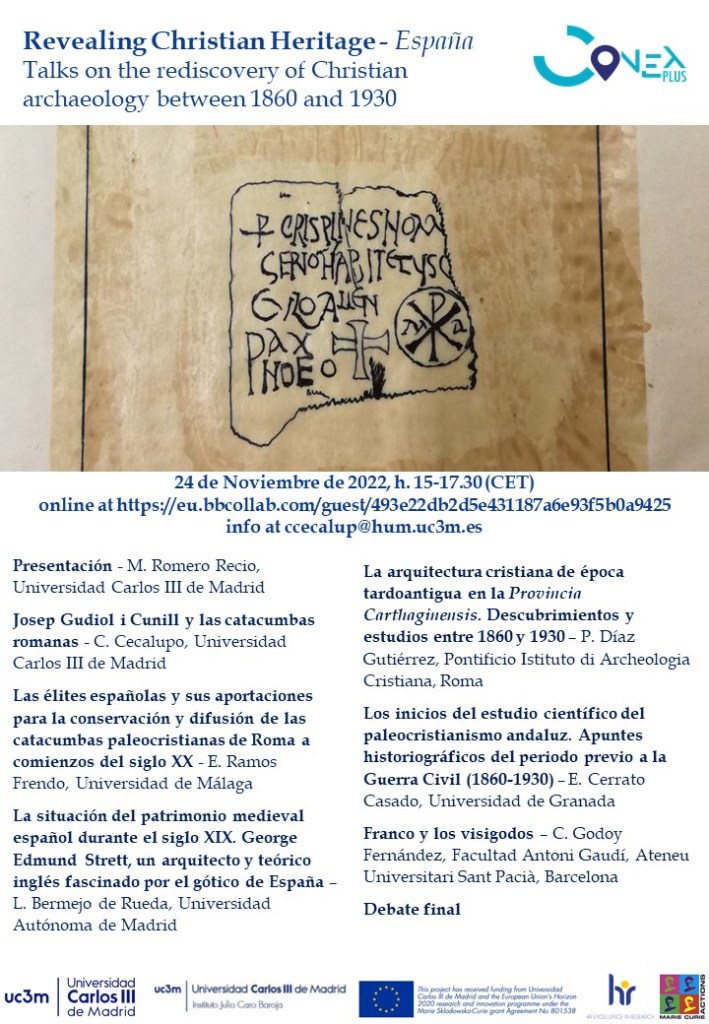
Second talk “Revealing Christian Heritage” – Spain edition

Among the dissemination activities of the Conex-Plus Project LIT!, we will celebrate the second talk of the series “Revealing Christian Heritage – Talks on the rediscovery of Christian archaeology between 1860 and 1930”. This year, the workshop will focus on the rediscovery of Christian antiquity in Spain in late 19th-early 20th century.

The first talk took place in September 2021 (more info here and here) and the publication of the proceedings will be announced soon.

Meanwhile, join us for the second talk on November 24th, at 15 CEST at https://eu.bbcollab.com/guest/493e22db2d5e431187a6e93f5b0a9425

The abstract book is available here:

Project results: latest publications

After the summer break, the first two months of this academic year have been devoted to results dissemination. I will dedicate a separete blog post to online or on-person activities (stay tuned!), but first I would like to share the latest publications regarding the LIT! project. All in open access!

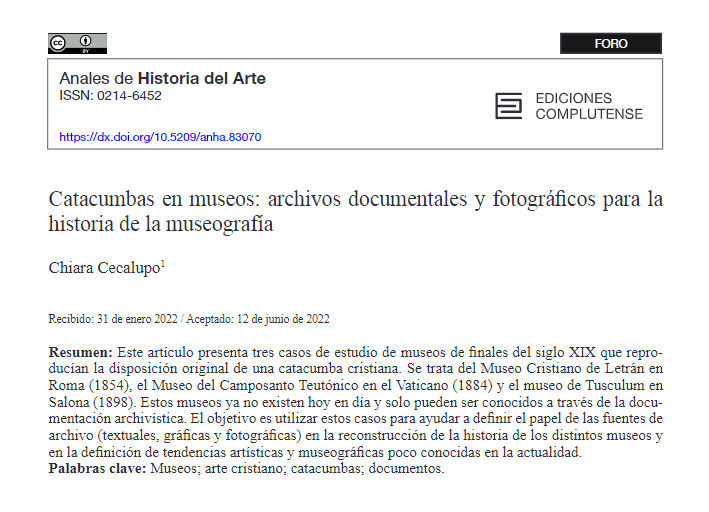
On October the 5th, the volume 32 of the Anales de Historia del Arte came out with the title Arte y Archivo. I contributed with the article “Catacumbas en museos: archivos documentales y fotográficos para la historia de la museografía” (“Catacombs in Museums: Archival Texts and Photos for the History of Museums”).

Available here: https://revistas.ucm.es/index.php/ANHA/article/view/83070

The contribution “Father Delattre’s Correspondence and the History of Christian Archaeology in the Maghreb: His Correspondence with Giovanni Battista de Rossi in 1885” is a much loved one for me, and came out on the 21st of October in the 2022 anniversary issue of the Moroccan journal Hespéris-Tamuda “Practicing Archaeology in the Maghreb: Historical Perspectives and Contemporary Realities / pratiquer l’archéologie au Maghreb: Perspectives historiques et réalités contemporaines“.

It can be found here: https://www.hesperis-tamuda.com/Downloads/2022/fascicule-2/14.pdf

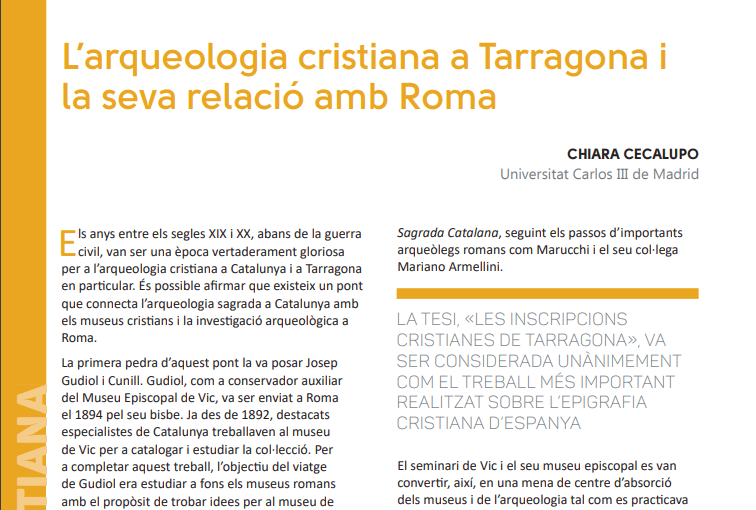
In the September/October issue of the local magazine Esglesia de Tarragona came out a short article of mine regarding the connection between Christian archaeology in Tarragona and in Rome. Check it out here: https://www.esglesiadetarragona.cat/wp-content/uploads/2022/09/R328.pdf

Bonus: my latest article about German researchers in the early Christian Catacombs of Malta finally saw the light this September. I wrote this article during the first months of the pandemic outbreak and I am very fond of it. It was published in the Römische Quartalschrift Band 117, Heft 1-2.

February 2022: the month of Giovanni Battista de Rossi

On the 22nd of February 2022 the scientific community celebrates the second centenary of the birth of Giovanni Battista de Rossi (1822-1894), one of the ‘founding fathers’ of Christian archaeology. He was Scriptor and then head of the Vatican Library, first secretary of the Commission of Sacred Archaeology, established by Pius IX in 1852, creator and curator of the Museo Pio Cristiano Lateranense founded in 1854. He is remembered also as founder and editor of the first specialist journal in the field, the Bullettino di Archeologia Cristiana (still existing today as Rivista di Archeologia Cristiana). He began the publication of the critical edition of all the early Christian inscriptions of Rome (ICVR) and was the author of the Roma Sotterranea Cristiana, an in-depth study of the main Roman catacombs (especially the catacombs of San Callisto) drawn up following his own important discoveries.

To celebrate the event, the Vatican State issued a special stamp where de Rossi is portayed with the ruins of the Hypogeum of the Flavi in the catacombs of Domitilla.

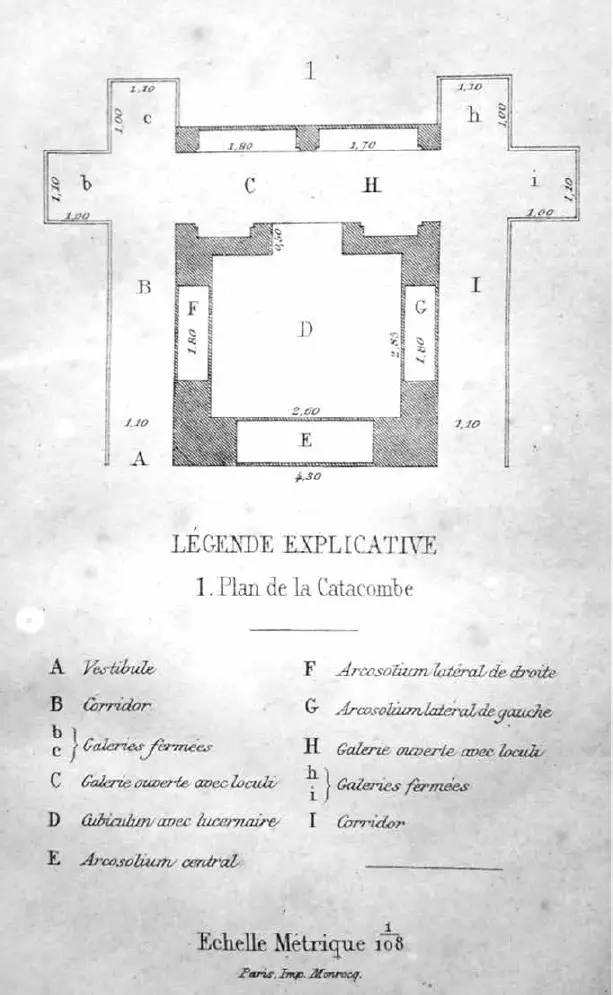
The project LIT! owns very much to de Rossi’s work. He was the one who created the first fac-simile catacombs in 1867 for the Universal Exhibition in Paris. We are therefore very happy to share the brand new article about the topic. Enjoy!

C. Cecalupo, GIOVANNI BATTISTA E MICHELE STEFANO DE ROSSI ALL’ESPOSIZIONE UNIVERSALE DI PARIGI (1867), in Rivista di Archeologia Cristiana, 97, 2021,2, pp. 319-347.

Psss, hey! Universidad Carlos III will soon celebrate de Rossi with a special exhibition. Stay tuned…

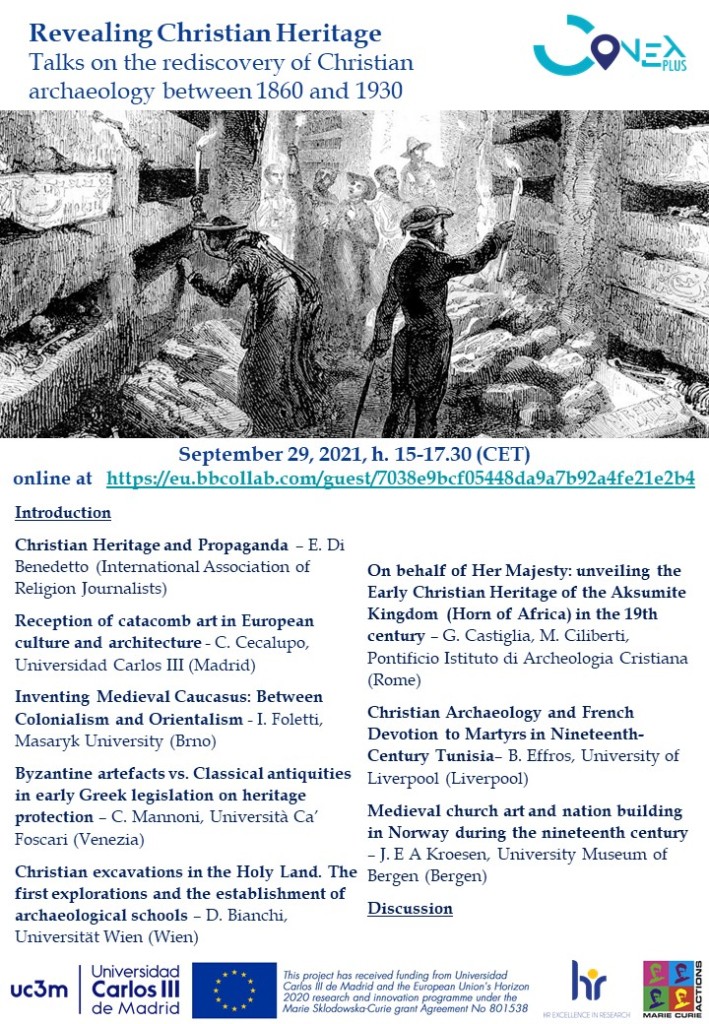
Online talk: Revealing Christian Heritage

We are glad to announce that on September 29, 2021, h. 15-17.30 (CET), the project Conex Plus will host the following workshop:

Revealing Christian Heritage. Talks on the rediscovery of Christian archaeology between 1860 and 1930

September 29, 2021, h. 15-17.30 (CET)

online at https://eu.bbcollab.com/guest/7038e9bcf05448da9a7b92a4fe21e2b4

Everyone is invited to participate to the talk and the discussion!Feel free to comment this post for additional info!

LIT! at the 27th EAA Annual Meeting

On Friday 10 of September The Project LIT! was presented at the 27th Annual Meeting of the European Association of Archaeologists (officially in Kiel, but held online due to the current situation)

The presentation was included in Session #230, “Stories and Compassion: Material Culture, Memory, and Emotion”, organized by Liv Nilsson Stutz (Linnaeus Univeristy, Sweden) and Sarah Tarlow (University of Leicester, United Kingdom). The precious session explored theories of memory and emotion through archaeological case studies and analysis of material culture. All the presenteed studies explored the connections between materiality, emotion, and memory in the lived experience of the past and present.

My speech investigated the growing interest of European people in catacomb archaeology from the late 19th century and provided many old prints and pictures, archival texts and old articles, that offer clear evidence of the public response to some of the most important fac-simile catacombs build in Northern Europe. From these sources, it appeared that the incredible fascination of original Roman catacombs remained vivid in these “fake” monuments. They clearly contributed to the definition of the role that Christian antiquity had in Europe in creating emotional experience of archeological sites.

I truly hope that the proceedings of these session will be published somewhen!

LIT! Project in the 27th MCAA NEWSLETTER

Our CONEX-Plus project LIT! has been presented on the 27th Newsletter of the Marie Curie Alumni Association (MCAA).

The MCAA is an international non-profit organization established and supported by the European Commission, but entirely run by volunteer members and with a bottom-up approach at its core.

This issue of June 2021 is dedicated to the making of a more inclusive research community. As the Editorial by Gian Maria Greco (MCAA Newsletter Editor-in-Chief) states, diversity and access are pivotal factors for the flourishing of the research endeavour. As a community of researchers, over the past few years the Marie Curie Alumni Association (MCAA) has been committed to increasing the accessibility of its communication products, services, and events. 

The last section of the issue is dedicateed to out LIT! project (with a wonderful cartoon illustration!) and can be read on the online version: here. Thank you MCAA!