The project UndergroundMed was presented among the on-going research project at the University of Malta Research Expo 2025 held in Valletta on 28 May 2025.
Abstract and presentation
Notes from Underground: the project UndergroundMed
The MSCA project UndergroundMed traces the history of the rediscovery of ancient catacombs between the 16th and 20th centuries across the Mediterranean, in particular Italy, Malta, and Tunisia. It analyses the topic from a broad European perspective, through studies conducted on travel routes, explorations, archive and museum collections, and it enhances the role of European scholars in creating an international and multicultural research-network while travelling across the shores of the Mediterranean in search for catacombs. I will share some preliminary results of this systematic analysis on catacombs rediscovery, to illustrate how UndergroundMed defines the role played by catacomb archaeology in building a European common culture.
[This is part of the text read during a public lecture at the Royal Netherlands Institute of Rome on 30 April 2025]
From the mid-sixteenth century, the discovery of many Christian catacombs in Rome spread knowledge about early Christian art throughout Europe, and made catacombs a popular subject. This process took place through promotion of academic studies, vast numbers of copies, and museum displays, all supporting the progress of archaeological discoveries. This phenomenon from the sixteenth through the twentieth centuries is obviously connected to political key events occurring in the Papal States.
One can say that the history of Christian archaeology cannot be divorced from the political and confessional use of the the catacombs. This use constantly characterised the work of many researchers and scholars, in periods when Christian archaeology was perceived as an official, national, catholic and papal discipline. They mostly fostered this relation between catacomb archaeology and politics through their scholarly publications and the production of copies of catacomb paintings. What is certainly evident is the key role of the papacy, which from time to time finds a political and cultural reason to reassert its authority through its most ancient past and claiming authority and exclusive control on it over the centuries, and playing a pivotal role in the process of dissemination of Christian art.
Catacombs for the Counter-Reformation agenda
Knowledge of the catacombs and the artistic treasures they contained was never totally ignored or forgotten contrary to long-standing assertions made by questionable but influential twentieth-century historiography. Records of pilgrims visiting the catacombs as part of the Christian-Rome cult circuit are numerous from the Middle Ages to the early modern age. Renaissance humanist scholars were the first to analyse the art of catacombs, often based on first-hand knowledge acquired during visits to the sites themselves. The scholarly impact of the construction of New St. Peter’s throughout the whole sixteenth century, an intervention that required extensive and lengthy excavations, was very important too: on that occasion, a significant number of sarcophagi, epigraphs and artefacts came to light, representing the first major contact for the modern world of Rome with early Christian art.
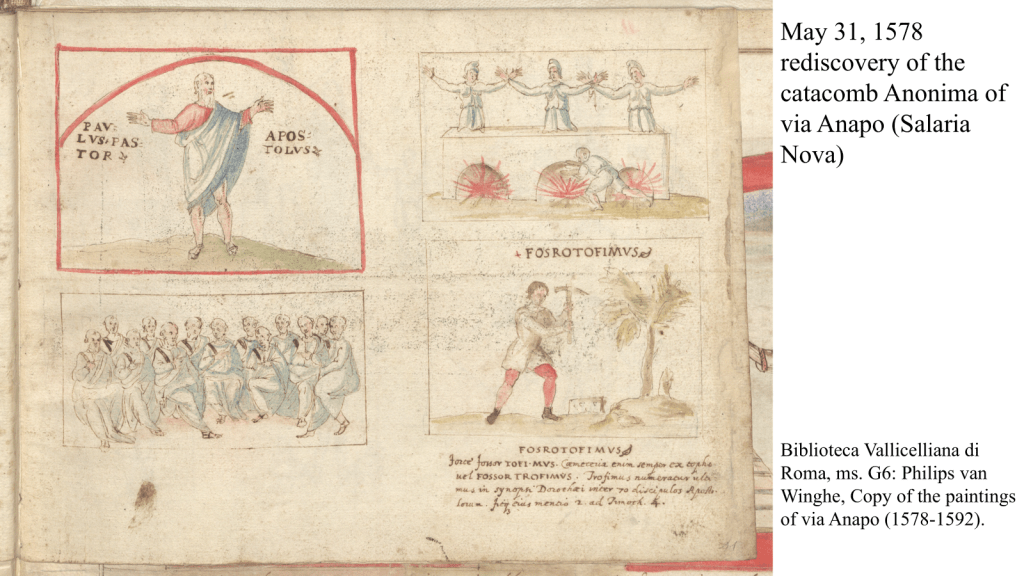
A crucial event happed on 31 May, 1578, during the pontificate of Gregory XIII: the accidental discovery of a Christian catacomb within the Sanchez vineyard on the Via Salaria Nova (at that time identified as the catacomb of Priscilla, but later in the late twentieth century as the Anonymous Catacomb of Via Anapo), with its impressive set of wall paintings. This is considered to be the moment when Christian archaeology began. However questionable that narrative is, this discovery nonetheless represented a real novelty involving sections of Roman population of the countryside, hitherto excluded from the rediscovery of and appreciation for Christian antiquities. These underground tunnels, marvellously decorated with paintings, totally unknown and extraordinary, attracted an incredible number of people, so much so that Gregory XIII decided to fence off the area (and then that the fence was torn down by eager groups of visitors), including not only clerics, scholars, and antiquarians, but also, and perhaps above all, ordinary people. This novel attention to of ancient Christian art is extremely interesting for the political and confessional use of catacomb art, because it appeared to have a great appeal for common people everywhere and could be used to convey Catholic messages in Italy and beyond. The first discovery of a catacomb also stimulated the search for more underground cemeteries throughout the Roman countryside, archaeological forays led by scholars, ordinary citizens, and different religious groups.
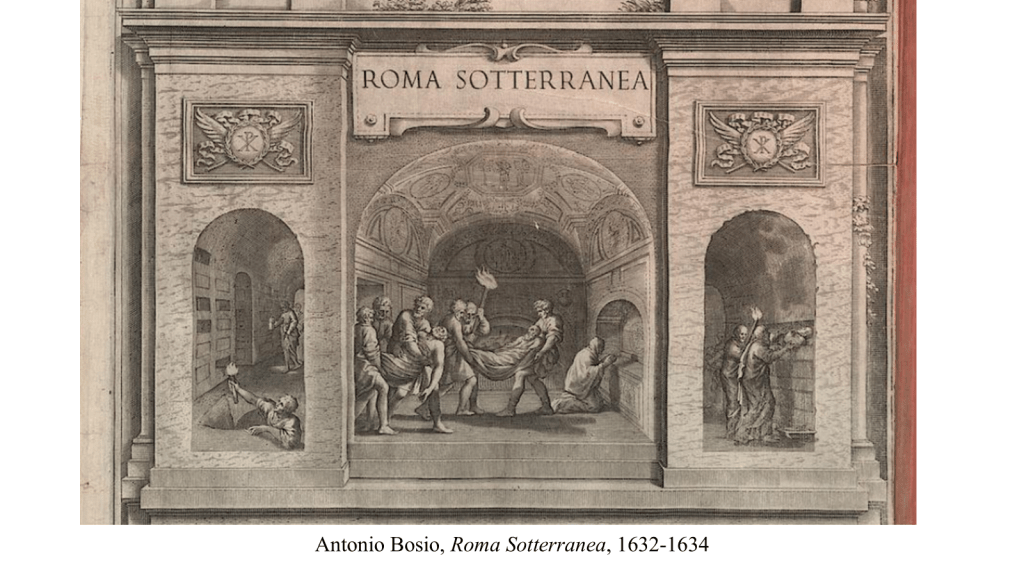
That feverish research culminated in 1634 with the publication of the first monograph on the Roman catacombs, Antonio Bosio’s Roma Sotterranea. This work and the explorations of catacombs led by Bosio increased indeed the international interest in the catacombs. While Christian cemeteries had already attracted the attention of scholars during the fifteenth and sixteenth centuries, after 1578, scholars or artists from all over Europe and Italy flocked to Rome with the intention of drawing and describing the paintings found in the catacomb galleries.
In a cultural context generally dominated by the new Tridentine needs in developing a new, unique artistic discourse controlled and directed by the Catholic Church, we must recall clear links between a genuine interest in Christian antiquities and the Catholic Counter-Reformation, with sacred antiquaria and apologetics in support of Catholic historiography. In fact, Roman and other European Catholic scholars of the second half of the sixteenth century were very keen to render service to the Catholic Church. Certainly, the findings, and in particular the paintings of the catacombs, could corroborate knowledge derived from literary and historical sources, and both could be used to legitimize a Catholic position against Protestant divisions. The most immediate interest was to record the paintings that were being gradually discovered during the sixteenth and seventeenth centuries in various Roman cemeteries. This was due to the intrinsic wonder aroused by the sight of such unknown, mysterious and yet so well-preserved Christian paintings, and to their clear link to scriptural episodes narrated in the early times of the new religion, but well known to contemporary Catholics and Protestants. These ancient paintings conveyed familiar religious stories and concepts, moreover in an easily understood visual language.
It was precisely the memory of a heroic era of the Church, of which the stories of saints and martyrs represented the main legacy, that produced a particular interest in the catacombs. In fact, a revival of early Christian themes and symbols, like palm as a sign of martyrdom, were used in all the arts to translate into images the Tridentine needs to create a set of iconographies to develop new resources for the faithful and new devotions to foster popular piety. This revival was translated into new styles, and tastes, as proven, for example, by the widespread diffusion of paintings with early Christian saints (Caecilia above all) in churches and private houses in the early seventeenth-century. Even the grandly Baroque architecture sought to make ancient Christianity present through the monumental recreation of early Christian liturgical spaces, which was one of the main aims of the great reconstructions of Roman churches financed by the various popes.
From a political point of view, the discovery, study, and recreation of early Christian art found in the catacombs therefore had a broad cultural role, expressed into two main directions. First, early Christian pictorial art was presented as incorrupt, pure, severe, and spiritual, thus the perfect vehicle for a process of artistic and figurative renewal of Catholicism that was to serve to counter Protestant criticism . Second, it is precisely the discovery of early Christian art and its clear message that served to convey and promote unbroken continuity of the Roman Church from apostolic times to the present. The catacomb images were very old; but in a certain sense, they were new too because they were reinterpreted as living images, models to be imitated, and a source of artistic inspiration.
Christian archaeology din late nineteenth century
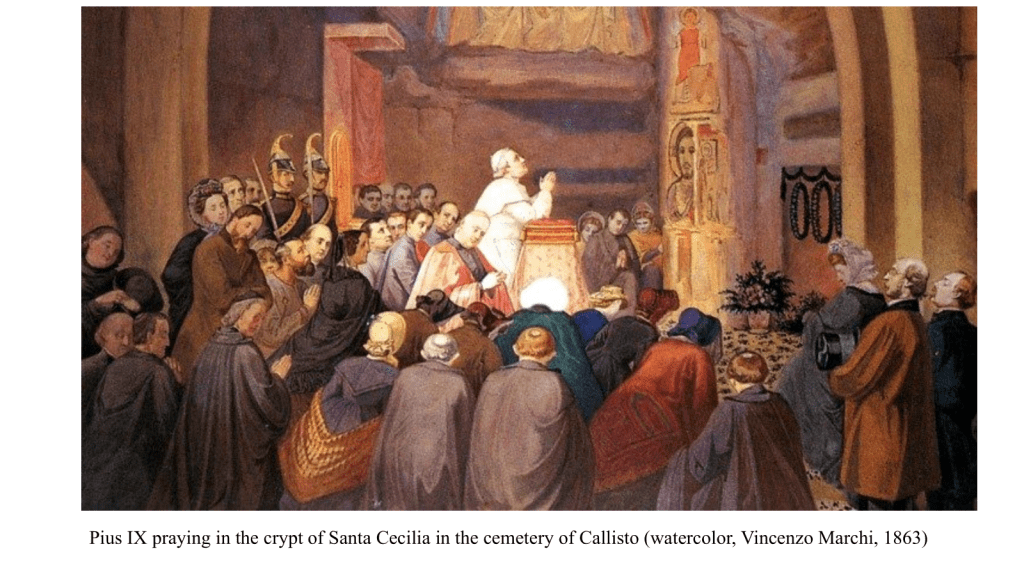
One has to wait until the 1850s for the next great change in the history of Christian archaeology to take place. Under the pontificate of Pius IX (1846-1878), in particular, the promotion of the excavation and study of Roman catacombs became extensive and more explicitly political. The Roman Republic (1849), the exile in Gaeta in the Bourbonic Kingdom and the return to Rome were the initial act of a pontificate characterised by perennial conflicts with the emerging kingdom of Italy that culminated in the end of the Papal States and thus of the popes’ political power in 1870. Given such political turmoil, unique in the history of the papacy, Pius IX was called upon to promote the papacy’s temporal power and Catholic Christianity with self-assertive policies at both the local and international level. Until the end of his pontificate, Pius IX insisted on the self-exaltation of Christian culture and the centrality of Rome in an international culture with ancient apostolic roots. Christian antiquity therefore assumed a key role in the cultural policy of Pius IX, who financed important initiatives for the development of the discipline of Christian archaeology. The Roman catacombs were proposed as a symbol of the times of persecution and thus a material embodiment of the martyrial narrative with which his pontificate was cloaked.
Events that supported this objective occurred in the first years of Pius IX’s pontificate. In 1860 Europe was in the midst of numerous social transformations, revolutionary uprisings and wars of independence due to nationalistic drives hostile to the great empires reformed after the Congress of Vienna. These upheavals resulted in the emergence of nation states, particularly in Italy, where the papacy lost its territory. In a slow political and cultural process culminating in the capture of Rome in 1871, Pope Pius IX (1846-1878) saw his temporal dominion reduced to the Vatican City. We were thus facing the most radical geopolitical change on the continent, in which the political as well as the cultural definition of nations played a very important role.
Under the cultural point of view, the pope made use of the work of the Jesuit Giuseppe Marchi (1795-1860), who is considered one of the founders of Christian archaeology as a scientific discipline, and Giovanni Battista de Rossi, who was then his young assistant. The two were put in charge of excavations in countless catacombs and were also entrusted with the dissemination their discoveries in textual and visual reports/accounts. They were also the protagonists of Pius IX’s major institutional foundations dedicated to Christian archaeology. The Commission of Sacred Archaeology (1852) oversaw the study and protection of the catacombs and other Christian monuments while the Lateran Christian Museum (1854) included a lapidary section to provide a proper place to display the many works of art found in the catacombs. It functioned, in effect, as an appendix to the visit to the catacombs, replete with didactic intents designed to advance the understanding Christian antiquities . Here, then, we are in front of a real state archaeology, scientifically conducted, but in the overt service of a political agenda. If that were not enough, there were large construction and restoration campaigns that became more customary as the situation became more complicated: think of the large investments for the restoration of the great early Christian basilicas such as S. Lorenzo fuori le Mura, Santa Maria in Trastevere, or even St Paul’s outside the walls after it was destroyed by a huge fire in 1823; as well as the celebration of the papal soldiers defeated in the battles against the Reign of Italy, who in the contemporary narrative rose to the rank of martyrs of the faith and received a monument in St John Lateran, the city’s cathedral.
One of the most important tasks of an archaeologist on an excavation is to keep a diary in which to record daily work and eventual discoveries, a diary that thus becomes the main source of facts and details of an archaeological exploration of any kind. Keeping an excavation diary is a sort of obligation towards both the past that unfolds before us and the present and future generations that expect us to take care and attention to preserve the discoveries. Even the archaeologists of the past have not shirked this obligation: there are some diaries of excavations from centuries ago that are extraordinary texts (such as, for example, the eighteenth-century diaries of the discoveries of the Vesuvian cities, which take us by the hand on a tour of wonders to places that are still mythical today), but all of them, even the lesser-known ones, maintain a charm that those objects that act as a bridge between us and the thinking of our ancestors know how to have.
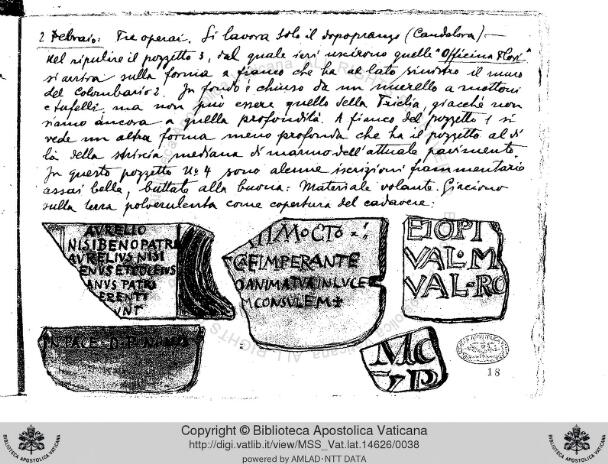
One of the most interesting diaries for catacomb archaeology is the excavation diary of the Swiss Paul Styger, archaeologist and scholar of Christian antiquities in Rome, professor of archaeology and religious arts in Poland and one of the protagonists of the potpourri of nations that was the horizon of archaeological science in Rome in the early 20th century. Due to a series of fortunate circumstances (in particular, his proximity to the German circles in the Vatican that a century ago were carrying out archaeological research and museographic experiments in the Eternal City), Styger found himself -between 1915 and 1917- directing the excavation of the church of San Sebastiano on the Via Appia in Rome. This is a very important site: an ancient church that later became a Baroque jewel, but set on an extensive cemetery area. Styger’s excavation is particularly concerned with investigating the area directly underneath the nave and the Platonia, with the intention of also tracing the tomb where, according to a tradition invented in the Middle Ages, the bodies of Peter and Paul extracted from their original tombs in the basilicas of the same name would have been temporarily protected.
The diary is a little gem. It starts on 8 February 1915, ends on 27 February 1917 and is a mixture of text and pen illustrations, later coloured in watercolour. It is a true snapshot of what it must have been like to manage an excavation at the time, with constant inspection visits by the Ministry of Education and the Commission of Sacred Archaeology, fluctuating relationships with the workers, and more or less long interruptions for various reasons. The most beautiful feature are of course the drawings, not only of the individual objects found, but also of some of the structural situations found during the excavation.
The diary arrived in its current location in the Vatican Library after Styger’s death in 1939, by his own will, after having been missing for a while. This is confirmed by a letter pasted at the end of the manuscript, in which his sister refers to a certain Gerke who will help her find this diary and donate it to the library. At the end of this letter, an anonymous hand adds, in pen, that he received the diary on 31 May 1939 and adds: ‘And Gerke, if I am not mistaken, is the Nazi whom those of the Commission of Sacred Archaeology allowed to examine the excavations of the catacombs with all freedom, while they would have obstructed the Styger’. A small note full of implications, which relates to the strong relations between archaeological bodies and certain authoritarian political parties in the 1930s and 1940s, an issue that archaeological historiography has yet to come to terms with. As an appendix to the diary, there are some typed sheets, with pencil-drawn illustrations, in which Styger lists pieces found in various catacombs during the 1920s, which were then lost, either because they were left on the site and treated carelessly, or because they were not handed over to the Vatican Museums. This list, too, is a singular evidence the practices of preserving artefacts: not a few objects were damaged by handlers who had ‘tried to tear them off’, or because they were left ‘without any precautions to save them’.
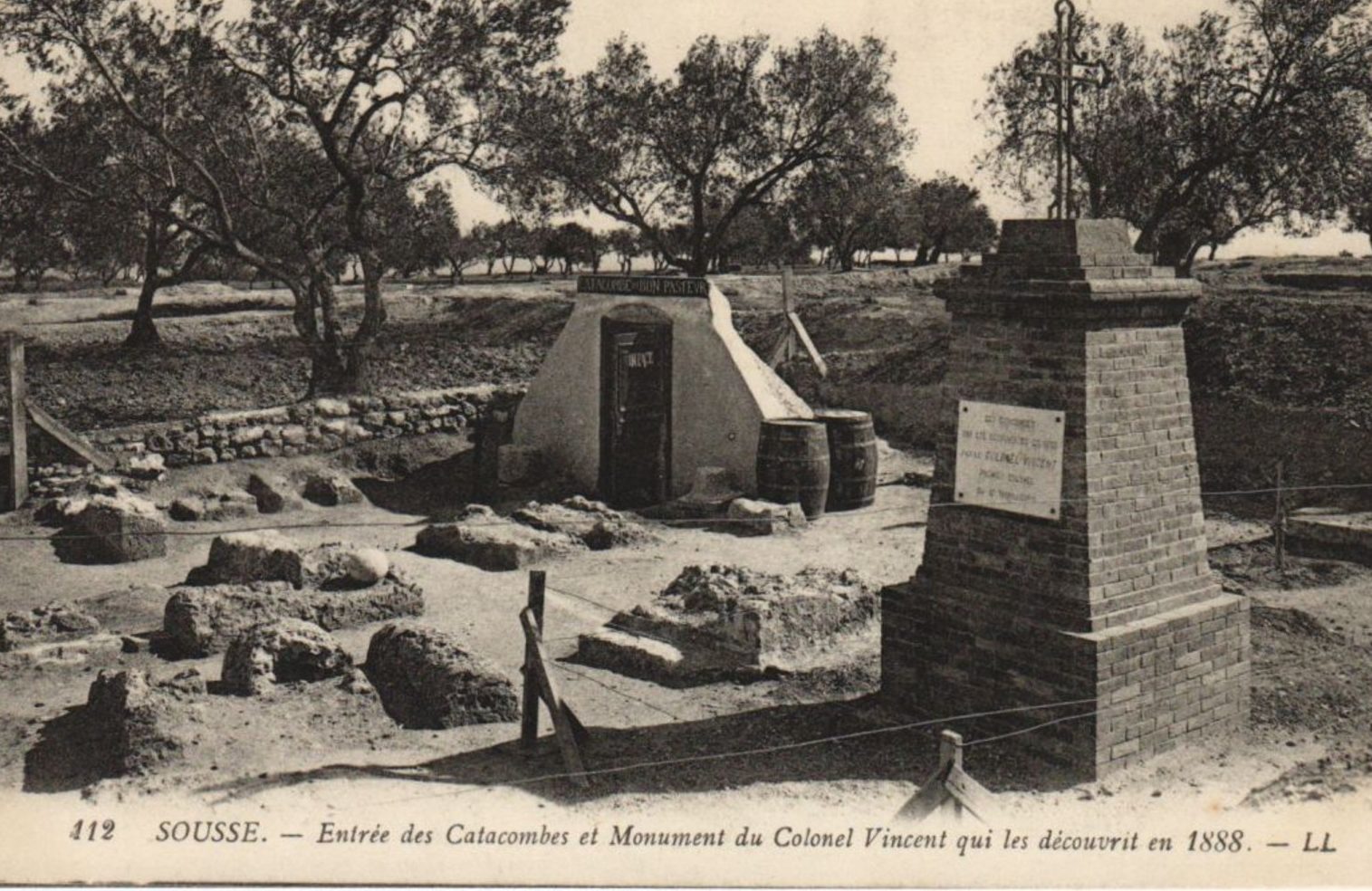
At the end of 1880s, a colonel of the 4th Algerian Rifle Battalion stationed near the Tunisian city of Sousse, the ancient Hadrumetum, accidentally discovered a catacomb gallery, sparking the interest of local society in Christian antiquities.
It was only at the end of 1903, however, that Abbot Leynaud and doctor Carton managed to receive funds and permits to undertake excavations, thus uncovering what became known as the Catacomb of the Good Shepherd, the first and largest Christian catacomb found in North Africa.
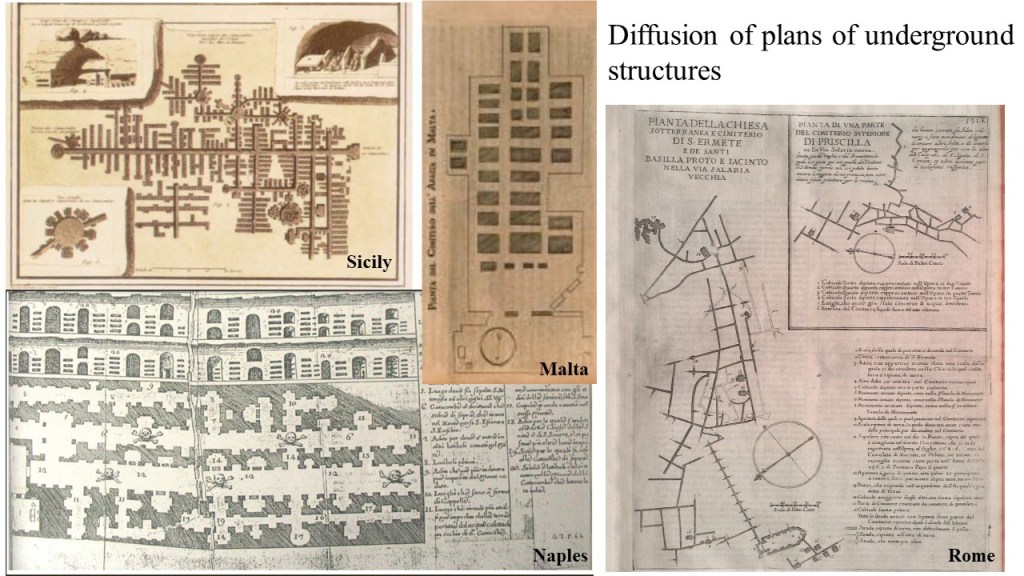
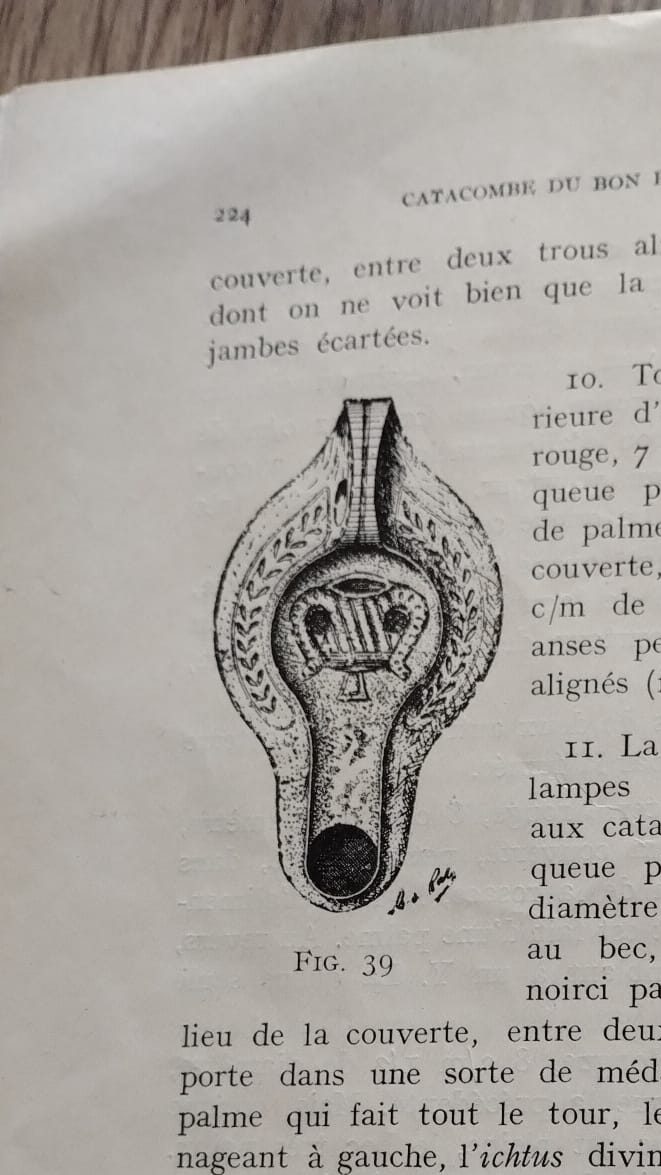
This was the starting point of a compelling story of discovery that, through ups and downs, led the French abbot to recover no less than five catacombs in the Sousse area. This led to a wider knowledge of the Tunisian catacombs from an architectural point of view (with the production of the first maps), and of the materials found, particularly funerary inscriptions and oil lamps.
These excavations brought visitors and tourists interested in Christianity to the ancient Hadrumetum for the first time. This was precisely one of the intentions of the abbot, who is also strongly committed to promoting the site from a touristic point of view.
Leynaud’s work was the first and last systematic excavation of the catacombs of Sousse, which still remain intermittently visitable today and still tend to be little known.
Anyone still interested in this story today will find all the historical and archaeological details in a series of reprints and publications of the seminal volume ‘Les Catacombes Africaines’, still the only real handbook on the catacombs of Sousse.
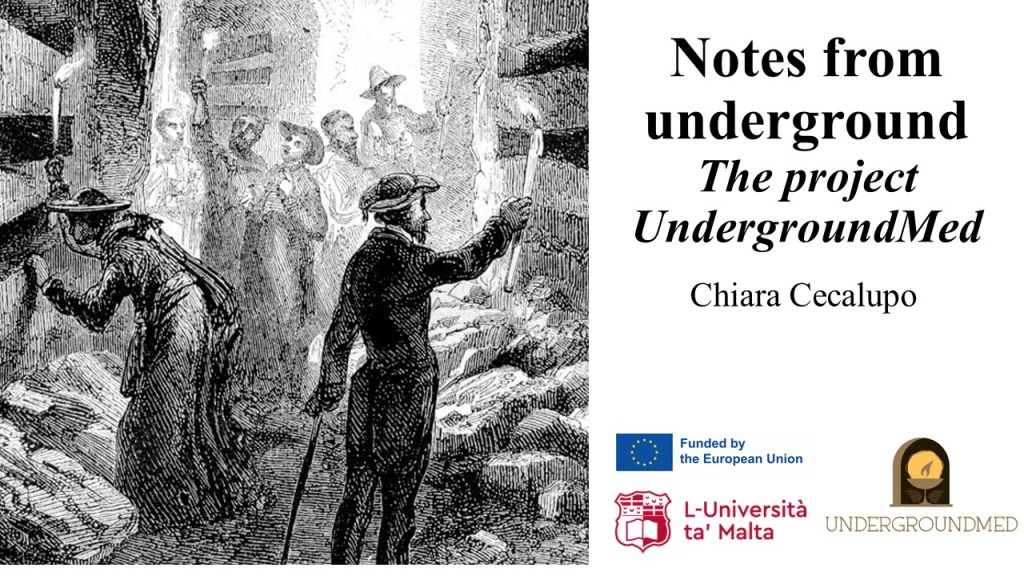
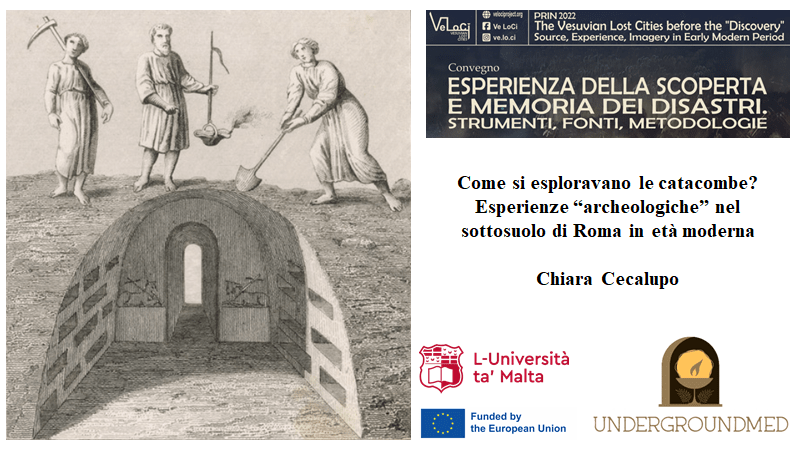
Exploration of Christian catacombs was a widespread and very fashionable practice in Rome between the sixteenth and eighteenth centuries. It involved Roman population, regardless of their social classes, as well as scholarly and ecclesiastical groups from outside Rome, generating a huge wave of interest in Christian catacombs that revolved in a “race” for catacomb exploration.
From a technical point of view, the ways of exploring the catacombs remain the same throughout the centuries. And the problems due to the architecture of the catacombs also remain the same: the darkness, the inconvenience of access, the labrinthic structure. The theme is, therefore, universal and serves a reconstruction of catacomb explorations over the centuries.
An answer to the question “how were the catacombs explored?” was given during an interesting conference in Rome in November 2024 (Here is the link: https://www.velociproject.org/en/events/rome24 )
The catacombs were accessed through random openings in the countryside, or specially dug ones, from which one descended and from which one exited along with the finds recovered underground. It was therefore necessary to make them wider; hoes and spades were used, as well as ladder. To make one’s way through the tunnels without fear of losing one’s way, long ropes were used that were tied to the entrances and then uncoiled as one went along, or one could mark the points at which one turned at each fork in the road. Then of course one had to use flashlights and candles, in such quantities that they could last for days.
Once inside the catacomb, therefore, one proceeded mostly on all fours, or by crawling, or enlarged passages by excavating the tufa.
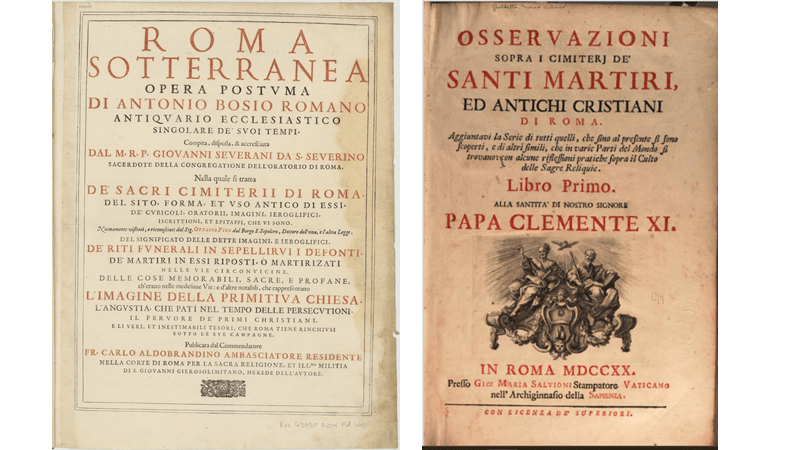
“Roma Sotterranea” (1630) and “Osservazioni sopra i cimiteri de Santi Martiri” (1720) are the main sources of information for this topic.
Then, once inside the catacomb, one would proceed to walk around to find new areas and discover new parts of the monument, especially galleries with closed tombs.
But aside from basic exploration, what was being done in the catacomb? Coming soon…
The “Cubicolo della Velata” (Cubicle of the Veiled Woman) is one of the most famous burial chamber in the catacombs of Rome, known since the 16th century and much loved by all scholars of the past. It is located in the central core of the Catacombs of Priscilla in Rome, and its name derives from the presence of a ‘Veiled’ woman painted in the bottom lunette in a praying attitude. The scenes, dated to the late 3rd century, are interpreted as the important moments in the life of the deceased: her marriage (left), motherhood (right) and her admission among the blessed (in the middle).
It was one of the very first places to be investigated by explorers in the 16th century. In fact, we have two original drawings reproducing the cubicle, preserved inside two important manuscripts in the Vatican Library.
The first, Vat. lat. 10545, f. 187r, dates from around 1590 and was executed by a draughtsman from the circle of the Flemish scholar Philip van Winghe, who is also known for having executed the first extant plans of the Roman catacombs. The style of the copy is very simple and straightforward, almost childlike, but close to the original, a typical feature of copies of catacomb paintings in this manuscript.
The second, Vat. lat. 5409, f. 24r, belongs to the rich set of images of the Roman catacombs in the work of the Spanish Dominican Alonso Chacon, and dates to the late 1590s. The drawing is completely different from the previous one, the original early Christian painting is copied in a very baroque manner, with reminiscences of Michelangelo and a richness that does not belong to the style of the catacomb art. In addition, the inconographic reading is also misinterpreted, creating images of Christ and Mary that do not correspond to the original work.










 Catacombs rediscovery