New book is out!

Finally my latest book is here:
An Archaeologist in Rome at the Service of the Order: Letters from the Hospitaller Grand Master to Antonio Bosio (1604–1629), Routledge: New York and London, 2025.

I wrote my doctoral thesis, about ten years ago now, on Antonio Bosio, a seventeenth-century archaeologist and scholar who, the illegitimate son of a knight, was brought as a child from Malta to Rome and spent his entire life discovering and exploring the catacombs of Rome. The studies on Bosio, and all those that came in connection, have been the important basis on which I built my researcher portfolio and led me to my current job, which I truly love.

At the time when I finally published -in June 2020- the volume based on my doctoral thesis (Antonio Bosio e i primi collezionisti di antichità Cristiane, Piac: Vatican City, 2020), I did not really think it would end there. In fact, when in February 2022 I signed the contract with Routledge for the publication of the Grand Master’s letters to Antonio Bosio, it seemed to me that I was doing exactly what I was supposed to be doing: picking up the theme again but focusing on Antonio’s political life, on his work for the Order of Malta and, at the same time, working on unpublished materials preserved in my place of the heart: the National Library of Malta.

Brief description of the book

This volume is part of “The Military Orders Project” series and provides the original texts of the Grand Masters’ letters to Antonio Bosio in Rome, preserved in the National Library of Malta, together with a biographical study on Antonio Bosio, carried out over the years and now expanded with new information and research.

The volume opens with a historical presentation of the Bosio family within the Order of Malta. This is followed by a complete biographical profile of Antonio Bosio, compiled from the Order’s official sources and from archive documents found in various locations.

A short chapter is then dedicated to the presentation of the various archive collections in which Antonio Bosio’s private documents and autograph manuscripts are found, to offer a complete panorama of Bosio’s figure, although I focussed more on the biographical aspects inherent to the Order and his work at its service.

The core of the volume is obviously the letters of the Grand Masters to Bosio from 1604 to the time of his premature death in September 1629. The letters are presented in a simple transcription of their original form, and then their translation into English.

I believe that the task of this book is to offer a set of sources that will be useful to scholars on the international scene for years to come. The aim is to make public as widely as possible material that is not widely accessible, both in geographical (because it is preserved in Malta and so far not public in digital form) and linguistic terms (with these being handwritten in seventeenth-century Italian).

A general, critical reflection on the letters and the role of the Order’s Agent in the early seventeenth century is then proposed in the final two chapters. Here, the texts and their recurring questions are taken as a starting point for further comments, but above all to present the role and prerogatives of the Agent of the Sacred Religion on the basis of what is revealed in the Bosio epistolary.

Some small mosaics from the catacombs to the museum

Summary of the speech read at the XXXI Aiscom Colloquium

The mosaic heritage in catacombs is very limited and concerns ‘three species of mosaic works’: the floors, the slabs (marble or fictile) closing the tombs decorated with series of tesserae, and finally the wall mosaics decorating the arcosolii or the walls and vaults of the cubiculi. I will not refer to catacomb mosaics in general, but focus on a few cases and their collecting fate.

The history of mosaics in museums for the first centuries of the Modern Age has some shadows. For the 16th century, for example, we have little information on pieces of Roman floor mosaics in collections, but I would like to point out that in Chapter VI of Giorgio Vasari’s Vite, Del modo di fare i pavimenti di commesso, in the chapter on architecture (and not on painting…) he comments on the way Roman mosaics were executed ‘come se ne vede in Parione in Roma, in casa di messer Egidio e Fabio Sasso’. Moving on to the 17th century, in the collection of Cardinal Maximus, there was a ‘Stanza ultima de Musaici’, there was a special room adjoining the library, dedicated precisely to the mosaics in the collection. Even in the library itself, however, there were mosaics.

During the 17th century, coinciding with the extensive underground discoveries, the existence of mosaics in the catacombs was noted, and they too entered collections and the antiquities market.

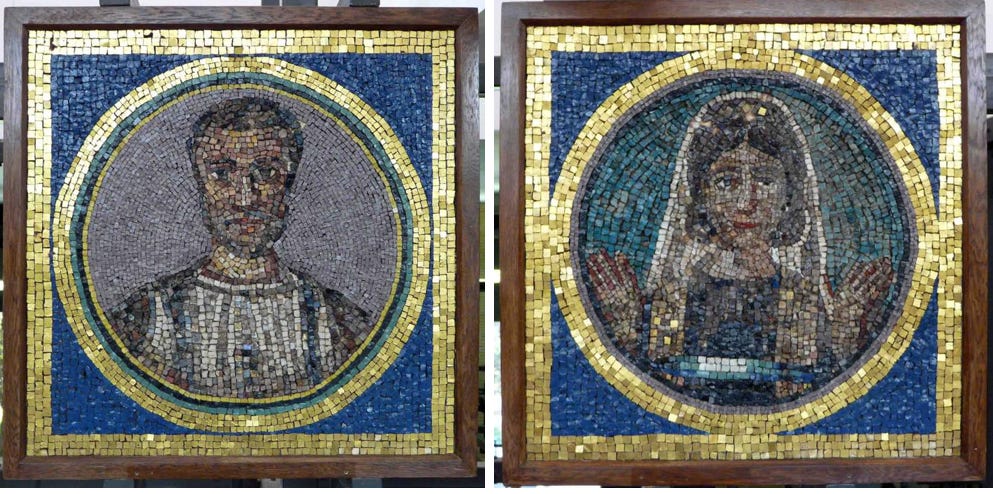
Following a ‘translation of saints’ bones’ in 1656 the mosaic portraits of Flavio Giulio Giuliano and Simplicia Rustica were discovered in the cemetery of Ciriaca, detached between 1656 and 1677 from a tomb with their epigraph and acquired by the collection of Agostino Chigi. They were placed, as was the custom at the time, on the wall in the staircase leading to the Library, according to a design by Pietro da Cortona Chigi and in a pattern not unlike the one we have mentioned for the Massimo collection. An interesting contiguity, therefore, between mosaics and libraries. It was not until 1918 that the mosaics were detached and acquired by the Lateran Christian Museum, where they were again restored.

Catalogue of the Vatican Museums

In the 18th century, the century in which mosaics made their entry into museums and collections, we find several testimonies of mosaics in the catacombs, without precise topographical references, by the Custodian of the Cemeteries Marc’Antonio Boldetti in 1720. He testifies of mosaic decorations on lithic or fictile supports, and is the main source on the topic for that century.

A couple of examples: Boldetti describes a brickwork from the cemetery of Ciriaca, on which there was a monogram between alpha and omega in mosaic tesserae. It is now lost, but at the time it ended in Gaetano Marini’s private collection. I do not think it is a coincidence that a mosaic artefact of this type, i.e. more epigraphic than artistic, aroused the interest of the leading epigrapher of the time, who was also the Vatican Librarian. Secondly, Boldetti draws a direct connection between some mosaics found in the catacombs and the Carpegna Museum: these are mainly ‘several birds and flowers formed on terracotta boards with non-ordinary artifice, and of minute workmanship’, i.e. emblemata, found between the Appia and Ardeatina roads, in particular at Callisto, used as closures for burial niches. All these pieces were later transported to the then Carpegna Museum in the Rione Sant’Eustachio in Rome, of which no further information is available afterwards.

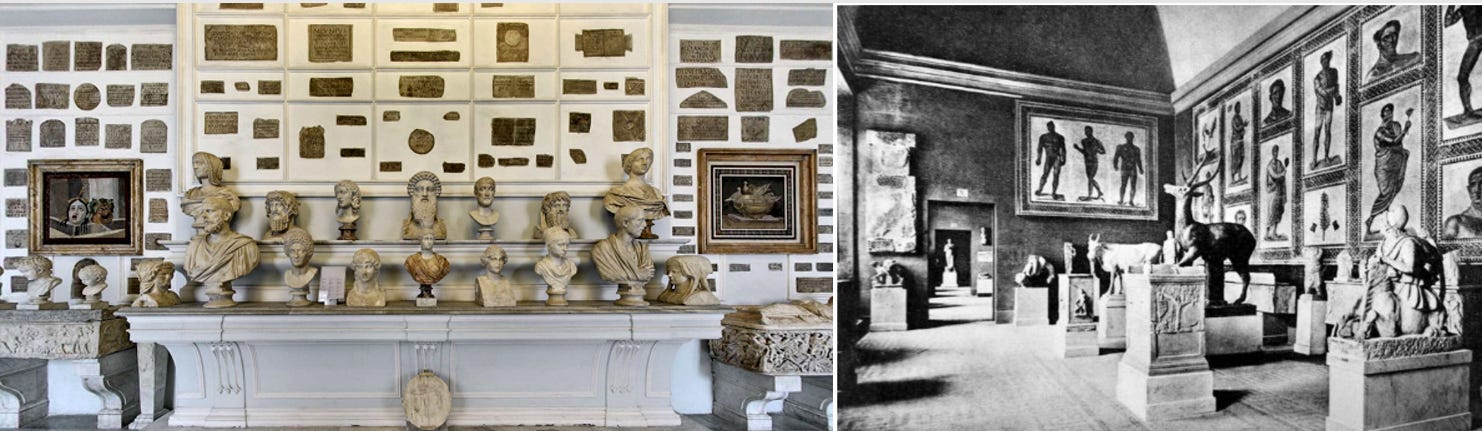
In general, mosaics in collections in the 18th century had to be tear out and cut up to make more artefacts, for immediate placement in an antiquarian market. The 19th century in Rome marked the beginning of massive systematic excavations in the catacombs, the founding of the first institution for the protection of these monuments and above all the opening of a large museum dedicated to them in 1854 at the Lateran Palace, where the discovered mosaics were directly brought. In the Lateran Museum, they are displayed into the wall, following a practice that has been going on for centuries, inaugurated in papal museums by the display of the Dove emblema of Villa Adriana. Indeed, in the Lateran Palace hosted the important museum experiment of displaying the mosaic of the athletes of the Baths of Caracalla, discovered in 1824 and then placed in the museum in 1836, first in an imaginative reconstruction of the floor and then set into the wall, had been developed.

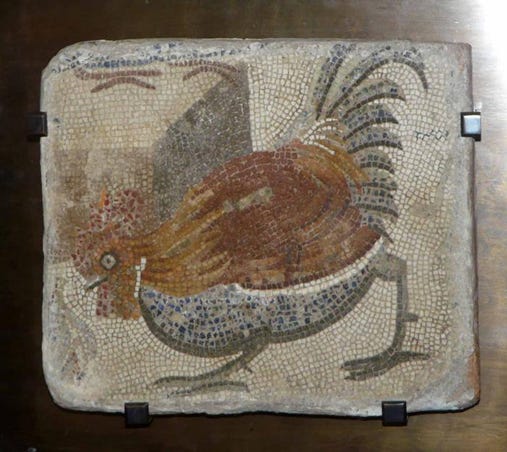
For our theme, an emblematic case is the brick with the mosaic image of a cock, a pavement emblem probably reused to close a niche. It was discovered in 1837 during the works of Virginio Vespignani in the cemetery of Verano, as stated in the sixth volume of Louis Perret’s disputed Catacombes of 1852, which places the mosaic to cover an unspecified martyr’s grave. Upon its discovery, it was sent straight into the Lateran Museum, where it was slightly restored and placed on the wall, in the large gallery of sarcophagi, along with all the other ‘sculptural works’, as noted in the catalogues of the time.

During the 20th century, the museum housed both mosaics previously housed in private collections (as the one in the Chigi Library which passed to the Laternanense Museum and then to the Pio Cristiano in the Vatican) and new discoveries, such as the two fictile slabs decorated with polychrome glass mosaic tiles from the Aproniano catacomb depicting three episodes from the biblical story of Jonah. They were discovered on 1 February 1938, the Pontifical Commission of Sacred Archaeology donated them to the Holy See and they immediately entered the Vatican collections, also becoming part, in 1963, of the new Pius Christian Museum opened in the Vatican after the closure of the Lateran Museum. Perhaps the most linear path in our little story.

Work in progress: map of the project UndergroundMed

Please note that the homepage of the UndergroundMed project now hosts the map of the catacombs, archives and museums under study in the project.

The map is being continuously implemented as the research progresses, and will contain a lot of data and information regarding the rediscovery of catacombs in Italy, Tunisia and Malta between the 16th and 20th centuries.

Why I left Facebook and Twitter as a European researcher

This entry may appear very far from the general aim of this website. But everything we do is a political act, even our silence. A short reflection on why I left Facebook and Twitter.

I opened my Facebook account as soon as I arrived at university (so 17 years ago…), in the first few years I used it a lot, then less and less, until I posted a few scattered photos every three-four month, ending in an absolute silence on 25 April 2024. In 2015, for an event I was attending that involved live tweeting, I opened a twitter page, long forgotten but then used frequently over the last two years, only to become a spectator lately. No instagram, no tik tok.

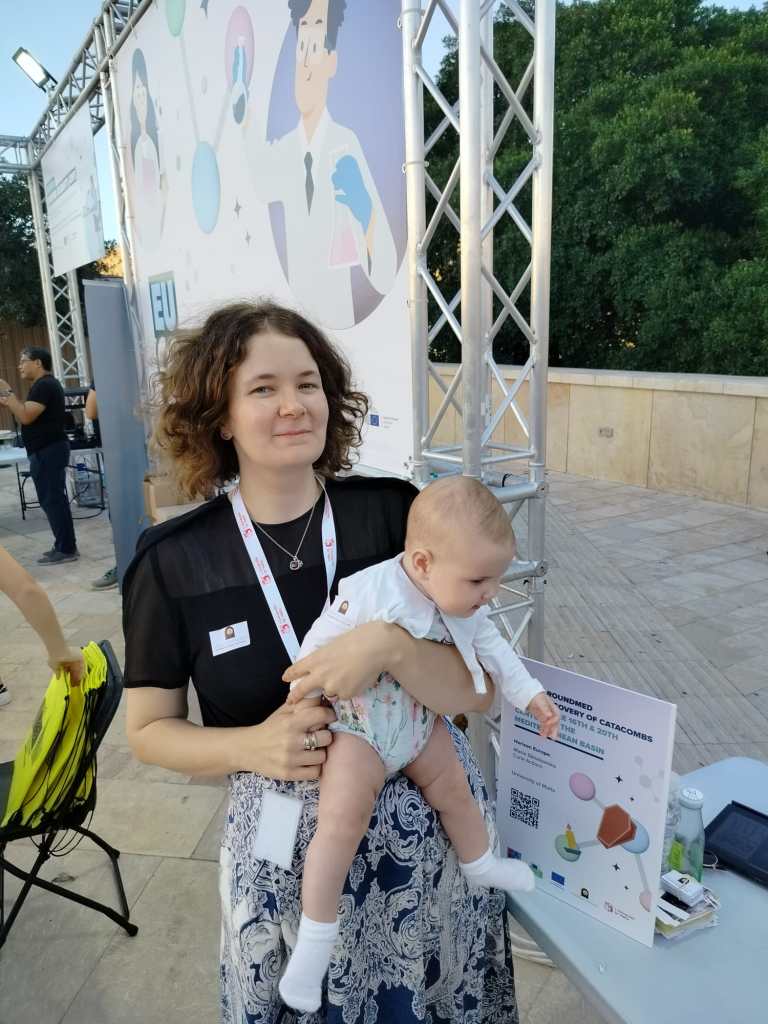
I am a researcher. I am currently on my second research contract: I was in Spain for three years and now I am an happy postdoctoral fellow at the University of Malta. Both these contracts are within a major European university research funding scheme. This means that my salary comes from the taxes of European citizens, and that my work must go back to them, through a continuous work of dissemination of results on various levels. Europe demands this widespread dissemination from us, just as it demands adherence to the inviolable pillars of transparency in work, in practices, in the dissemination of results.

In general, the relationship between academics and social media is definitely interesting. It is undeniable that for many years, ever since the need to democratise the impact of our research became bigger, social platforms have been at the heart of all the projects funded at academic level for the dissemination of results, perceived as the main vehicle for wider reaching.

I have never shied away from this practice, even though it has been very difficult for me: not only have I always struggled to maintain a continuous online presence (which is the key to success, they say), even for this website, but it has undoubtedly been precious time taken away from research work, time spent on activities with no results in terms of quality and visibility. Those few moments of feeble visibility, which happened quite accidentally when I was working in Madrid, were in any case tremendously ephemeral from a quantitative point of view, and totally null for disseminating results, or obtaining feedback of any kind.

However, if I look at my colleagues (those who are on similar career levels) and their social presence, it seems to me that from the academic perspective it is a full illusion to find visibility through social media. The posts we embark on are all the same, according to standards of self-promotion that can also be slightly pathetic: lots of ‘I am thrilled to announce’ for new articles/works/projects published, achieved, funded, etc. that don’t really interest anyone, receive a few dozen interactions and fall at great speed into the oblivion (in fact, it is well known that the life of posts on the main social networks is only a few minutes).

Moreover, the majority of academics on social media actually live between self-promotion and complaining about the funding and recruitment dynamics of our ivory tower. They end up being a group that ultimately becomes self-referential, whose posts do not leave the insiders’ circle (thanks in part to the algorithm), and whose members seek approval more than scientific confrontation or information.

This was what I felt I was trapped into, and also had a hard time staying afloat. And this, then, was the cause of a gradual shift from fatigue to social awareness.

A somewhat clearer view of what social platforms are today was offered to me by Alex Grech’s Young People and Information manifesto, the main source of what appears in the following sections. [Incidentally, it was his very interesting seminar at the University of Malta on Social Media and Academics that gave me the final push to deactivate all accounts].  Grech reminds us how the speed and urgency to publish according to the expectation of the public can compromise the truth by making social media fertile for extremism, discrimination, disturbing content always accessible without control. Technology is no longer that miraculous asset for collective freedom that was imagined years ago, but is increasingly a tool at the economic and political service of those who own, create, can buy and control it.  The Internet is no longer the place for widespread democracy, but that of constant surveillance and commercialisation, under the hegemonic control of those who run the platforms. Everything is monetised, the individual user is a source of information to resell, no longer a citizen with ideas in a community, but an individual who feeds a machine in which interactions and likes are the only indicators of personal success and human value.

Under this control, the algorithm is the main weapon of a political and propaganda technology that manipulates choices, tastes, behaviour, and purchases. The algorithm shapes what we consume and allows the platform to control the flow of information, collecting data opaquely and pushing engagement at the expense of integrity. There is no room for integrity in the parallel post-truth world of these platforms; truth, that is at the very basis of academic research, is no longer needed and outdated. Disinformation and misinformation are therefore not limited problems that can be solved, but symptoms of a broader social condition.

The last straw in this bleak panorama was for me how the big tech stars flocked to salute the new US president, which exacerbated the moral issue arose with deepening the problems mentioned so far. The reflexive relationship between technology (read: billionaire giants that own the platforms) and society in its political expression makes these issues now public and necessary, and not limited to the sphere of what happens online: fake news, control and the dissemination of propaganda for hegemonic purposes have now entered our society, our homes, from the screen we all carry in our pockets.

An example of this is Musk’s new habit of commenting European politics; a billionaire who uses his voice to spread opinions favourable to the far-right and thus against the truest core of the institutions to which I belong (i.e. the EU). And he speaks using a very powerful platform, which contributes to the political polarisation of ideas, the amplification of propaganda and disinformation at the expense of user privacy and truth.

Here, then, is what we feed with every single post. And as if that were not enough, user-generated content (and thus generated by researchers too) plays a key role not only in enriching these plutocrats with fascist sympathies, but in feeding to those AI content generators of which we are only now beginning to understand the danger to university teaching and research.

This is against my innermost being as a person, as a citizen, as a mother and as a researcher. Indeed, to leave social media and give up even my mere presence as a spectator is for me a political act that I do precisely from my being a researcher. Research can and today must transcend this slavery, in the name of freedom of thought, of speech, and of choice of where and how to communicate. By maintaining our online presence only on our websites, perhaps the future of communication and the dissemination of the results of European projects can be precisely that of going back to the people, without a screen: a conference, a meeting, a guided tour, a fair, the often manage to gather a larger number of people than a single self-promotional post, adding the human factor, the physical involvement, the creation of direct links.

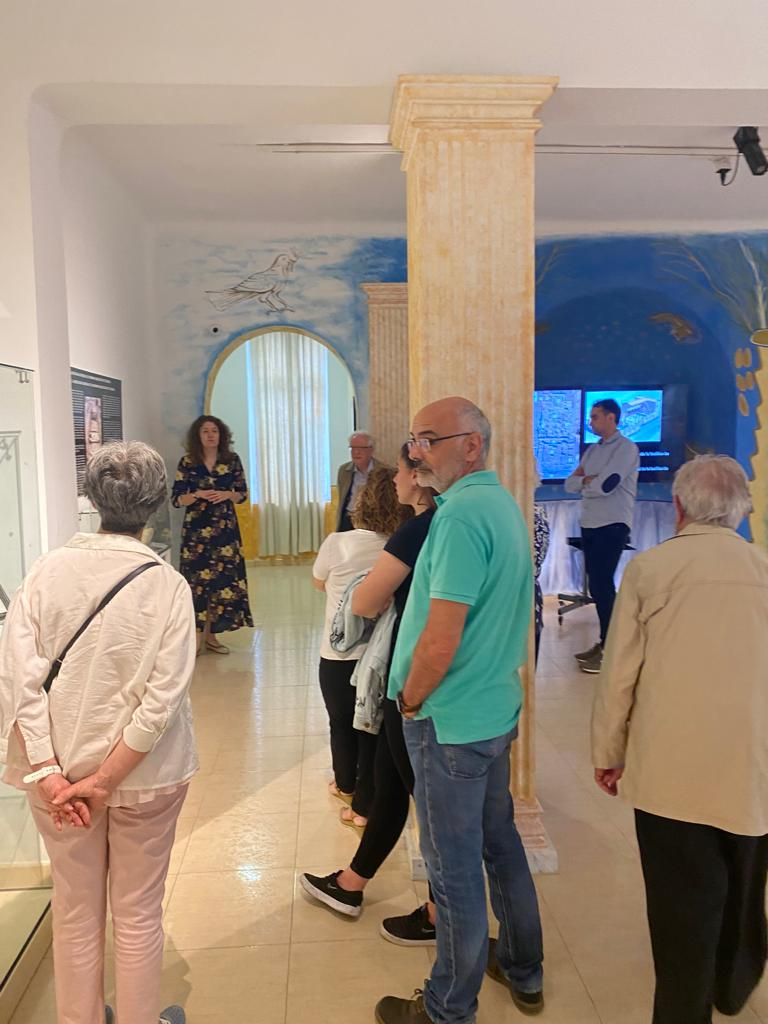
Technical meeting for the future of the necropolis of Tarragona and its museum

On the 30th June 2023 I joined the technical meeting on the future of the necropolis of Tarragona in the year of the 100th anniversary of its discovery, organised by the director of the National Archaeological Museum of Tarragona.

The necropolis has awarded seven million euros from the EU Next Generation funds, in the fSpanish “Plan de Recuperación, Transformación y Resiliencia” for its restoration and reopening. In light of this news, a panel of interdisciplinary professionals and the heads of the cultural organisations of the city of Tarragona (full programme here) got together to ask ourselves:
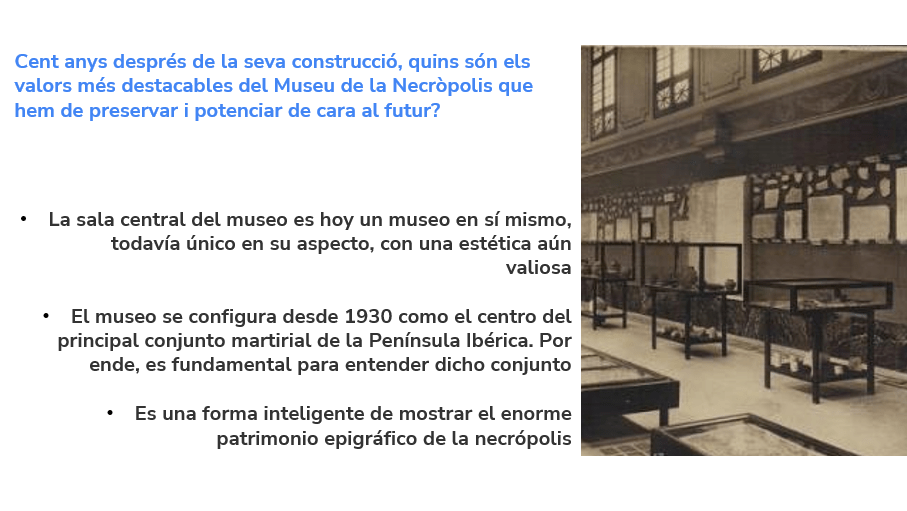
One hundred years after its discovery, what are the most outstanding values of Necropolis that we must preserve for the future? And what needs to be done to transmit and enhance these values?

My role wwas to provide answers under the museologial point of view. In a full morning of work I presented some results of the study carried out during my secondment in 2022 (more info here). the answers are about to be developed more deeply in a pubblication, but this is the core of my presentation:

The day aimed to exchange points of view, offer a dialogue and reflection on this site and was open to the public, both in a presencial format and online, and is fully available online:

The exhibition closes

On 3 June we closed the exhibition «Los orígenes de la arqueología cristiana de Tarragona y la figura del Dr. Pere Batlle Huguet (1907-1990)»  at the Museo Biblico in Tarragona. it was organised as part of the dissemination programme of the Conex-Plus project LIT! with the collaboration of many local and international institutions (as explained here).

This month has been very busy, the museum has been open and the entrance free of charge, offering lectures of various kinds and guided tours of the exhibition, to which the citizens have responded very well. The events were always very crowded and heartfelt: many friends, relatives and acquaintances of Pere Battle accompanied us in these activities and shared their memories and photographs with us.

The exhibition therefore closes with the certainty of having left something in our visitors and having learned from them, created connections between institutions and helped to enhance the heritage of the city of Tarragona.

«Los orígenes de la arqueología cristiana de Tarragona y la figura del Dr. Pere Batlle Huguet (1907-1990)».

The exhibition «Los orígenes de la arqueología cristiana de Tarragona y la figura del Dr. Pere Batlle Huguet (1907-1990)» is intended as a tribute to Dr. Pere Batlle, an important figure for the protection of the archaeological and artistic heritage of the city of Tarragona, who wrote the first scientific work on the Christian epigraphs of the Roman-Christian necropolis of Tarragona.

It is also an opportunity to deepen and disseminate some important findings about his person and his work and finally to transfer knowledge about the genesis of Christian archaeology in Tarragona.

The exhibition is part of the UC3M Conex Plus project “LIT! Living in the catacombs! Reception of catacomb art in European culture and architecture between the 19th and 20th century”. It was born from an idea of Chiara Cecalupo and the director of the Museum Andreu Muñoz, with the cooperation of their collaborators, but also from the contribution of the Historical Archive of the Archdiocese of Tarragona and the Library of the Pontifical Seminary, in particular the director Enric Mateu. Other entities such as the Catalan Institute of Classical Archaeology and Tarraco Viva, the Roman Festival of Tarragona, as well as the Pontifical Institute of Christian Archaeology of Rome also played an important role. This harmony of local and international collaboration has therefore been a good opportunity to create a link between people and institutions that enhances Tarragona, its heritage and history, and which hopefully will continue in the future in other activities and with the same spirit.

The exhibition is structured in the following sections:
1. Christian archaeology and the first art of the universal Church.
2. Christian archaeological heritage of Tarraco.
3. Christian archaeology in Catalonia between the 19th and 20th centuries.
4. Dr. Pere Batlle Huguet. His training and research in Christian archaeology and epigraphy.
5. Safeguarding the heritage of Tarragona.

The exhibition is located in the Biblical Museum of Tarragona, specifically in the room dedicated to the early Christian world (Mn. Joan Magí room). The exhibition contents are projected through a set of explanatory posters accompanied by archaeological objects, photographs and documents.

The exhibition has been scheduled to run from 10 May to 3 June 2023 and the planned activities are set out below:

10 May, 7 p.m.: Opening act and lecture: “The origins of Christian archaeology in Tarragona and the figure of Dr. Pere Batlle Huguet (1907-1990)”, by Dr. Chiara Cecalupo (UC3M). Auditorium of the Museo Bíblico Tarraconense.

18 May, 7 p.m.: Lecture: “The Cathedral of Tarragona: Contributions to the Christian archaeology of the city” by Dr. Josep M. Macias Solé (ICAC). Auditorium of the Biblical Museum of Tarragona.

20 May: Guided tours of the area of the latest archaeological work in the cloister of Tarragona Cathedral. By the archaeologists Josep M. Macias Solé (ICAC), Andreu Muñoz Melgar (MDT/ICAC) and Andreu Muñoz Virgili (ICAC).

Saturday 27th May (11 a.m.), Wednesday 31st May (5 p.m.), Saturday 3rd May (11 a.m.). Guided visits to the exhibition by Dr. Chiara Cecalupo (UC3M). The visits are free of charge and without prior reservation.

More info at museu.biblic@arquebisbattarragona.cat

A video (in Catalan and Spanish) of the opening and the exhibition:

The catalogue of the exhibition is in open access for free downloading:

Credits:

Scientific Committee of the exhibition:
Chiara Cecalupo (Universidad Carlos III de Madrid)
Josep M. Macias Solé (Instituto Catalán de Arqueología Clásica)
Enric Mateu Usach (Archivo Histórico Archidiocesano de Tarragona y Biblioteca del Seminario)
Andreu Muñoz Melgar (Museos Diocesanos de Tarragona / Instituto Superior de Ciencias
Religiosas San Fructuoso)
Míriam Ramon Mas (Museos Diocesanos de Tarragona)
Stefan Heid (Pontificio Istituto di Archeologia Cristiana, Roma)
Immaculada Teixell Navarro (Asociación Cultural San Fructuoso)
Exhibition curators:
Chiara Cecalupo (Universidad Carlos III Madrid)
Míriam Ramon Mas (Museos Diocesanos de Tarragona)
Texts:
Chiara Cecalupo y Andreu Muñoz Melgar
Production and assembly:
Josep M. Brull Alabart, Magda Domènech Jordà, Rosa Ferré Rovira, Roser Fornell Guasch, Josefina Folch Sabaté, Josepa Franquès Bultó, Joaquim Galià Romaní, Sergi Guardiola Martínez, Dolors Iglesias Torrellas, Joan Quijada Bosch, Neus Sánchez Pié, Paco Roca Simón, Jordi-Lluís Rovira Canyelles, Adolf Quetcuti Carceller y Andreu Ximenis Rovira.
Audiovisual:
«La Tarraco de los primeros cristianos», Asociación Cultural San Fructuoso
Acknowledgements:
Asociación Cultural San Fructuoso
Museo Nacional Arqueológico de Tarragona
Real Sociedad Arqueológica de Tarragona
Jordi López Vilar

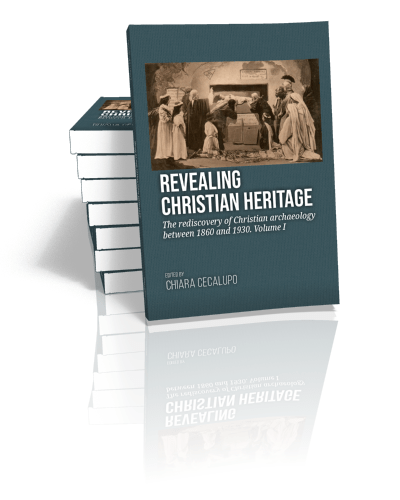
The book is out!

REVEALING CHRISTIAN HERITAGE

The rediscovery of Christian archaeology between 1860 and 1930. Volume I

This book is first product of the international online workshop series “Revealing Christian Heritage. Talks on the rediscovery of Christian archaeology between 1860-1930”. It collects different case studies of rediscovery of Christian antiquities between 1860-1930 in Europe and the Mediterranean basin, in order to stimulate reflections about the impact of these rediscoveries on our culture in a period of great political transition.

By turning the light on lesser-known stories on a wider European and Mediterranean horizon (Greece, Holy Land, Eritrea, Malta, Norway), this book gives a strong contribution to the history of Christian archaeology. All articles deal with many topics of the field (museology, cultural heritage protection law, history of religious orders, field archaeology, military explorations), and therefore offer a strong interdisciplinary cut.

You can buy it or read it online for free at https://www.sidestone.com/books/revealing-christian-heritage

The proceedings of the Volume 2: “Revealing Christian Heritage – Spain edition” are in preparation…stay tuned!

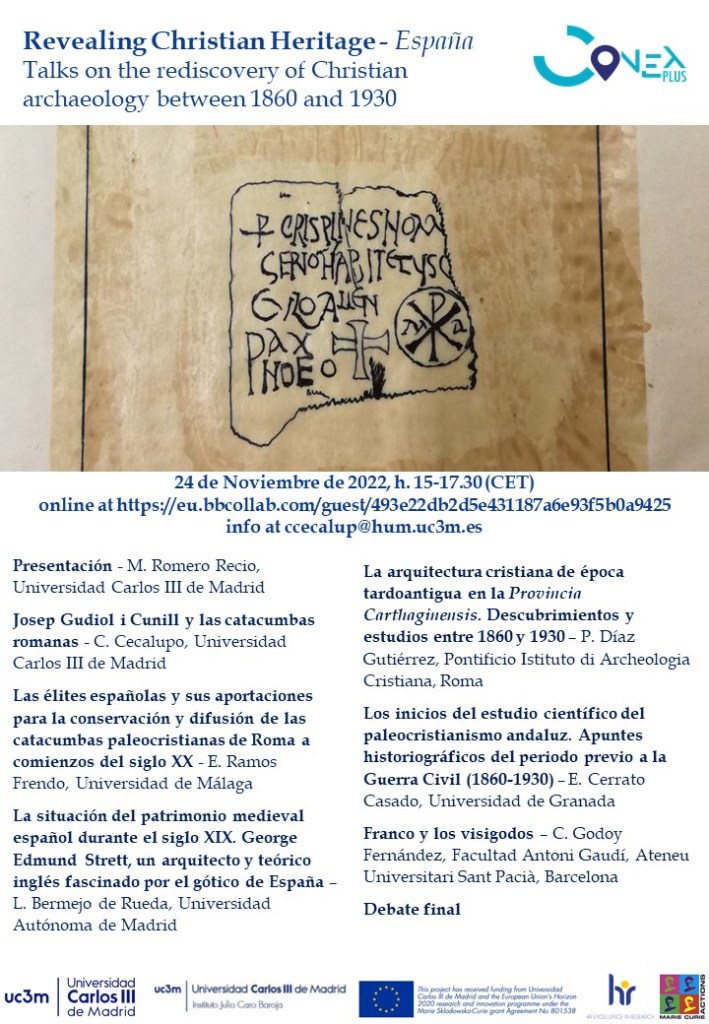
Second talk “Revealing Christian Heritage” – Spain edition

Among the dissemination activities of the Conex-Plus Project LIT!, we will celebrate the second talk of the series “Revealing Christian Heritage – Talks on the rediscovery of Christian archaeology between 1860 and 1930”. This year, the workshop will focus on the rediscovery of Christian antiquity in Spain in late 19th-early 20th century.

The first talk took place in September 2021 (more info here and here) and the publication of the proceedings will be announced soon.

Meanwhile, join us for the second talk on November 24th, at 15 CEST at https://eu.bbcollab.com/guest/493e22db2d5e431187a6e93f5b0a9425

The abstract book is available here: