One of the aims of this website is also to keep an eye on other projects and research on the history of collections of Christian archaeology in Europe.
In this case we would like to point out the call for contribution to the website of the project God’s Collections by Crispin Paine and Jessica Hughes.
The project God’s Collections studies how and why collections have developed and lived inside places of worship of all traditions and chronology: check it out here.
Given the proximity of the themes of this work to the LIT! project, we hope to be able to undertake a future collaboration soon!
For a few weeks now, everyone can surf on Open Research Europe, the European Union’s revolutionary open access platform, that allows researchers in the Horizon 2020 programme to publish their research in accordance with the FAIR principles (Findability, Accessibility, Interoperability, and Reuse) and without being subject to the often very long publishing times.
Once the article has passed the prepublication checks, the preprint version is published within 10 days, enabling immediate viewing and citation. Expert reviewers are selected and invited, and their reviews and names are published alongside the article, together with the authors’ responses and comments from registered users. Articles that pass peer review are sent to major indexing databases and repositories. More info here.
Some of the results of the LIT! project will be surely disseminated via Open Research Europe in the following months. For now, however, I would love to share two researches of similar topics already published on the portal.
It is therefore clear that the platform can be used as an important tool for studies in the history of Christian archaeology. We will keep on checking and disseminating future publications on this topic!
In the annals of the pontificate of Gregory XIII (1572-1585), we read of the discovery -on the 31st of May 1578– of the anonymous catacomb in the Via Anapo, then identified with the cemetery of Priscilla:
“Around the same time, outside Porta Salaria, in the excavation of the Pozzolana, the famous Cimiterio di Priscilla, lost since the time of the Goths, was unexpectedly found surrounded by various burials of the Holy Martyrs with inscriptions in different languages. The Pope sent Cardinal Savelli, his Vicar, to certify everything, and many others went there to see the antiquity. Among other things considered worthy of the memory by the French Ambassador Luigi Castegnero, and Marc Antonio Moretto, both men of great learning, was the sepulchre of Leonidas, Father of Origen, deceased more than one thousand three hundred years ago, was recognised“. (Vatican Library, Vat. lat. 12214, Annali di Gregorio XIII, libro VII, tomo II, f. 66).
Even we cannot speak of a true discovery of Christian antiquities (see here for more information), the historical and social importance of this event lies in the fact that it reawakened interest in Christian antiquities among large sections of the population: the crowd in the Vineyard was so large that Pope Gregory XIII was forced to close the gates. Equally important is the influence of this discovery on the scholars of the time, that generation of scholars who found themselves moving from theory to practical knowledge of Christian cemeteries in a very short space of time. It is to some of them (in particular the Spaniard Alfoncso Chacón – see here) that we owe the copies of the paintings in the catacomb of via Anapo, which are now unfortunately lost.
J. G. Deckers, G. Mietke, A. Weiland, Die Katakombe“Anonima di via Anapo” Repertorium der Malereien , Città del Vaticano 1991.
V. Fiocchi Nicolai, Storia e topografia della catacomba anonima di via Anapo, in J. G. Deckers, G. Mietke, A. Weiland, Die Katakombe“Anonima di via Anapo” Repertorium der Malereien , Città del Vaticano 1991, pp. 1-23.
M. Ghilardi, Le catacombe di Roma dal Medioevo alla Roma sotterranea di Antonio Bosio, in Studi Romani, 40, 2001, pp. 27–56.
C. Cecalupo, Gregorio XIII e la nascita dell’archeologia cristiana: dal cantiere di San Pietro alla riscoperta delle catacombe, in V. Balzarotti, B. Hermanin (eds.), Gregorio XIII. Arte dei moderni e immagini venerabili nei cantieri della nuova ecclesia, Rome, forthcoming.
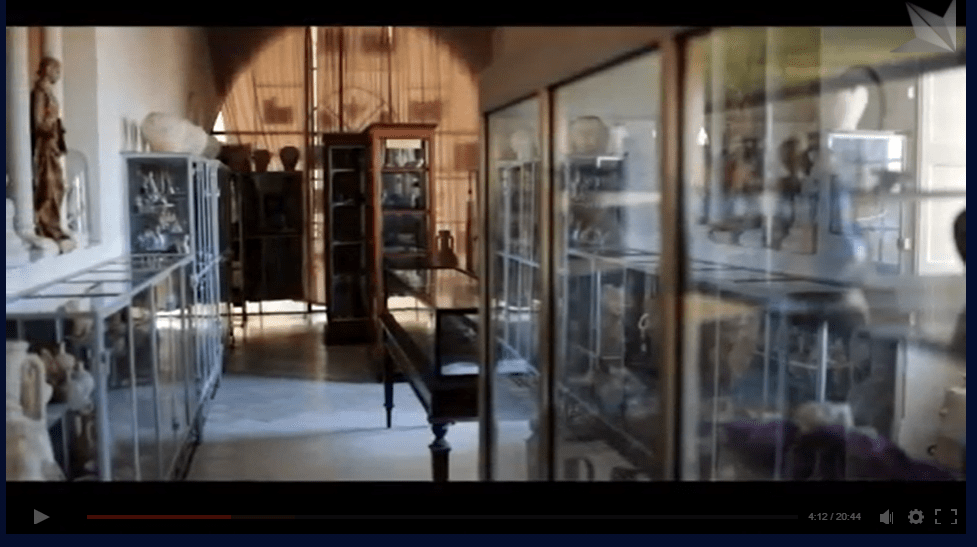
We are very happy to share the episode on the museum of the Complex of St. Agatha (Rabat, Malta) of the documentary “Il-Kollezzjonist”, created and presented by Raymond Saliba (a contribution to this site by Raymond can be read here).
The whole episode is available here. It is in Maltese language, but the images of the collection are pure bliss!
Congratulations to our friend Raymond for this beautiful episode.
Il-Kollezzjonist (The Collector) is a series of short documentaries that take the audience on a journey to explore some of the most beautiful private collections in the Maltese and Gozitan islands. It is presented by Raymond Saliba and Sharp Shoot Media Ltd. Il-Kollezzjonist started on the 30th December 2020, and is on air every Wednesday at 6.30pm on Television Malta. Follow the programme here.
The first part of the project was obviously dedicated to the start of the action and to the preliminary bibliographical study (identified as Work Package 2). The first three months, in fact, were dedicated to the bibliographical investigation and collection of all edited materials (from the late 19th century to the present). Every publication regarding the topic has been collected, in particular those related to the copies of the catacombs paintings set up in 1852 in the Lateran Christian Museum in Rome. This can be seen as the starting point of the artistic trend the project investigates. This research phase created the basis for the more detailed studies in the following months.
In fact, two months ago we moved on to the phase of analytical study of the individual cases (identified as Work Package 3). This involves collecting and analysing the already known cases and identified buildings. Given the period and the restrictions on mobility, the archival research has been concentrated in reduced periods of time, and documents has been read online aas well, while on-person surveys and documentation of the buildings have been postponed to the coming months.
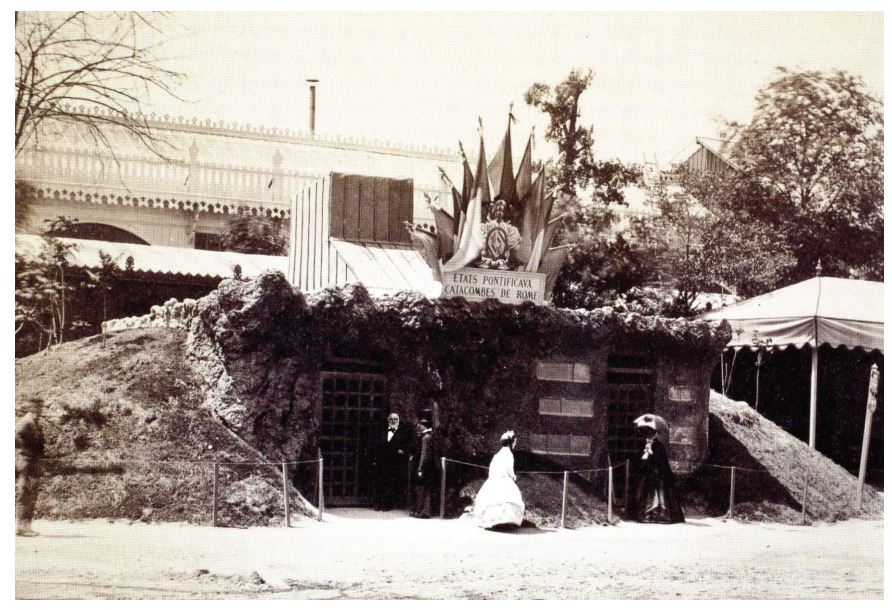
For now, the main case that was analyses is the facsimile catacomb, which had been sent to the 1867 Universal Exposition in Paris by Pope Pius IX. The research has led to a number of unpublished findings which will soon be made available both in specialist journals (but in Green Open Access) and on this website.
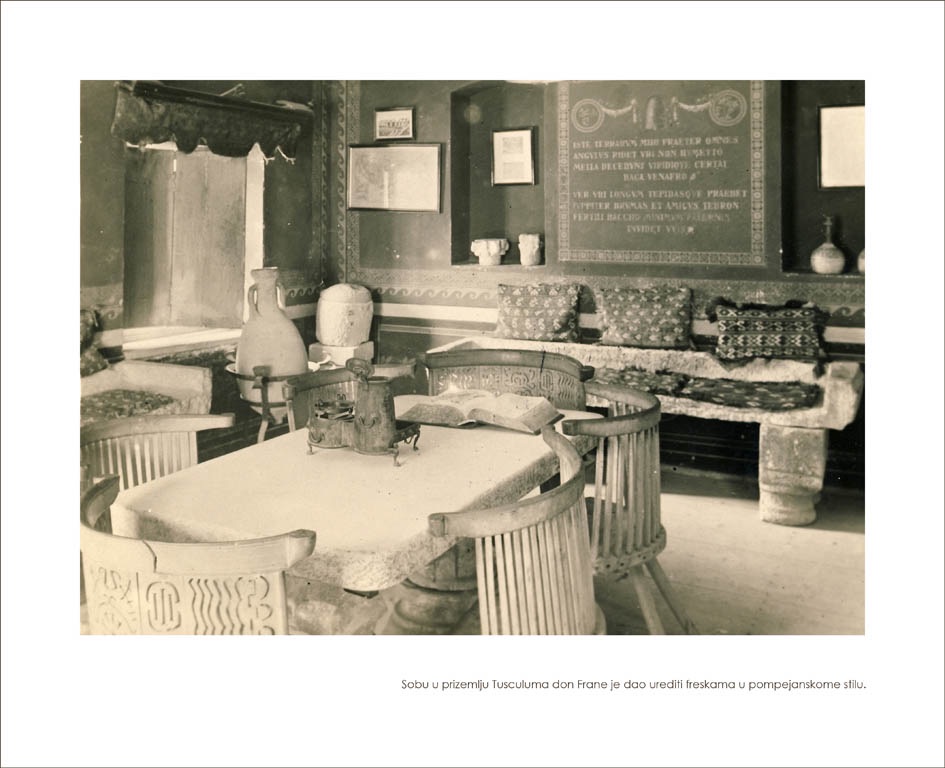
The next case to study is the museum of Tusculum (Solin -Croatia), set up by the great Dalmatian archaeologist Frane Bulic in 1898, decorated in catacomb and Pompeian style. The political and cultural implications of this operation are manifold, and the links with other European scholars of the time very stimulating. Similarly, working in an unfamiliar linguistic context has allowed us to make contact with local scholars who will certainly participate in the publication of the results. This, too, will thus create an important network of international contacts.
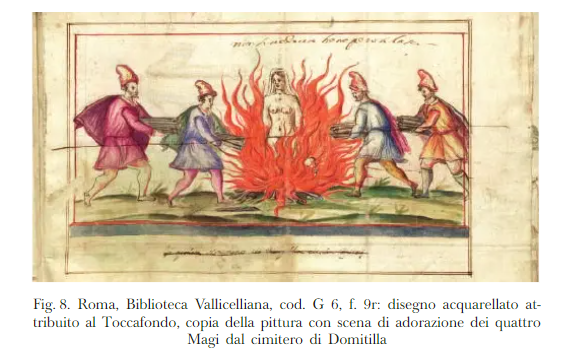
In order to continue on analysing the topic of visual sources for the exploration of the Roman catacombs in the 16th century, we present today the manuscript G6, kept in the Vallicelliana Library in Rome.
This is an archival unit of extraordinary importance, which remains unpublished to this day. It consists of 25 sheets, mostly drawn on both sides, and contains late 16th- and early 17th-century copies of some of the paintings in the catacombs of Rome (in particular from those of Domitilla and the Appian Way district), intended for reproduction in Antonio Bosio’s Roma Sotterranea. In addition to these, there are some sheets added later at the time of binding, but evidently of property of Bosio and his editor Giovanni Severano: among these, there is a pen sketch of the full decoration of the so-called niche of the Virgin in the Catacomb of Priscilla, with notes by Severano, discussed here.
(From C. Cecalupo, Giovanni Severano da Sanseverino prete dell’Oratorio e le catacombe romane, in Rivista di Archeologia Cristiana, 95, 2019)
These reproductions in watercolour of some of the paintings of the catacombs were evidently commissioned by Bosio to derive copper basis for the engravings, with the aim of illustrating his Roma Sotterranea. Its structure is not easy to understand and little can be said about the identity of the artists/copyists, who evidently worked in the catacombs without the direct supervision of Bosio. Among the authors, the famous copyists of Bosio are currently considered plausible, Giovanni Angelo Santini (better known as Toccafondo) and Sante Avanzini (for the both of them, more information can be found here).
(From M. Ghilardi, I copisti della Roma sotterranea nel primo Seicento. Nuovi dati da ricerche d’archivio, in ATTI DELLA PONTIFICIA ACCADEMIA ROMANA DI ARCHEOLOGIA (SERIE III) RENDICONTI, LXXXVII, 2015)
One of the strengths of the Conex-Plus LIT! project is its remarkable internationality, which allows the phenomenon of facsimile catacombs to be studied on a European scale. This study, which began only five months ago, has already made possible to establish connections with scholars from other countries.
In particular, during the preliminary study of the Memory Room at the Tusculum Museum in Solin (Croatia), we came into contact with Ana Vrdoljak, the restorer who was responsible for the reconstruction of the original catacomb environment in 1896. While we wait to publish new information about Tusculum, we are happy to share Ana’s website and the page where she presents her work in Solin!
In the process of historical reconstruction of the discoveries of the Roman catacombs between the sixteenth and nineteenth centuries, the available sources are many and of very different types.
It is actually very convenient to know some alternative textual sources which are useful for a correct historical reconstruction of the events. Among these are obviously newspapers, which report the news ‘in real time’ and with exact dates. In the contemporary press, one can find various references to the discoveries of the catacombs, especially in Rome, accompanied by numerous social and cultural information.
The Diario Ordinario -also known as “Chracas” after the family that printed it, and from 1808 as Diario di Roma- was a periodical newsletter printed in Rome from 1716 to 1848. It was published weekly or bi-weekly, usually on Saturdays. The first part of each issue contained all the main news of the city of Rome, especially concerning papal engagements; the second part offered news from correspondents in the main European cities.
The Diario Ordinario is full of detailed information about events in the city of Rome, and it is not uncommon to find references to discoveries made in the catacombs. In particular, it is very useful for tracing extractions of bodies or relics and similar events with both historical-archaeological and religious implications.
Such an interesting and useful source is actually long in consultation. The complete series is available to scholars in the Sala Stampati of the Vatican Library and, recently, in a new online version on the website of the Biblioteca Casanatense in Rome, at this link.
Here is a small sample of how information about the catacombs of Rome can be found in a volume of the Diario Ordinario:
***We are happy to share a biographical remembrance of Brother Victor Camilleri and his work on the enhancement of the catacombs of St. Agatha in Rabat (Malta), written by our friend Raymond Saliba (Cathedral Museum, Mdina). Thank you Raymond! Follow Raymond’s work at http://www.facebook.com/kollezzjonist/
Rev. Victor Camilleri was the pioneer in making the historic complex of Saint Agatha in Rabat (Malta), what it is today. Born in Senglea on October 13, 1933, he entered the Missionary Society of St. Paul (MSSP) at a young age and became a priest on April 2, 1960. He passed away on the 15th of December, 2011.
The St. Agatha complex is located on the outskirts of the old capital city, where we find the largest amount of catacombs on the Maltese islands. Along with the Pauline catacomb complex, St. Agatha’s offers a kaleidoscopic of pagan; Christian, and Jewish hypogeous, along with a unique underground chapel that included an altar decorated with paleochristian frescos. This historic complex is made up of the church and crypt of St. Agatha; the convent and motherhouse of the MSSP; the SPCM collage; St. Agatha’s Museum and many underground cemeteries.
Fr. Camilleri, who from an early age was interested in local history, find much to be drawn to when he joined the religious community at St. Agatha’s, particularly, archeology. During the time of his formation to the priesthood, together with some of his colleagues, in his spare time, he embarked on the cleaning of several small hypogeous discovered under the convent. Although there has always been part of the catacombs attached to the crypt accessible to the public, most of the underground complex we see today was closed or not even excavated. It was also Fr. Victor who discovered several 5th-century frescos on some Christian tombs.
From 1978 onwards, Fr. Camilleri became part of St. Agatha’s community again. At first, he began to think seriously about setting up a museum to collect and conserve objects that were in the personal collection of Mons. Joseph de Piro, the Society founder, as well as many objects which belong to the church of St. Agatha. In 1985 he assumed the curatorship of both the church and museum after he was already doing tours of the catacombs. The clean-up of small catacombs, which were found under the new SPCM collage, also continued under his direction. Apart from the daily work as a priest and curator, he indulges in the study and writing about this important complex and its treasures. He published four books and numerous articles in local journals and newspapers, and also planned the said complex, which covers some 4,100 square meters.