Rev. Victor Camilleri and St. Agatha’s – by R. Saliba

***We are happy to share a biographical remembrance of Brother Victor Camilleri and his work on the enhancement of the catacombs of St. Agatha in Rabat (Malta), written by our friend Raymond Saliba (Cathedral Museum, Mdina). Thank you Raymond!
Follow Raymond’s work at http://www.facebook.com/kollezzjonist/

Rev. Victor Camilleri was the pioneer in making the historic complex of Saint Agatha in Rabat (Malta), what it is today. Born in Senglea on October 13, 1933, he entered the Missionary Society of St. Paul (MSSP) at a young age and became a priest on April 2, 1960. He passed away on the 15th of December, 2011. 

The St. Agatha complex is located on the outskirts of the old capital city, where we find the largest amount of catacombs on the Maltese islands. Along with the Pauline catacomb complex, St. Agatha’s offers a kaleidoscopic of pagan; Christian, and Jewish hypogeous, along with a unique underground chapel that included an altar decorated with paleochristian frescos. This historic complex is made up of the church and crypt of St. Agatha; the convent and motherhouse of the MSSP; the SPCM collage; St. Agatha’s Museum and many underground cemeteries. 

Fr. Camilleri, who from an early age was interested in local history, find much to be drawn to when he joined the religious community at St. Agatha’s, particularly, archeology. During the time of his formation to the priesthood, together with some of his colleagues, in his spare time, he embarked on the cleaning of several small hypogeous discovered under the convent. Although there has always been part of the catacombs attached to the crypt accessible to the public, most of the underground complex we see today was closed or not even excavated. It was also Fr. Victor who discovered several 5th-century frescos on some Christian tombs. 

From 1978 onwards, Fr. Camilleri became part of St. Agatha’s community again. At first, he began to think seriously about setting up a museum to collect and conserve objects that were in the personal collection of Mons. Joseph de Piro, the Society founder, as well as many objects which belong to the church of St. Agatha. In 1985 he assumed the curatorship of both the church and museum after he was already doing tours of the catacombs. The clean-up of small catacombs, which were found under the new SPCM collage, also continued under his direction. Apart from the daily work as a priest and curator, he indulges in the study and writing about this important complex and its treasures. He published four books and numerous articles in local journals and newspapers, and also planned the said complex, which covers some 4,100 square meters. 

Raymond Saliba

Two essays on Giovanni Severano, explorer of the Christian catacombs in Rome

Among the many personalities involved in the study of the Roman catacombs in the first half of the 17th century, Giovanni Severano (priest of the Oratory of San Filippo Neri) is one of the best known but at the same time least understood.

Recently, some studies have been carried out to re-evaluate his figure. Over the centuries he has in fact been considered only as the editor who completed Antonio Bosio’s Roma Sotterranea, left unfinished at the author’s death in 1629 and published by father Severano only in 1634.
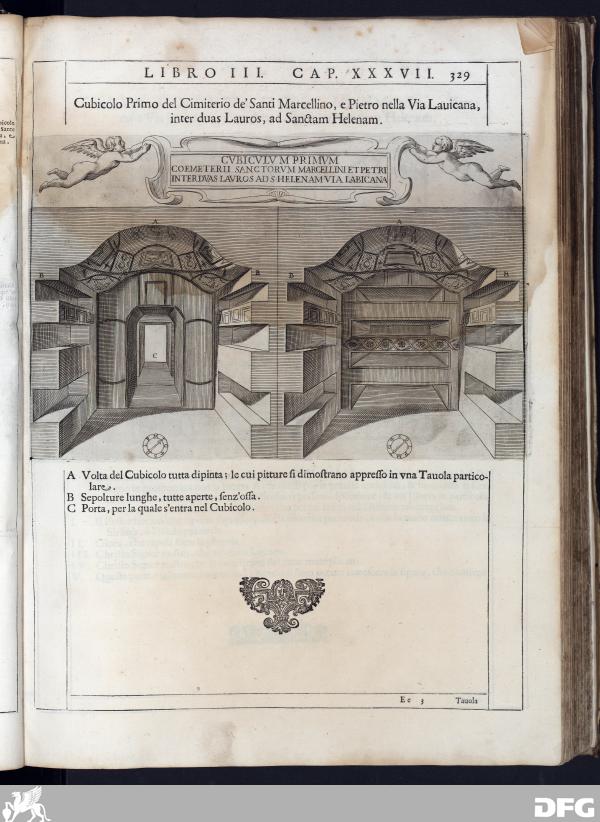
Extensive studies have shown that, in the process of completing Roma Sotterranea, he personally explored many areas of the Roman catacombs to confirm and expand Bosio’s descriptions. For example, there is ample evidence of his explorations of the catacomb of Saints Marcellinus and Peter on the Via Labicana. Here, he explored many areas that had not been recorded by Bosio.

Some traces of his explorations and, in particular, some drawings of Christian antiquities commissioned by Severan can be seen here.

The most up-to-date biography of Giovanni Severano can be found here.

An unknown explorer of the Roman Catacombs in 1596

When recounting the history of the first explorers of the Roman catacombs at the end of the 16th century, the first names that come to mind are those of the great scholars whose discoveries initiated the exploration of Christian antiquities in the first place, for example Alonso Chacòn, Philip van Winghe and, above all, Antonio Bosio, the founder of Christian archaeology and discoverer of the majority of Roman Christian cemeteries. One can assume that in addition to the famous figures, there were others who moved in the same historical-social environment. About these men little is known and many of them have been almost completely forgotten.

There are some sources that provide us with information about these unknown explorers. We have, for example, literary and archival sources, in particular great works such as Antonio Bosio’s Roma Sotterranea, that inform us about the explorations of people about whom we know nothing else.

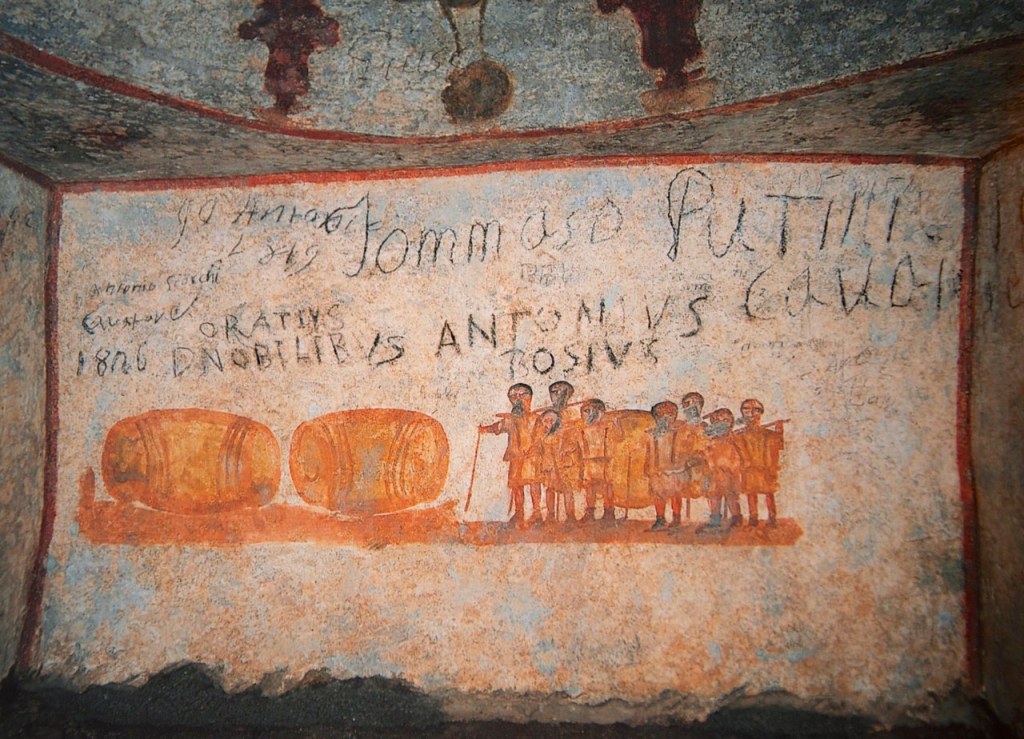
Primary and direct sources, however, are the signatures left by these explorers on the walls of the catacomb galleries.

Signatures of explorers in the Catacomb of Priscilla (ph. from romapedia)

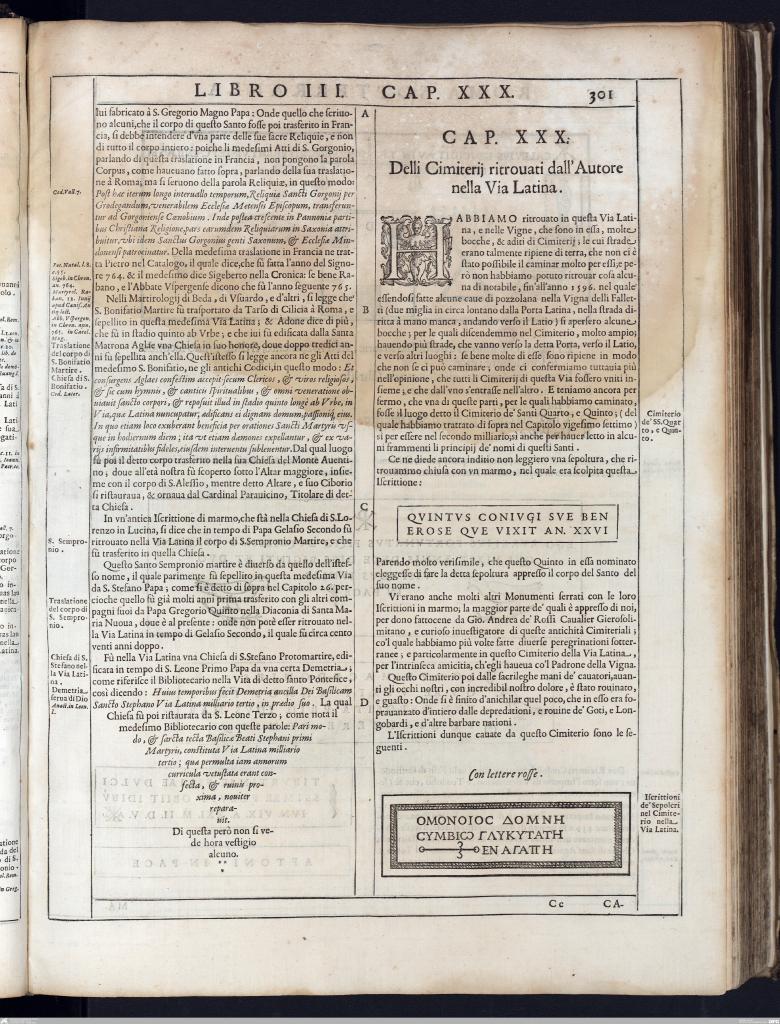
A special personality in this is Giovanni Andrea Rossi, described by Bosio as his colleague in the underground researches.

A. Bosio, Roma Sotterranea, Roma 1632, p. 301

Brother of the very well-known scholar Giano Nicio Eritreo, Giovanni Andrea was born in Rome around 1578. He was a friend of Antonio Bosio and often accompanied him on his catacomb explorations. However, we know with certainty that Giovanni Andrea also explored the catacombs of Rome on his own.

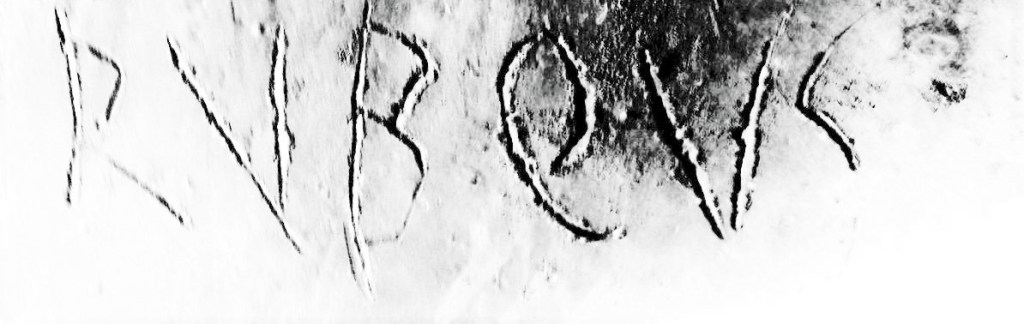
There are valuable proofs of his catacomb visits, and probably many others are to be discovered. These are the signatures (with the latinised version of his name Io. Andreas Rubeus) he left on the walls of the galleries of Priscilla and Domitilla Catacombs.

Drawing and graphic elaboration one of Rossi’s signature

Many of these signatures bear the date 1596, written directly by Giovanni Andrea under his own name. This allows us to date his explorations precisely to a fairly early period. Moreover, some of his signatures are found in areas that were probably not known nor explored by Bosio (such as the cubicle of Lazarus in the catacomb of Priscilla).

This shows us how independent Giovanni Andrea was in his explorations. And without these signatures, we would know almost nothing about him and his activities.

For more information: C. Cecalupo on Römische Quartalschrift 

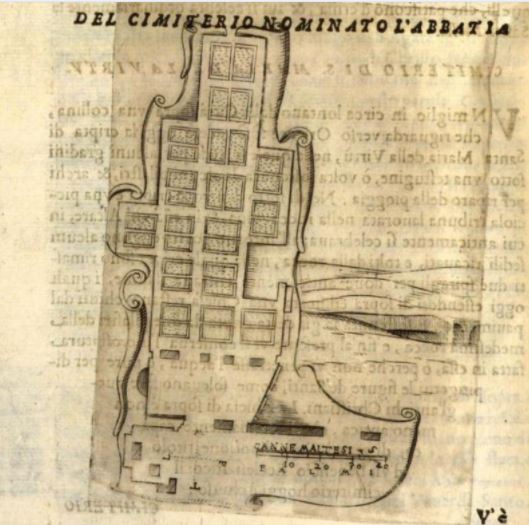
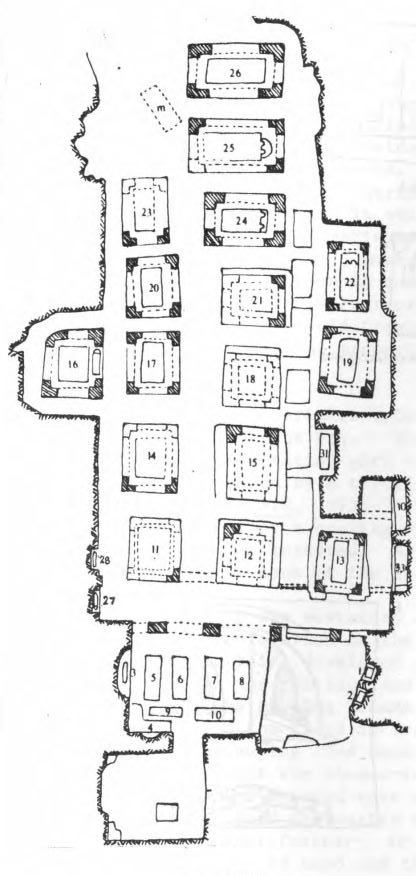
Three historical plans of a famous Maltese catacomb

The rediscovery of Christian catacombs in the Mediterranean can also be a visual story. It is not always possible to find maps and plans of Christian cemeteries, especially dating back to the 16th and 17th centuries: this means that existing plans assume great importance for us. In this small post we propose three plans (from the 17th, 18th and 19th centuries) of one of Malta’s main catacombs, the cemetery of Abbatja tad-Dejr.

The catacomb of Abbatja tad-Dejr is a famous and unfortunate Christian cemetery located in the suburbs of Rabat. It consisted of several hypogea, and was revitalised in the Middle Ages by the establishment of a cult centre used for a long time, at least until late 16th century.

Today, the site is rarely accessible and is only partially preserved. However, visitors can see there important expressions of Maltese catacomb art: monumental baldacchino-tombs, carved and painted arcosolia and ceilings decorated with geometric themes.

The plan of this cemetery is the first to be drawn in the history of Maltese Christian archaeology. It appears in fact, very schematically, in the masterpiece of Giovanni Francesco Abela, the first explorer of the Maltese catacombs, the Della descrittione di Malta isola nel mare Siciliano (Malta 1647), on page 48.

The entire volume can be read here.

Both the plan published by Abela became the most famous visual description of Christian sites of Malta in Europe. A reproduction of that image can also be found in Marcantonio Boldetti’s Osservazioni sopra i cimiteri de’santi martiri ed antichi christiani di Roma (Rome 1720, page 633), that is the main work on Mediterranean Christian cemeteries of the 17th century.

The full volume can be read here.

Antonio Annetto Caruana’s more extensive investigations at the end of the 19th century allowed this important Maltese author to offer a beautiful monochrome watercolour plan, of both archaeological and artistic value.

The full volume can be read here.

And today? Today the cemetery is largely unchanged, as can be seen in the 1986 plan published in Mario Buhagiar, Late Roman and Byzantine catacombs and related burial places in the Maltese islands (Oxford 1986, page 203).

What the visitor can walk through today is, therefore, the same site seen in the early 17th century by Abela.

For more information and visits, you can contact Heritage Malta.

For a basic bibliography on the cemetery: M. Buhagiar, The Christianisation of Malta. Catacombs, cult centres and churches in Malta to 1530, Oxford 2007 (BAR Int. Series, 1674)

Why this site

After many years of archaeological, historical and archival research on the rediscovery of catacombs in the central Mediterranean, this site was created by the authors to offer a virtual and international space for the dissemination of ideas and results on this topic.

We want to make available to as many people as possible the interdisciplinary results of the Koinè Mediterranea project, the studies of individual members and many other news and resources on the subject.

To get in touch with us, for suggestions and collaborations:

← Precedente

Grazie per la risposta. ✨