Rediscovering Agatha

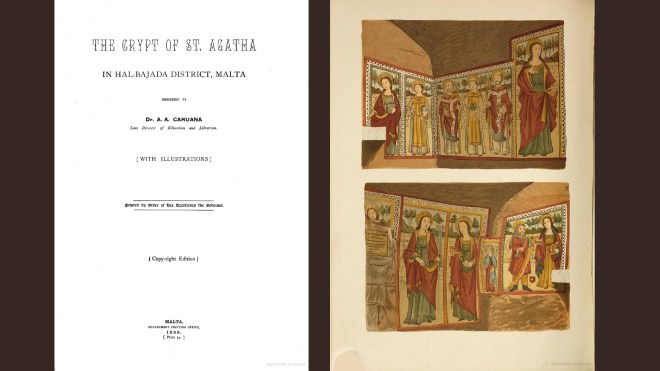
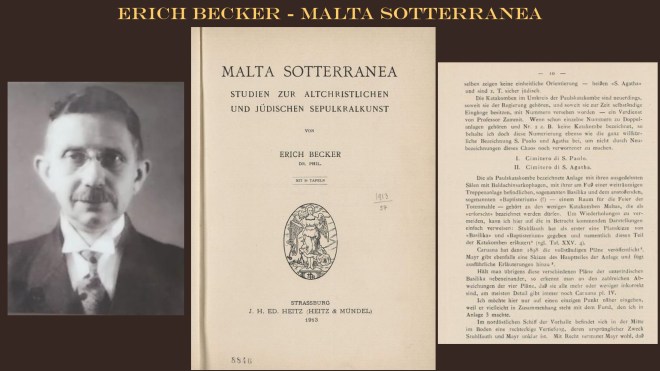
The “Rediscovering Agatha” was a success! It was organised at St Agatha’s Museum, with the cooperation of the Istituto Italiano di Cultura. During the conference, we offered an overview of the rediscoveries that took place in St Agatha’s catacombs during the last centuries and then the rebranding of the catacombs and museum was presented. After a light refreshment, attenders had the possibility to visit the crypt with a special guided tour.

Here are some pictures and the full presentation

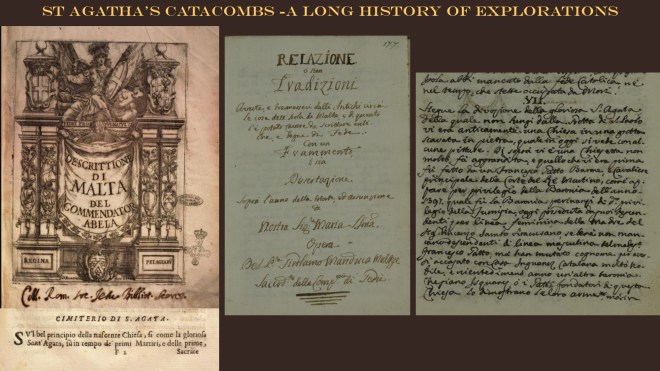
The “Relazione” by Marco Antonio Haxach: the Maltese catacombs in 1610

Anyone interested in the state of the Christian catacombs in Malta at the beginning of the 17th century should read Marco Antonio Axiaq’s ‘Relazione della nuova e grandissima divotione’ (Report on the new and great devotion). Axiaq was a Maltese surgeon who wrote a long description of the island in 1610, divided into several parts, of which only three handwritten copies of different chronologies remain today, addressed to various notable figures.

Axiaq provides the first descriptive mention of the Maltese catacombs, saying that they were somewhat frequented by locals in the early 17th century, although they remained completely misunderstood. He saw them first-hand and interpreted them above all as historical proof of the “victory” of the Christian religion over paganism.

Axiaq was the first to provide the names of five Christian hypogea on the island (St Paul, Madonna della Virtù, Madonna della Grotta, St Agatha, St Venera), but he also hinted at the presence of many other sites scattered throughout Malta.

Given the importance of the text and the difficulty in finding it, we transcribe below the part on the catacombs as contained in the manuscript version of the National Library of Malta (NLM, Lib. 515).

Relazione della nuova e grandissima divotione introdotta nella Santa Grotta di San Paolo nell’isola di Malta con una breve raccolta delle cose notande et antichità di detta Isola scritta per Marco Antonio Haxach Maltese

NLM 515, ff. 5v-6

Sono in questa Isola oltre l’antiche Reliquie delli grandissimi edifici, grotte sotterranee tagliate con mirabile destrezza, e forma, ed alcune cellule, et altri usci e portine, che d’una grotte s’entrava poi nell’altra con diversi appartamenti e se ne ritrovano alcuni de loro che a questa guisa se scondono da mezzo miglio, e più, considerandole alcune persone curiose stimarono, che anticamente gli abitanti di quest’Isola in quelle habitassero, perché forse li terremoti erano spessi, e grandi, o perché il modo di fabricare case ancor trovato non fosse, non havendo considerato questi tali di quello che nelle grotte si scorge, il che io con dura fatiga molte volte ad alcuni di loro ho disingannato con mostrargli manifestamente esser sepolture, e non ad altro fine fatte, ancorché così belle, e con diversi lavori abbellite fossero poiché si vede, che nella maggior parte di loro nella medesima pietra vi è il cavo, quanto può stare il corpo umano, e d’altri cavi piccoli per li figliuoli, nelle quali per insino al dì di hoggi ossa e teste umane si ritrovano, ed alcune ancora con balate di pietra coperte, e dentro alcuni vasetti, piattini, lucerne d’ogni, fatti di creta, di diverse forme all’uso antico per il che io ho sempre giudicato, che gli habitanti antichi, come Gentili l’opinione di Pitagora avessero avuto della trasmigrazione dell’Anime, cioè che uscendo da  un corpo qual’all’ora moriva, inanzi che un altro s’introducesse visitando quelli corpi, nelli quali prima era stata cossì errante andava trovandoli cossì bene acconcie, e di quelle antiche ceremonie, che far si solevano, si compiaceva, tenevano che questa era la sua gloria, se bene poi questa, e tutte le altre vane et erronee opinioni di Gentili, non solo de’ Maltesi ma da tutti i fedeli furono abolite et annichilate mediante il lume della S. Fede Cattolica dal Nostro Redentor Gesù Christo imparata, e dai suoi SS. Apostoli e Ministri della S. Chiesa predicata, colla quale come suoi figli, e seguaci Cattolici ci confirmiamo.

11r

Ad imitazione di questa S. Grotta già Chiesa consecrata dal Glorioso S. Paolo successivamente li Christiani altre grotte coltivorno, che più comode gli parevano tanto in nome della SS. Madonna, come ce n’è intorno a questa Città Notabile alcune insin al dì d’oggi, com’è la Madonna della Virtù, la Madonna della Grotta incorporata poi dalli Padri di S. Domenico dove già fabricato lor Convento, così anche d’alcuni altri Santi, che di mano in mano dalla S. Romana Chiesa sono stati Canonizati, come S. Agata, S. Vennera e molti altri sparsi per questa Isola.

UndergroundMed presented @ UMRE Valletta

The project UndergroundMed was presented among the on-going research project at the University of Malta Research Expo 2025 held in Valletta on 28 May 2025.

Abstract and presentation

Notes from Underground: the project UndergroundMed

The MSCA project UndergroundMed traces the history of the rediscovery of ancient catacombs between the 16th and 20th centuries across the Mediterranean, in particular Italy, Malta, and Tunisia. It analyses the topic from a broad European perspective, through studies conducted on travel routes, explorations, archive and museum collections, and it enhances the role of European scholars in creating an international and multicultural research-network while travelling across the shores of the Mediterranean in search for catacombs. I will share some preliminary results of this systematic analysis on catacombs rediscovery, to illustrate how UndergroundMed defines the role played by catacomb archaeology in building a European common culture.

New book is out!

Finally my latest book is here:
An Archaeologist in Rome at the Service of the Order: Letters from the Hospitaller Grand Master to Antonio Bosio (1604–1629), Routledge: New York and London, 2025.

I wrote my doctoral thesis, about ten years ago now, on Antonio Bosio, a seventeenth-century archaeologist and scholar who, the illegitimate son of a knight, was brought as a child from Malta to Rome and spent his entire life discovering and exploring the catacombs of Rome. The studies on Bosio, and all those that came in connection, have been the important basis on which I built my researcher portfolio and led me to my current job, which I truly love.

At the time when I finally published -in June 2020- the volume based on my doctoral thesis (Antonio Bosio e i primi collezionisti di antichità Cristiane, Piac: Vatican City, 2020), I did not really think it would end there. In fact, when in February 2022 I signed the contract with Routledge for the publication of the Grand Master’s letters to Antonio Bosio, it seemed to me that I was doing exactly what I was supposed to be doing: picking up the theme again but focusing on Antonio’s political life, on his work for the Order of Malta and, at the same time, working on unpublished materials preserved in my place of the heart: the National Library of Malta.

Brief description of the book

This volume is part of “The Military Orders Project” series and provides the original texts of the Grand Masters’ letters to Antonio Bosio in Rome, preserved in the National Library of Malta, together with a biographical study on Antonio Bosio, carried out over the years and now expanded with new information and research.

The volume opens with a historical presentation of the Bosio family within the Order of Malta. This is followed by a complete biographical profile of Antonio Bosio, compiled from the Order’s official sources and from archive documents found in various locations.

A short chapter is then dedicated to the presentation of the various archive collections in which Antonio Bosio’s private documents and autograph manuscripts are found, to offer a complete panorama of Bosio’s figure, although I focussed more on the biographical aspects inherent to the Order and his work at its service.

The core of the volume is obviously the letters of the Grand Masters to Bosio from 1604 to the time of his premature death in September 1629. The letters are presented in a simple transcription of their original form, and then their translation into English.

I believe that the task of this book is to offer a set of sources that will be useful to scholars on the international scene for years to come. The aim is to make public as widely as possible material that is not widely accessible, both in geographical (because it is preserved in Malta and so far not public in digital form) and linguistic terms (with these being handwritten in seventeenth-century Italian).

A general, critical reflection on the letters and the role of the Order’s Agent in the early seventeenth century is then proposed in the final two chapters. Here, the texts and their recurring questions are taken as a starting point for further comments, but above all to present the role and prerogatives of the Agent of the Sacred Religion on the basis of what is revealed in the Bosio epistolary.

“Il-Kollezzjonist”: documentary about the Catacombs of St. Agatha – Rabat (Malta)

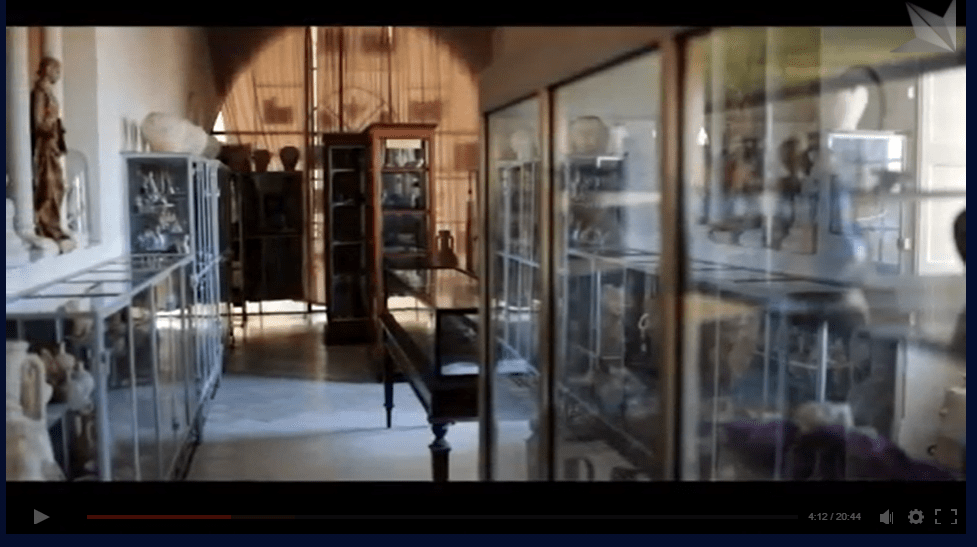
We are very happy to share the episode on the museum of the Complex of St. Agatha (Rabat, Malta) of the documentary “Il-Kollezzjonist”, created and presented by Raymond Saliba (a contribution to this site by Raymond can be read here).

The whole episode is available here. It is in Maltese language, but the images of the collection are pure bliss!

Congratulations to our friend Raymond for this beautiful episode.

Il-Kollezzjonist (The Collector) is a series of short documentaries that take the audience on a journey to explore some of the most beautiful private collections in the Maltese and Gozitan islands. It is presented by Raymond Saliba and Sharp Shoot Media Ltd. Il-Kollezzjonist started on the 30th December 2020, and is on air every Wednesday at 6.30pm on Television Malta. Follow the programme here.

Rev. Victor Camilleri and St. Agatha’s – by R. Saliba

***We are happy to share a biographical remembrance of Brother Victor Camilleri and his work on the enhancement of the catacombs of St. Agatha in Rabat (Malta), written by our friend Raymond Saliba (Cathedral Museum, Mdina). Thank you Raymond!
Follow Raymond’s work at http://www.facebook.com/kollezzjonist/

Rev. Victor Camilleri was the pioneer in making the historic complex of Saint Agatha in Rabat (Malta), what it is today. Born in Senglea on October 13, 1933, he entered the Missionary Society of St. Paul (MSSP) at a young age and became a priest on April 2, 1960. He passed away on the 15th of December, 2011. 

The St. Agatha complex is located on the outskirts of the old capital city, where we find the largest amount of catacombs on the Maltese islands. Along with the Pauline catacomb complex, St. Agatha’s offers a kaleidoscopic of pagan; Christian, and Jewish hypogeous, along with a unique underground chapel that included an altar decorated with paleochristian frescos. This historic complex is made up of the church and crypt of St. Agatha; the convent and motherhouse of the MSSP; the SPCM collage; St. Agatha’s Museum and many underground cemeteries. 

Fr. Camilleri, who from an early age was interested in local history, find much to be drawn to when he joined the religious community at St. Agatha’s, particularly, archeology. During the time of his formation to the priesthood, together with some of his colleagues, in his spare time, he embarked on the cleaning of several small hypogeous discovered under the convent. Although there has always been part of the catacombs attached to the crypt accessible to the public, most of the underground complex we see today was closed or not even excavated. It was also Fr. Victor who discovered several 5th-century frescos on some Christian tombs. 

From 1978 onwards, Fr. Camilleri became part of St. Agatha’s community again. At first, he began to think seriously about setting up a museum to collect and conserve objects that were in the personal collection of Mons. Joseph de Piro, the Society founder, as well as many objects which belong to the church of St. Agatha. In 1985 he assumed the curatorship of both the church and museum after he was already doing tours of the catacombs. The clean-up of small catacombs, which were found under the new SPCM collage, also continued under his direction. Apart from the daily work as a priest and curator, he indulges in the study and writing about this important complex and its treasures. He published four books and numerous articles in local journals and newspapers, and also planned the said complex, which covers some 4,100 square meters. 

Raymond Saliba

Giovanni Francesco Abela and the catacombs of Malta: new book!

This book is one of the latest outcomes of our research project. This book offers a new vision of the role played by Giovanni Francesco Abela, the father of Maltese historiography, in the rediscovery of Christian antiquities in Malta and in the
development of private antiquarian collection in early-Baroque times.
It also contributes to the definition of his international figure as European scholar, deals with the museological content of his masterpiece Della Descrittione di Malta, and offers the transcription of many archival texts about Abela’s life and work.

In the following articles we will address some of the topics discussed in this book, stay tuned! In the meantime, here you are the table of contents!

Chiara Cecalupo, Giovanni Francesco Abela. Work, private collection and birth of Christian archaeology in Malta. Rome: Edizioni Quasar, 2020

This book is on sale here. Regular price €12,00.