A general reconstruction of the history of catacombs rediscovery in central Mediterranean have to involve the catacombs of Siracusa, in Sicily.
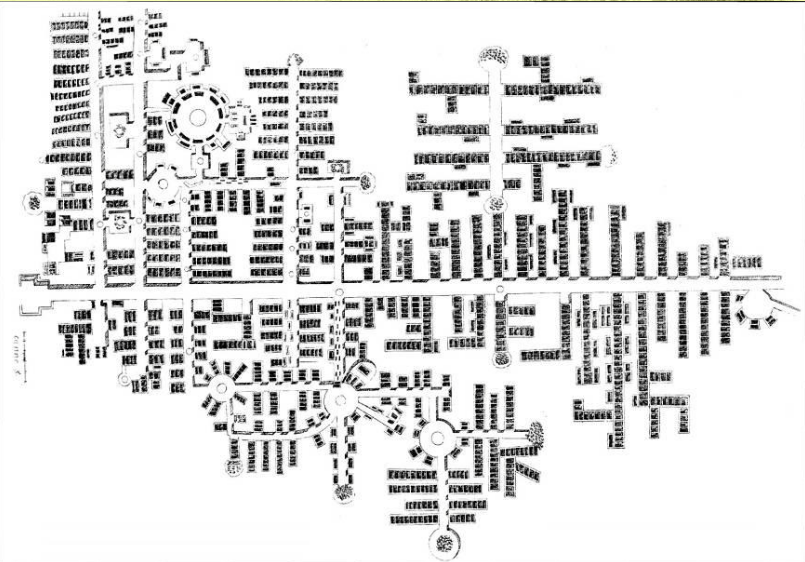
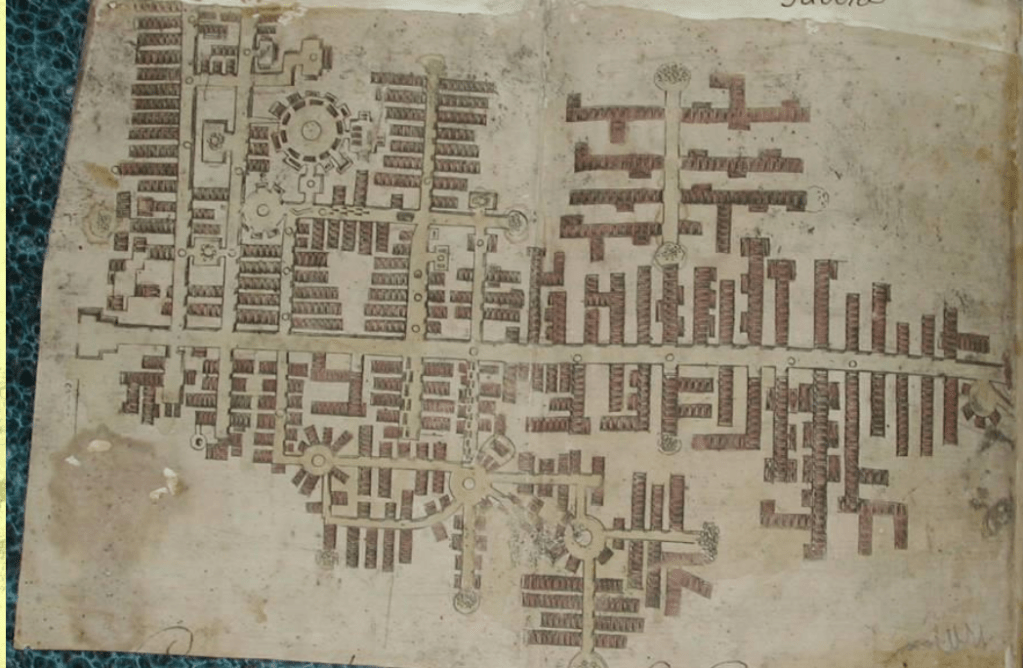
The most important underground Christian cemetery of the city is the catacomb of San Giovanni. It was built at the beginning of the 6th century and continued to be used throughout the 4th and 5th centuries, until the early decades of the 6th century. The cemetery is built using an ancient aqueduct and its ancient cisterns, acquiring its typical character of perpendicular galleries (with the central decumanus maximus and the various cardines that intersect it) with various rotundae, the cisterns that were later transformed into burial chambers. It also features a large number of arcosolia with multiple burials, important paintings, and a remarkable collection of epigraphs, mainly in Greek.
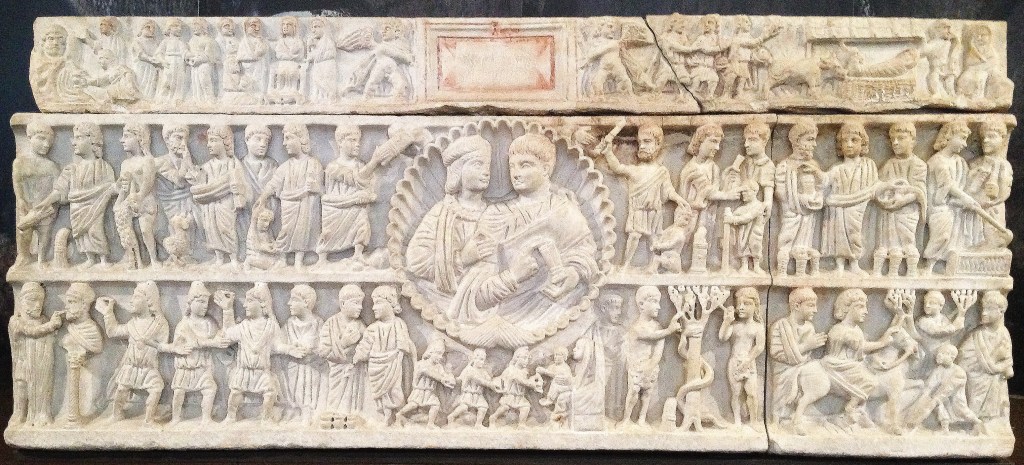
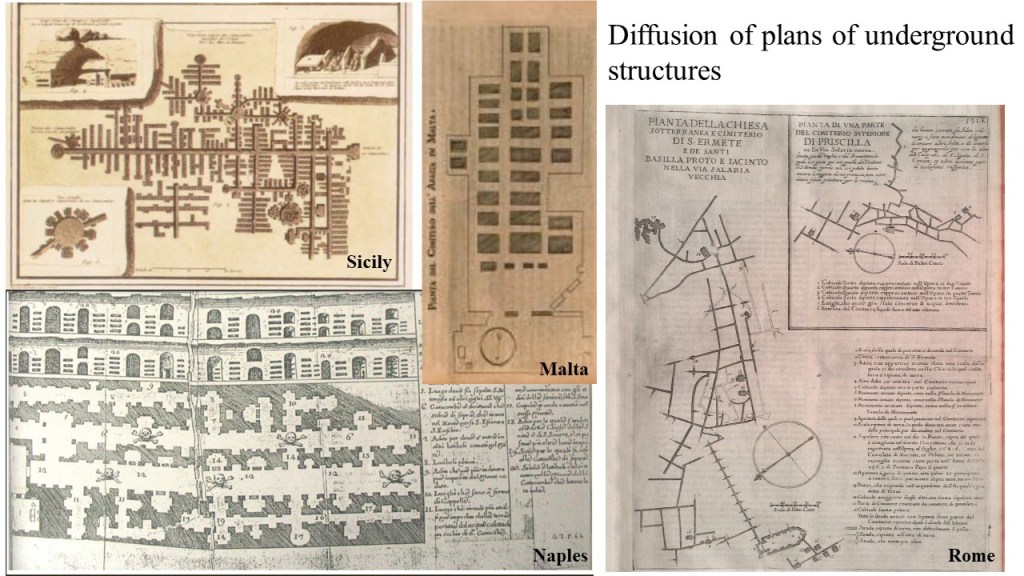
The catacomb and its surroundings were always known to the citizens. The first to describe it and record its layout was Vincenzo Mirabella (1613), but it then became a focal point for all European travelers visiting Sicily. Many of them described it and published drawings of the layout (including Jean Houel, Dominique Vivant Denon, and others). From the end of the 18th century, it was known and explored by the city’s leading scholars, such as Gaetani della Torre and Giuseppe Maria Capodieci. With the establishment of the city’s Archaeological Museum, its directors took charge of the excavations, starting with Francesco Saverio Cavallari (the discoverer of the Aldelfia sarcophagus in 1872) and then Paolo Orsi, who brought most of the underground structures to light.
S. Giovanni, plan after Mirabella (1613)Adelfia Sarcophagus
The objects found in the catacombs are currently stored and exposed at the local National Museum of Archeology “Paolo Orsi”. It is one of the largest museums in Europe in terms of size and contains the results of research carried out in the Syracuse area from the end of the 18th century onwards, with finds ranging from prehistory to the Roman era.
In 1780, Bishop Alagona inaugurated the Seminary Museum, which became the Civic Museum of the Archbishopric in 1808. After the unification of Italy, it was transformed into the National Archaeological Museum of Syracuse and opened in 1886 in a historic building in Piazza Duomo. From 1895 to 1934, Paolo Orsi directed the museum, expanding its collection with excavation campaigns in the area. Luigi Bernabò Brea, superintendent since 1941, proposed after the war the purchase of the Landolina villa for the creation of a new museum in its vast garden. The design of the sections, which began in 1961, was carried out according to a scientific order by Bernabò Brea himself and Gino Vinicio Gentili, while the design of the building was entrusted to architect Franco Minissi. The architectural structure and educational apparatus made it a truly avant-garde museum, which was inaugurated in 1988. With its various floors and 9,000 m² of floor space, it remains one of the largest archaeological museums in Europe. Over the years, the museum has undergone modifications and expansions.
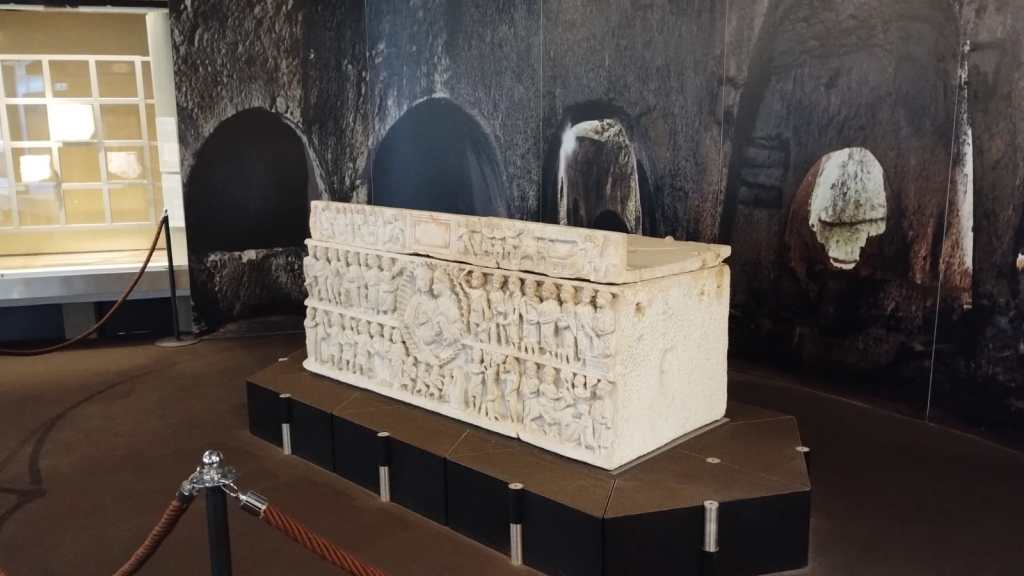
The entire F section on the first floor is dedicated to early Christian artifacts from the Syracuse area. It begins with an installation of the Adelfia rotunda from the catacombs of San Giovanni, with the sarcophagus of the same name at its center. The section mainly displays the most important Christian epigraphs of the sites and oil lamps found in the catacombs of San Giovanni, Vigna Cassia, Santa Lucia, and Cappuccini in Syracuse. The discovery of the Adelfia sarcophagus was undoubtedly one of the decisive moments in the creation of a museum in Syracuse. The section has undergone two expansions: first in 2014 for the new display of the Adelfia Sarcophagus and other finds related to the catacombs of Syracuse, and now in 2022 for a renovation to celebrate the 150th anniversary of the discovery of the sarcophagus.
On the other hand, documents relating the catacombs throughout the centuries are stored at the Alagoniana Library and Diocesan Historical Archives of Siracusa. In the library there are abundant references and studies relating to the city’s numerous catacomb complexes, particularly in texts relating to the antiquities of Syracuse, written between the 18th and 19th centuries by various prelates of the city. These texts offer not only detailed textual descriptions of the sites and their state of preservation, but also a wealth of information on their use for scientific and religious purposes, as well as drawings of their layouts. Of particular note among the manuscripts are: Vestigij di Siracusa Antica Illustrata, C. Gaetani della Torre (1718–1805) Raccolta d’iscrizioni antiche Siracusane, C. Gaetani della Torre (1718–1805) Iscrizioni di Siracusa in numero 642, Giuseppe Maria Capodieci (1749-1828) Gli antichi Monumenti di Siracusa in 54 volumi, Giuseppe Maria Capodieci (1749-1828).
S. Giovanni after Capodieci, antichi Monumenti di Siracusa
Basic bibliography Scandurra C., Un nuovo spazio espositivo sulle catacombe siracusane: il Settore F del Museo Archeologico “Paolo Orsi”, in M. Sgarlata, D. Tanasi (edd.), KOIMESIS. Recenti esplorazioni nelle catacombe siracusane e maltesi, Parnassos Press 2016, pp. 151-184. M. Sgarlata, S. Giovanni a Siracusa, Città del Vaticano 2004. M. Sgarlata, L’architettura del sotterraneo a Siracusa nelle memorie di eruditi e viaggiatori del Settecento, in Annali del barocco in Sicilia. Ediz. illustrata. Vol. 8: Siracusa antica e moderna. Il val di Noto nella cultura di viaggio, Roma, 2007, pp. 25-36. M. Sgarlata, La raccolta epigrafica e l’epistolario archeologico di Cesare Gaetani conte della Torre, Palermo 1996.
The “Rediscovering Agatha” was a success! It was organised at St Agatha’s Museum, with the cooperation of the Istituto Italiano di Cultura. During the conference, we offered an overview of the rediscoveries that took place in St Agatha’s catacombs during the last centuries and then the rebranding of the catacombs and museum was presented. After a light refreshment, attenders had the possibility to visit the crypt with a special guided tour.
Next weekend we will celebrate European Researchers’ Night and the project UndergroundMed will be presented in two different events.
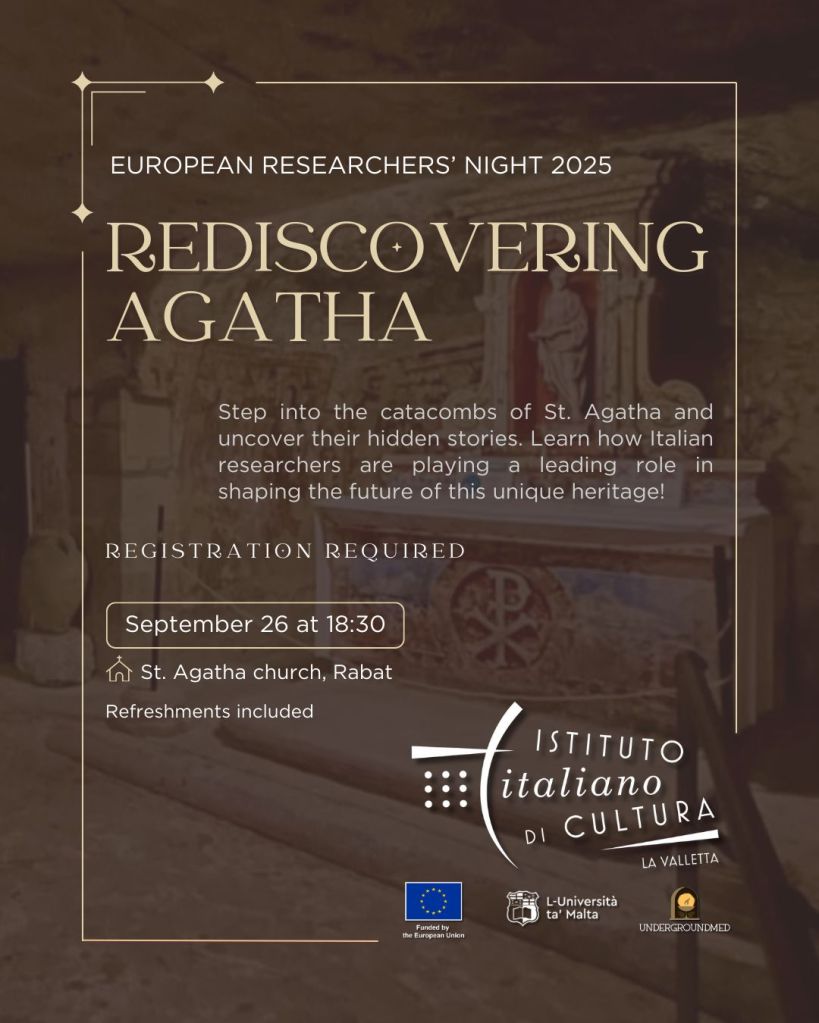
On the 26th of September, let’s join together at st Agatha’s Catacombs in Rabat for Rediscovering Agatha!
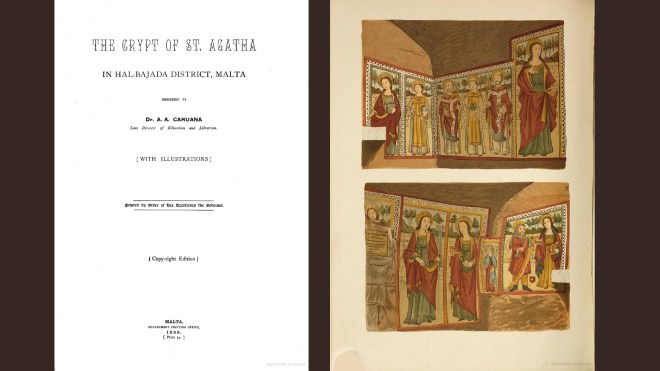
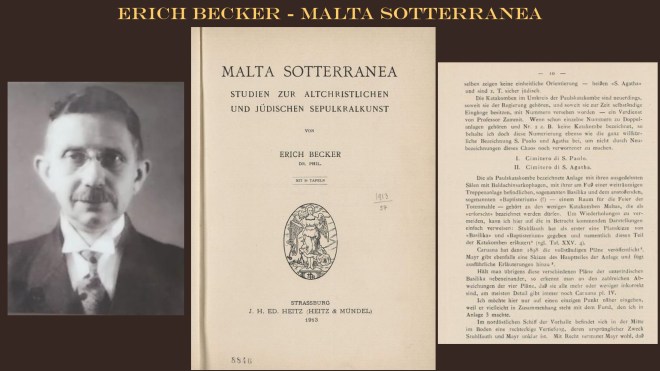
The catacombs of St Agatha in Rabat have been a topic of interest since the 17th century. The tunnels, crypt, and paintings from different periods have always attracted the attention of scholars, travellers, curious individuals, and devotees.
Rediscovering Agatha, organised as part of the European Researchers’ Night 2025, will retrace the stages of the rediscovery of the catacombs of St Agatha and the role of foreign archaeologists in the investigation process. The research currently underway and the future of the site will also be presented.
On the 27th of September, instead, I will showcase the project at the EU Corner in the big fair Science in the City in Valletta!
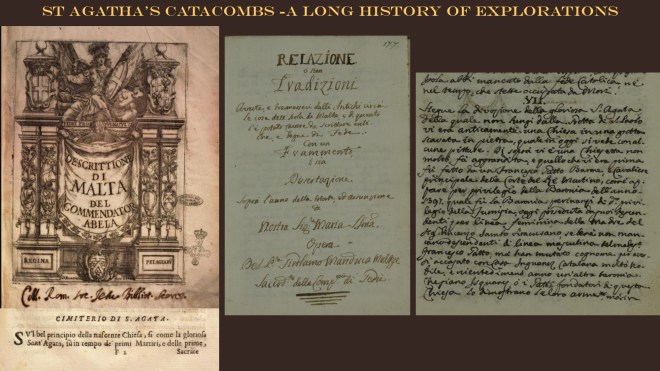
Anyone interested in the state of the Christian catacombs in Malta at the beginning of the 17th century should read Marco Antonio Axiaq’s ‘Relazione della nuova e grandissima divotione’ (Report on the new and great devotion). Axiaq was a Maltese surgeon who wrote a long description of the island in 1610, divided into several parts, of which only three handwritten copies of different chronologies remain today, addressed to various notable figures.
Axiaq provides the first descriptive mention of the Maltese catacombs, saying that they were somewhat frequented by locals in the early 17th century, although they remained completely misunderstood. He saw them first-hand and interpreted them above all as historical proof of the “victory” of the Christian religion over paganism.
Axiaq was the first to provide the names of five Christian hypogea on the island (St Paul, Madonna della Virtù, Madonna della Grotta, St Agatha, St Venera), but he also hinted at the presence of many other sites scattered throughout Malta.
Given the importance of the text and the difficulty in finding it, we transcribe below the part on the catacombs as contained in the manuscript version of the National Library of Malta (NLM, Lib. 515).
Relazione della nuova e grandissima divotione introdotta nella Santa Grotta di San Paolo nell’isola di Malta con una breve raccolta delle cose notande et antichità di detta Isola scritta per Marco Antonio Haxach Maltese
NLM 515, ff. 5v-6
Sono in questa Isola oltre l’antiche Reliquie delli grandissimi edifici, grotte sotterranee tagliate con mirabile destrezza, e forma, ed alcune cellule, et altri usci e portine, che d’una grotte s’entrava poi nell’altra con diversi appartamenti e se ne ritrovano alcuni de loro che a questa guisa se scondono da mezzo miglio, e più, considerandole alcune persone curiose stimarono, che anticamente gli abitanti di quest’Isola in quelle habitassero, perché forse li terremoti erano spessi, e grandi, o perché il modo di fabricare case ancor trovato non fosse, non havendo considerato questi tali di quello che nelle grotte si scorge, il che io con dura fatiga molte volte ad alcuni di loro ho disingannato con mostrargli manifestamente esser sepolture, e non ad altro fine fatte, ancorché così belle, e con diversi lavori abbellite fossero poiché si vede, che nella maggior parte di loro nella medesima pietra vi è il cavo, quanto può stare il corpo umano, e d’altri cavi piccoli per li figliuoli, nelle quali per insino al dì di hoggi ossa e teste umane si ritrovano, ed alcune ancora con balate di pietra coperte, e dentro alcuni vasetti, piattini, lucerne d’ogni, fatti di creta, di diverse forme all’uso antico per il che io ho sempre giudicato, che gli habitanti antichi, come Gentili l’opinione di Pitagora avessero avuto della trasmigrazione dell’Anime, cioè che uscendo da un corpo qual’all’ora moriva, inanzi che un altro s’introducesse visitando quelli corpi, nelli quali prima era stata cossì errante andava trovandoli cossì bene acconcie, e di quelle antiche ceremonie, che far si solevano, si compiaceva, tenevano che questa era la sua gloria, se bene poi questa, e tutte le altre vane et erronee opinioni di Gentili, non solo de’ Maltesi ma da tutti i fedeli furono abolite et annichilate mediante il lume della S. Fede Cattolica dal Nostro Redentor Gesù Christo imparata, e dai suoi SS. Apostoli e Ministri della S. Chiesa predicata, colla quale come suoi figli, e seguaci Cattolici ci confirmiamo.
11r
Ad imitazione di questa S. Grotta già Chiesa consecrata dal Glorioso S. Paolo successivamente li Christiani altre grotte coltivorno, che più comode gli parevano tanto in nome della SS. Madonna, come ce n’è intorno a questa Città Notabile alcune insin al dì d’oggi, com’è la Madonna della Virtù, la Madonna della Grotta incorporata poi dalli Padri di S. Domenico dove già fabricato lor Convento, così anche d’alcuni altri Santi, che di mano in mano dalla S. Romana Chiesa sono stati Canonizati, come S. Agata, S. Vennera e molti altri sparsi per questa Isola.
The project UndergroundMed was presented among the on-going research project at the University of Malta Research Expo 2025 held in Valletta on 28 May 2025.
Abstract and presentation
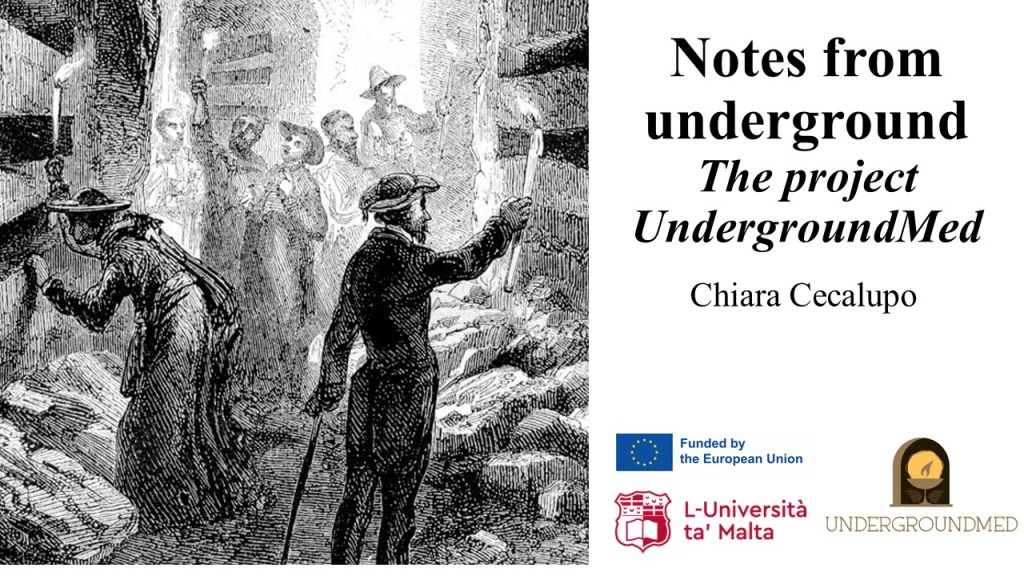
Notes from Underground: the project UndergroundMed
The MSCA project UndergroundMed traces the history of the rediscovery of ancient catacombs between the 16th and 20th centuries across the Mediterranean, in particular Italy, Malta, and Tunisia. It analyses the topic from a broad European perspective, through studies conducted on travel routes, explorations, archive and museum collections, and it enhances the role of European scholars in creating an international and multicultural research-network while travelling across the shores of the Mediterranean in search for catacombs. I will share some preliminary results of this systematic analysis on catacombs rediscovery, to illustrate how UndergroundMed defines the role played by catacomb archaeology in building a European common culture.
[This is part of the text read during a public lecture at the Royal Netherlands Institute of Rome on 30 April 2025]
From the mid-sixteenth century, the discovery of many Christian catacombs in Rome spread knowledge about early Christian art throughout Europe, and made catacombs a popular subject. This process took place through promotion of academic studies, vast numbers of copies, and museum displays, all supporting the progress of archaeological discoveries. This phenomenon from the sixteenth through the twentieth centuries is obviously connected to political key events occurring in the Papal States.
One can say that the history of Christian archaeology cannot be divorced from the political and confessional use of the the catacombs. This use constantly characterised the work of many researchers and scholars, in periods when Christian archaeology was perceived as an official, national, catholic and papal discipline. They mostly fostered this relation between catacomb archaeology and politics through their scholarly publications and the production of copies of catacomb paintings. What is certainly evident is the key role of the papacy, which from time to time finds a political and cultural reason to reassert its authority through its most ancient past and claiming authority and exclusive control on it over the centuries, and playing a pivotal role in the process of dissemination of Christian art.
Catacombs for the Counter-Reformation agenda
Knowledge of the catacombs and the artistic treasures they contained was never totally ignored or forgotten contrary to long-standing assertions made by questionable but influential twentieth-century historiography. Records of pilgrims visiting the catacombs as part of the Christian-Rome cult circuit are numerous from the Middle Ages to the early modern age. Renaissance humanist scholars were the first to analyse the art of catacombs, often based on first-hand knowledge acquired during visits to the sites themselves. The scholarly impact of the construction of New St. Peter’s throughout the whole sixteenth century, an intervention that required extensive and lengthy excavations, was very important too: on that occasion, a significant number of sarcophagi, epigraphs and artefacts came to light, representing the first major contact for the modern world of Rome with early Christian art.
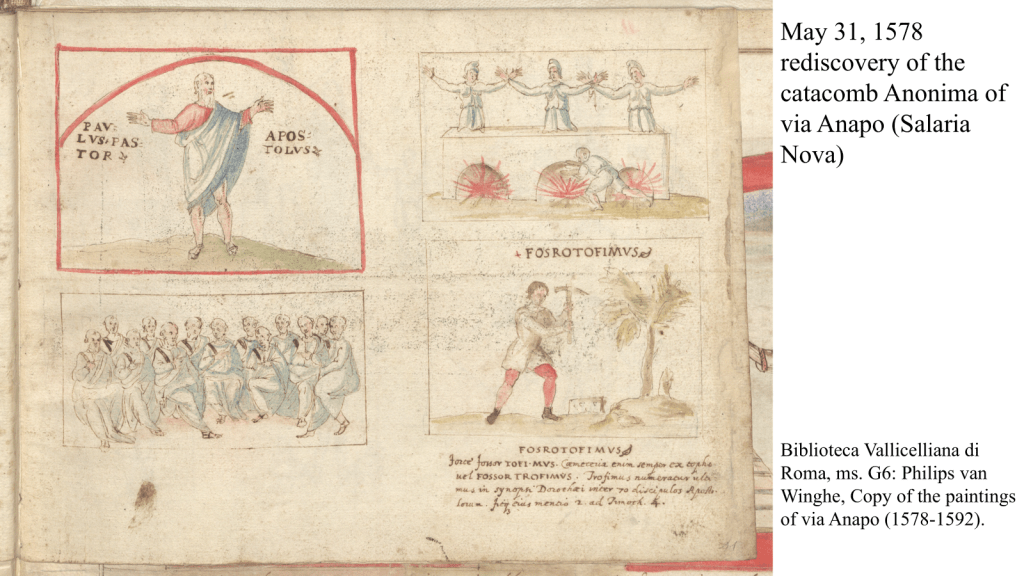
A crucial event happed on 31 May, 1578, during the pontificate of Gregory XIII: the accidental discovery of a Christian catacomb within the Sanchez vineyard on the Via Salaria Nova (at that time identified as the catacomb of Priscilla, but later in the late twentieth century as the Anonymous Catacomb of Via Anapo), with its impressive set of wall paintings. This is considered to be the moment when Christian archaeology began. However questionable that narrative is, this discovery nonetheless represented a real novelty involving sections of Roman population of the countryside, hitherto excluded from the rediscovery of and appreciation for Christian antiquities. These underground tunnels, marvellously decorated with paintings, totally unknown and extraordinary, attracted an incredible number of people, so much so that Gregory XIII decided to fence off the area (and then that the fence was torn down by eager groups of visitors), including not only clerics, scholars, and antiquarians, but also, and perhaps above all, ordinary people. This novel attention to of ancient Christian art is extremely interesting for the political and confessional use of catacomb art, because it appeared to have a great appeal for common people everywhere and could be used to convey Catholic messages in Italy and beyond. The first discovery of a catacomb also stimulated the search for more underground cemeteries throughout the Roman countryside, archaeological forays led by scholars, ordinary citizens, and different religious groups.
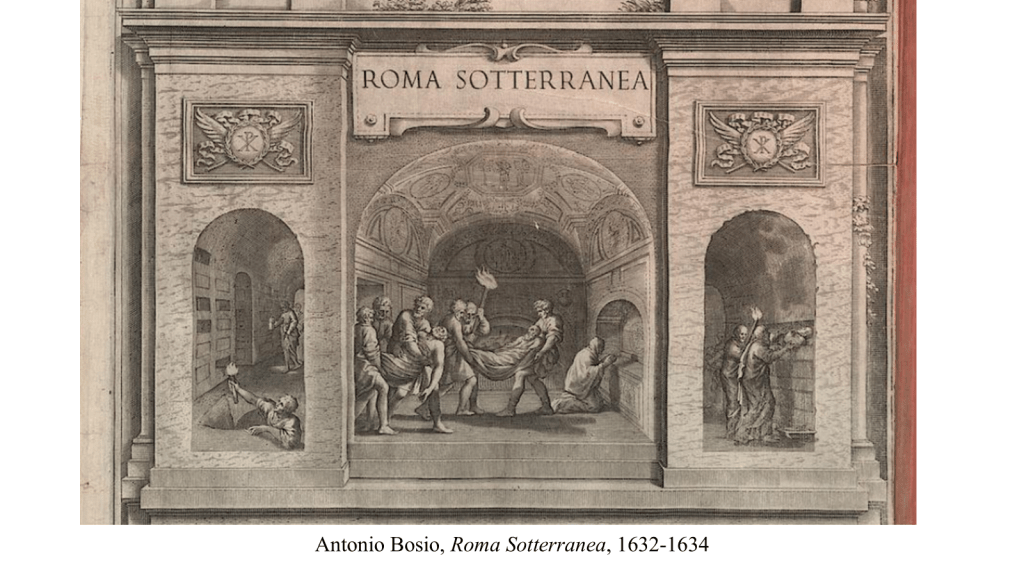
That feverish research culminated in 1634 with the publication of the first monograph on the Roman catacombs, Antonio Bosio’s Roma Sotterranea. This work and the explorations of catacombs led by Bosio increased indeed the international interest in the catacombs. While Christian cemeteries had already attracted the attention of scholars during the fifteenth and sixteenth centuries, after 1578, scholars or artists from all over Europe and Italy flocked to Rome with the intention of drawing and describing the paintings found in the catacomb galleries.
In a cultural context generally dominated by the new Tridentine needs in developing a new, unique artistic discourse controlled and directed by the Catholic Church, we must recall clear links between a genuine interest in Christian antiquities and the Catholic Counter-Reformation, with sacred antiquaria and apologetics in support of Catholic historiography. In fact, Roman and other European Catholic scholars of the second half of the sixteenth century were very keen to render service to the Catholic Church. Certainly, the findings, and in particular the paintings of the catacombs, could corroborate knowledge derived from literary and historical sources, and both could be used to legitimize a Catholic position against Protestant divisions. The most immediate interest was to record the paintings that were being gradually discovered during the sixteenth and seventeenth centuries in various Roman cemeteries. This was due to the intrinsic wonder aroused by the sight of such unknown, mysterious and yet so well-preserved Christian paintings, and to their clear link to scriptural episodes narrated in the early times of the new religion, but well known to contemporary Catholics and Protestants. These ancient paintings conveyed familiar religious stories and concepts, moreover in an easily understood visual language.
It was precisely the memory of a heroic era of the Church, of which the stories of saints and martyrs represented the main legacy, that produced a particular interest in the catacombs. In fact, a revival of early Christian themes and symbols, like palm as a sign of martyrdom, were used in all the arts to translate into images the Tridentine needs to create a set of iconographies to develop new resources for the faithful and new devotions to foster popular piety. This revival was translated into new styles, and tastes, as proven, for example, by the widespread diffusion of paintings with early Christian saints (Caecilia above all) in churches and private houses in the early seventeenth-century. Even the grandly Baroque architecture sought to make ancient Christianity present through the monumental recreation of early Christian liturgical spaces, which was one of the main aims of the great reconstructions of Roman churches financed by the various popes.
From a political point of view, the discovery, study, and recreation of early Christian art found in the catacombs therefore had a broad cultural role, expressed into two main directions. First, early Christian pictorial art was presented as incorrupt, pure, severe, and spiritual, thus the perfect vehicle for a process of artistic and figurative renewal of Catholicism that was to serve to counter Protestant criticism . Second, it is precisely the discovery of early Christian art and its clear message that served to convey and promote unbroken continuity of the Roman Church from apostolic times to the present. The catacomb images were very old; but in a certain sense, they were new too because they were reinterpreted as living images, models to be imitated, and a source of artistic inspiration.
Christian archaeology din late nineteenth century
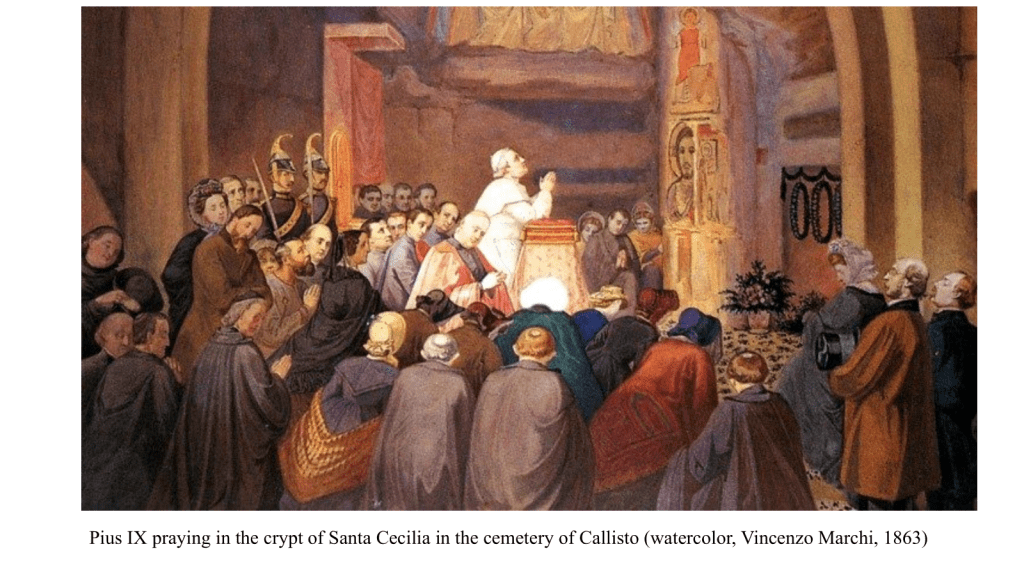
One has to wait until the 1850s for the next great change in the history of Christian archaeology to take place. Under the pontificate of Pius IX (1846-1878), in particular, the promotion of the excavation and study of Roman catacombs became extensive and more explicitly political. The Roman Republic (1849), the exile in Gaeta in the Bourbonic Kingdom and the return to Rome were the initial act of a pontificate characterised by perennial conflicts with the emerging kingdom of Italy that culminated in the end of the Papal States and thus of the popes’ political power in 1870. Given such political turmoil, unique in the history of the papacy, Pius IX was called upon to promote the papacy’s temporal power and Catholic Christianity with self-assertive policies at both the local and international level. Until the end of his pontificate, Pius IX insisted on the self-exaltation of Christian culture and the centrality of Rome in an international culture with ancient apostolic roots. Christian antiquity therefore assumed a key role in the cultural policy of Pius IX, who financed important initiatives for the development of the discipline of Christian archaeology. The Roman catacombs were proposed as a symbol of the times of persecution and thus a material embodiment of the martyrial narrative with which his pontificate was cloaked.
Events that supported this objective occurred in the first years of Pius IX’s pontificate. In 1860 Europe was in the midst of numerous social transformations, revolutionary uprisings and wars of independence due to nationalistic drives hostile to the great empires reformed after the Congress of Vienna. These upheavals resulted in the emergence of nation states, particularly in Italy, where the papacy lost its territory. In a slow political and cultural process culminating in the capture of Rome in 1871, Pope Pius IX (1846-1878) saw his temporal dominion reduced to the Vatican City. We were thus facing the most radical geopolitical change on the continent, in which the political as well as the cultural definition of nations played a very important role.
Under the cultural point of view, the pope made use of the work of the Jesuit Giuseppe Marchi (1795-1860), who is considered one of the founders of Christian archaeology as a scientific discipline, and Giovanni Battista de Rossi, who was then his young assistant. The two were put in charge of excavations in countless catacombs and were also entrusted with the dissemination their discoveries in textual and visual reports/accounts. They were also the protagonists of Pius IX’s major institutional foundations dedicated to Christian archaeology. The Commission of Sacred Archaeology (1852) oversaw the study and protection of the catacombs and other Christian monuments while the Lateran Christian Museum (1854) included a lapidary section to provide a proper place to display the many works of art found in the catacombs. It functioned, in effect, as an appendix to the visit to the catacombs, replete with didactic intents designed to advance the understanding Christian antiquities . Here, then, we are in front of a real state archaeology, scientifically conducted, but in the overt service of a political agenda. If that were not enough, there were large construction and restoration campaigns that became more customary as the situation became more complicated: think of the large investments for the restoration of the great early Christian basilicas such as S. Lorenzo fuori le Mura, Santa Maria in Trastevere, or even St Paul’s outside the walls after it was destroyed by a huge fire in 1823; as well as the celebration of the papal soldiers defeated in the battles against the Reign of Italy, who in the contemporary narrative rose to the rank of martyrs of the faith and received a monument in St John Lateran, the city’s cathedral.
The mosaic heritage in catacombs is very limited and concerns ‘three species of mosaic works’: the floors, the slabs (marble or fictile) closing the tombs decorated with series of tesserae, and finally the wall mosaics decorating the arcosolii or the walls and vaults of the cubiculi. I will not refer to catacomb mosaics in general, but focus on a few cases and their collecting fate.
The history of mosaics in museums for the first centuries of the Modern Age has some shadows. For the 16th century, for example, we have little information on pieces of Roman floor mosaics in collections, but I would like to point out that in Chapter VI of Giorgio Vasari’s Vite, Del modo di fare i pavimenti di commesso, in the chapter on architecture (and not on painting…) he comments on the way Roman mosaics were executed ‘come se ne vede in Parione in Roma, in casa di messer Egidio e Fabio Sasso’. Moving on to the 17th century, in the collection of Cardinal Maximus, there was a ‘Stanza ultima de Musaici’, there was a special room adjoining the library, dedicated precisely to the mosaics in the collection. Even in the library itself, however, there were mosaics.
During the 17th century, coinciding with the extensive underground discoveries, the existence of mosaics in the catacombs was noted, and they too entered collections and the antiquities market.
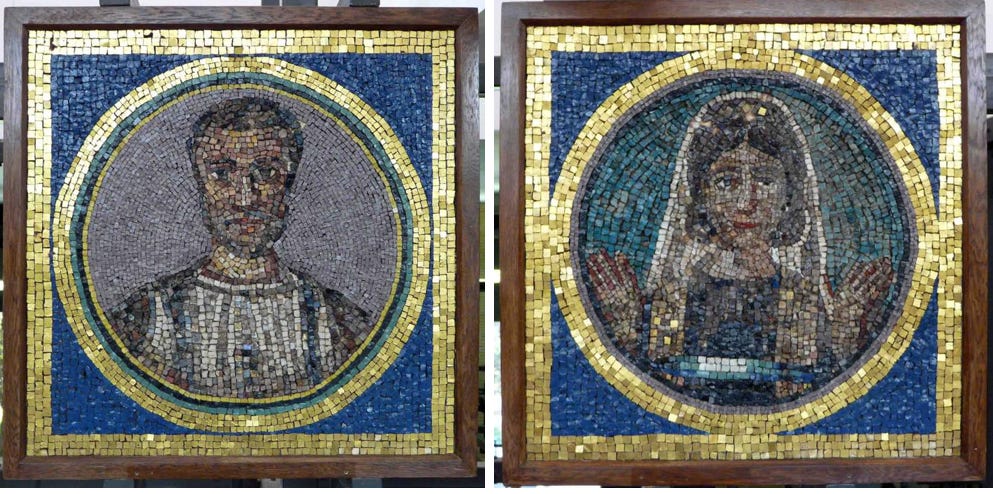
Following a ‘translation of saints’ bones’ in 1656 the mosaic portraits of Flavio Giulio Giuliano and Simplicia Rustica were discovered in the cemetery of Ciriaca, detached between 1656 and 1677 from a tomb with their epigraph and acquired by the collection of Agostino Chigi. They were placed, as was the custom at the time, on the wall in the staircase leading to the Library, according to a design by Pietro da Cortona Chigi and in a pattern not unlike the one we have mentioned for the Massimo collection. An interesting contiguity, therefore, between mosaics and libraries. It was not until 1918 that the mosaics were detached and acquired by the Lateran Christian Museum, where they were again restored.
In the 18th century, the century in which mosaics made their entry into museums and collections, we find several testimonies of mosaics in the catacombs, without precise topographical references, by the Custodian of the Cemeteries Marc’Antonio Boldetti in 1720. He testifies of mosaic decorations on lithic or fictile supports, and is the main source on the topic for that century.
A couple of examples: Boldetti describes a brickwork from the cemetery of Ciriaca, on which there was a monogram between alpha and omega in mosaic tesserae. It is now lost, but at the time it ended in Gaetano Marini’s private collection. I do not think it is a coincidence that a mosaic artefact of this type, i.e. more epigraphic than artistic, aroused the interest of the leading epigrapher of the time, who was also the Vatican Librarian. Secondly, Boldetti draws a direct connection between some mosaics found in the catacombs and the Carpegna Museum: these are mainly ‘several birds and flowers formed on terracotta boards with non-ordinary artifice, and of minute workmanship’, i.e. emblemata, found between the Appia and Ardeatina roads, in particular at Callisto, used as closures for burial niches. All these pieces were later transported to the then Carpegna Museum in the Rione Sant’Eustachio in Rome, of which no further information is available afterwards.
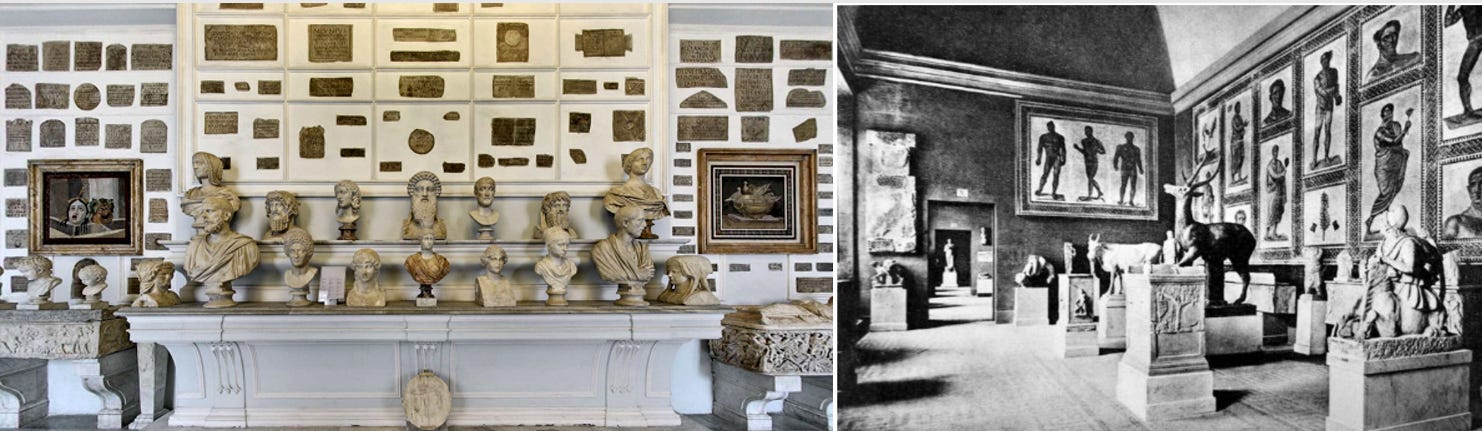
In general, mosaics in collections in the 18th century had to be tear out and cut up to make more artefacts, for immediate placement in an antiquarian market. The 19th century in Rome marked the beginning of massive systematic excavations in the catacombs, the founding of the first institution for the protection of these monuments and above all the opening of a large museum dedicated to them in 1854 at the Lateran Palace, where the discovered mosaics were directly brought. In the Lateran Museum, they are displayed into the wall, following a practice that has been going on for centuries, inaugurated in papal museums by the display of the Dove emblema of Villa Adriana. Indeed, in the Lateran Palace hosted the important museum experiment of displaying the mosaic of the athletes of the Baths of Caracalla, discovered in 1824 and then placed in the museum in 1836, first in an imaginative reconstruction of the floor and then set into the wall, had been developed.
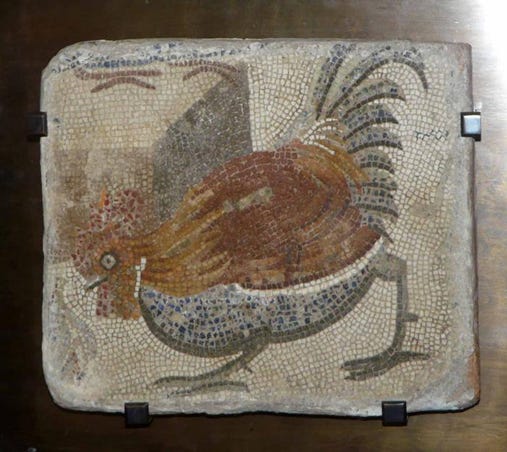
For our theme, an emblematic case is the brick with the mosaic image of a cock, a pavement emblem probably reused to close a niche. It was discovered in 1837 during the works of Virginio Vespignani in the cemetery of Verano, as stated in the sixth volume of Louis Perret’s disputed Catacombes of 1852, which places the mosaic to cover an unspecified martyr’s grave. Upon its discovery, it was sent straight into the Lateran Museum, where it was slightly restored and placed on the wall, in the large gallery of sarcophagi, along with all the other ‘sculptural works’, as noted in the catalogues of the time.
During the 20th century, the museum housed both mosaics previously housed in private collections (as the one in the Chigi Library which passed to the Laternanense Museum and then to the Pio Cristiano in the Vatican) and new discoveries, such as the two fictile slabs decorated with polychrome glass mosaic tiles from the Aproniano catacomb depicting three episodes from the biblical story of Jonah. They were discovered on 1 February 1938, the Pontifical Commission of Sacred Archaeology donated them to the Holy See and they immediately entered the Vatican collections, also becoming part, in 1963, of the new Pius Christian Museum opened in the Vatican after the closure of the Lateran Museum. Perhaps the most linear path in our little story.
One of the most important tasks of an archaeologist on an excavation is to keep a diary in which to record daily work and eventual discoveries, a diary that thus becomes the main source of facts and details of an archaeological exploration of any kind. Keeping an excavation diary is a sort of obligation towards both the past that unfolds before us and the present and future generations that expect us to take care and attention to preserve the discoveries. Even the archaeologists of the past have not shirked this obligation: there are some diaries of excavations from centuries ago that are extraordinary texts (such as, for example, the eighteenth-century diaries of the discoveries of the Vesuvian cities, which take us by the hand on a tour of wonders to places that are still mythical today), but all of them, even the lesser-known ones, maintain a charm that those objects that act as a bridge between us and the thinking of our ancestors know how to have.
One of the most interesting diaries for catacomb archaeology is the excavation diary of the Swiss Paul Styger, archaeologist and scholar of Christian antiquities in Rome, professor of archaeology and religious arts in Poland and one of the protagonists of the potpourri of nations that was the horizon of archaeological science in Rome in the early 20th century. Due to a series of fortunate circumstances (in particular, his proximity to the German circles in the Vatican that a century ago were carrying out archaeological research and museographic experiments in the Eternal City), Styger found himself -between 1915 and 1917- directing the excavation of the church of San Sebastiano on the Via Appia in Rome. This is a very important site: an ancient church that later became a Baroque jewel, but set on an extensive cemetery area. Styger’s excavation is particularly concerned with investigating the area directly underneath the nave and the Platonia, with the intention of also tracing the tomb where, according to a tradition invented in the Middle Ages, the bodies of Peter and Paul extracted from their original tombs in the basilicas of the same name would have been temporarily protected.
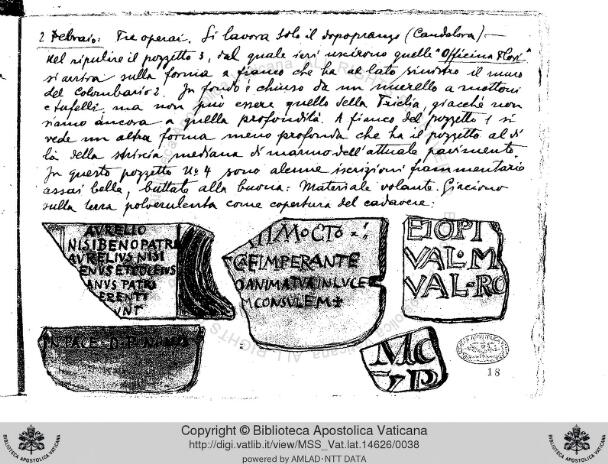
The diary is a little gem. It starts on 8 February 1915, ends on 27 February 1917 and is a mixture of text and pen illustrations, later coloured in watercolour. It is a true snapshot of what it must have been like to manage an excavation at the time, with constant inspection visits by the Ministry of Education and the Commission of Sacred Archaeology, fluctuating relationships with the workers, and more or less long interruptions for various reasons. The most beautiful feature are of course the drawings, not only of the individual objects found, but also of some of the structural situations found during the excavation.
The diary arrived in its current location in the Vatican Library after Styger’s death in 1939, by his own will, after having been missing for a while. This is confirmed by a letter pasted at the end of the manuscript, in which his sister refers to a certain Gerke who will help her find this diary and donate it to the library. At the end of this letter, an anonymous hand adds, in pen, that he received the diary on 31 May 1939 and adds: ‘And Gerke, if I am not mistaken, is the Nazi whom those of the Commission of Sacred Archaeology allowed to examine the excavations of the catacombs with all freedom, while they would have obstructed the Styger’. A small note full of implications, which relates to the strong relations between archaeological bodies and certain authoritarian political parties in the 1930s and 1940s, an issue that archaeological historiography has yet to come to terms with. As an appendix to the diary, there are some typed sheets, with pencil-drawn illustrations, in which Styger lists pieces found in various catacombs during the 1920s, which were then lost, either because they were left on the site and treated carelessly, or because they were not handed over to the Vatican Museums. This list, too, is a singular evidence the practices of preserving artefacts: not a few objects were damaged by handlers who had ‘tried to tear them off’, or because they were left ‘without any precautions to save them’.
The map is being continuously implemented as the research progresses, and will contain a lot of data and information regarding the rediscovery of catacombs in Italy, Tunisia and Malta between the 16th and 20th centuries.
This entry may appear very far from the general aim of this website. But everything we do is a political act, even our silence. A short reflection on why I left Facebook and Twitter.
I opened my Facebook account as soon as I arrived at university (so 17 years ago…), in the first few years I used it a lot, then less and less, until I posted a few scattered photos every three-four month, ending in an absolute silence on 25 April 2024. In 2015, for an event I was attending that involved live tweeting, I opened a twitter page, long forgotten but then used frequently over the last two years, only to become a spectator lately. No instagram, no tik tok.
I am a researcher. I am currently on my second research contract: I was in Spain for three years and now I am an happy postdoctoral fellow at the University of Malta. Both these contracts are within a major European university research funding scheme. This means that my salary comes from the taxes of European citizens, and that my work must go back to them, through a continuous work of dissemination of results on various levels. Europe demands this widespread dissemination from us, just as it demands adherence to the inviolable pillars of transparency in work, in practices, in the dissemination of results.
In general, the relationship between academics and social media is definitely interesting. It is undeniable that for many years, ever since the need to democratise the impact of our research became bigger, social platforms have been at the heart of all the projects funded at academic level for the dissemination of results, perceived as the main vehicle for wider reaching.
I have never shied away from this practice, even though it has been very difficult for me: not only have I always struggled to maintain a continuous online presence (which is the key to success, they say), even for this website, but it has undoubtedly been precious time taken away from research work, time spent on activities with no results in terms of quality and visibility. Those few moments of feeble visibility, which happened quite accidentally when I was working in Madrid, were in any case tremendously ephemeral from a quantitative point of view, and totally null for disseminating results, or obtaining feedback of any kind.
However, if I look at my colleagues (those who are on similar career levels) and their social presence, it seems to me that from the academic perspective it is a full illusion to find visibility through social media. The posts we embark on are all the same, according to standards of self-promotion that can also be slightly pathetic: lots of ‘I am thrilled to announce’ for new articles/works/projects published, achieved, funded, etc. that don’t really interest anyone, receive a few dozen interactions and fall at great speed into the oblivion (in fact, it is well known that the life of posts on the main social networks is only a few minutes).
Moreover, the majority of academics on social media actually live between self-promotion and complaining about the funding and recruitment dynamics of our ivory tower. They end up being a group that ultimately becomes self-referential, whose posts do not leave the insiders’ circle (thanks in part to the algorithm), and whose members seek approval more than scientific confrontation or information.
This was what I felt I was trapped into, and also had a hard time staying afloat. And this, then, was the cause of a gradual shift from fatigue to social awareness.
A somewhat clearer view of what social platforms are today was offered to me by Alex Grech’s Young People and Informationmanifesto, the main source of what appears in the following sections. [Incidentally, it was his very interesting seminar at the University of Malta on Social Media and Academics that gave me the final push to deactivate all accounts]. Grech reminds us how the speed and urgency to publish according to the expectation of the public can compromise the truth by making social media fertile for extremism, discrimination, disturbing content always accessible without control. Technology is no longer that miraculous asset for collective freedom that was imagined years ago, but is increasingly a tool at the economic and political service of those who own, create, can buy and control it. The Internet is no longer the place for widespread democracy, but that of constant surveillance and commercialisation, under the hegemonic control of those who run the platforms. Everything is monetised, the individual user is a source of information to resell, no longer a citizen with ideas in a community, but an individual who feeds a machine in which interactions and likes are the only indicators of personal success and human value.
Under this control, the algorithm is the main weapon of a political and propaganda technology that manipulates choices, tastes, behaviour, and purchases. The algorithm shapes what we consume and allows the platform to control the flow of information, collecting data opaquely and pushing engagement at the expense of integrity. There is no room for integrity in the parallel post-truth world of these platforms; truth, that is at the very basis of academic research, is no longer needed and outdated. Disinformation and misinformation are therefore not limited problems that can be solved, but symptoms of a broader social condition.
The last straw in this bleak panorama was for me how the big tech stars flocked to salute the new US president, which exacerbated the moral issue arose with deepening the problems mentioned so far. The reflexive relationship between technology (read: billionaire giants that own the platforms) and society in its political expression makes these issues now public and necessary, and not limited to the sphere of what happens online: fake news, control and the dissemination of propaganda for hegemonic purposes have now entered our society, our homes, from the screen we all carry in our pockets.
An example of this is Musk’s new habit of commenting European politics; a billionaire who uses his voice to spread opinions favourable to the far-right and thus against the truest core of the institutions to which I belong (i.e. the EU). And he speaks using a very powerful platform, which contributes to the political polarisation of ideas, the amplification of propaganda and disinformation at the expense of user privacy and truth.
Here, then, is what we feed with every single post. And as if that were not enough, user-generated content (and thus generated by researchers too) plays a key role not only in enriching these plutocrats with fascist sympathies, but in feeding to those AI content generators of which we are only now beginning to understand the danger to university teaching and research.
This is against my innermost being as a person, as a citizen, as a mother and as a researcher. Indeed, to leave social media and give up even my mere presence as a spectator is for me a political act that I do precisely from my being a researcher. Research can and today must transcend this slavery, in the name of freedom of thought, of speech, and of choice of where and how to communicate. By maintaining our online presence only on our websites, perhaps the future of communication and the dissemination of the results of European projects can be precisely that of going back to the people, without a screen: a conference, a meeting, a guided tour, a fair, the often manage to gather a larger number of people than a single self-promotional post, adding the human factor, the physical involvement, the creation of direct links.

















 Catacombs rediscovery