Some of the results of the project have just been published in open access on Histories:
Cecalupo, Chiara. 2026. “Catacomb Rediscoveries in the Central Mediterranean (16th–20th Century): An Overview” Histories 6, no. 1: 22. https://doi.org/10.3390/histories6010022
The article focuses on the rediscovery of catacombs in the central Mediterranean and explores some of this historiographic heritage through different kinds of documents in order to present some interesting results regarding human and cultural connections among Tunisia, Malta and Italy. It presents an overview of the history of the rediscovery of the catacombs without focusing on the details of individual explorers or events but rather by identifying some key points that reveal a trend among scientific research, antiquarianism and confessionalism. These points are crucial elements in defining a broad international and interdisciplinary phenomenon, one that goes way beyond the rediscovery of every single catacomb. This article begins with an archaeological point of view to explain what was a catacomb between the 2nd and the 7th centuries and then offers a brief history of catacomb exploration through the centuries, from the late 16th to the early 20th century. The central part of the text is dedicated to the development of the main pillars that identify the process of catacomb rediscovery: the political frame, cultural circulation and the movement of people.
A general reconstruction of the history of catacombs rediscovery in central Mediterranean have to involve the catacombs of Siracusa, in Sicily.
The most important underground Christian cemetery of the city is the catacomb of San Giovanni. It was built at the beginning of the 6th century and continued to be used throughout the 4th and 5th centuries, until the early decades of the 6th century. The cemetery is built using an ancient aqueduct and its ancient cisterns, acquiring its typical character of perpendicular galleries (with the central decumanus maximus and the various cardines that intersect it) with various rotundae, the cisterns that were later transformed into burial chambers. It also features a large number of arcosolia with multiple burials, important paintings, and a remarkable collection of epigraphs, mainly in Greek.
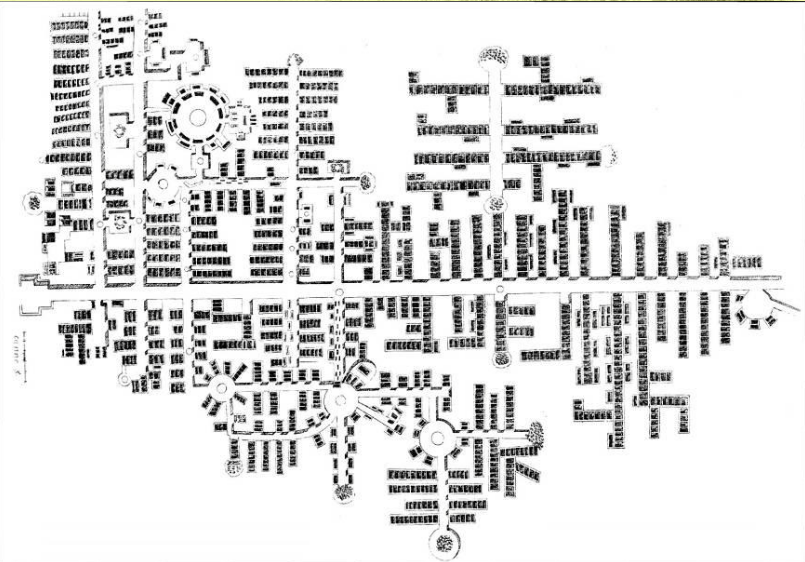
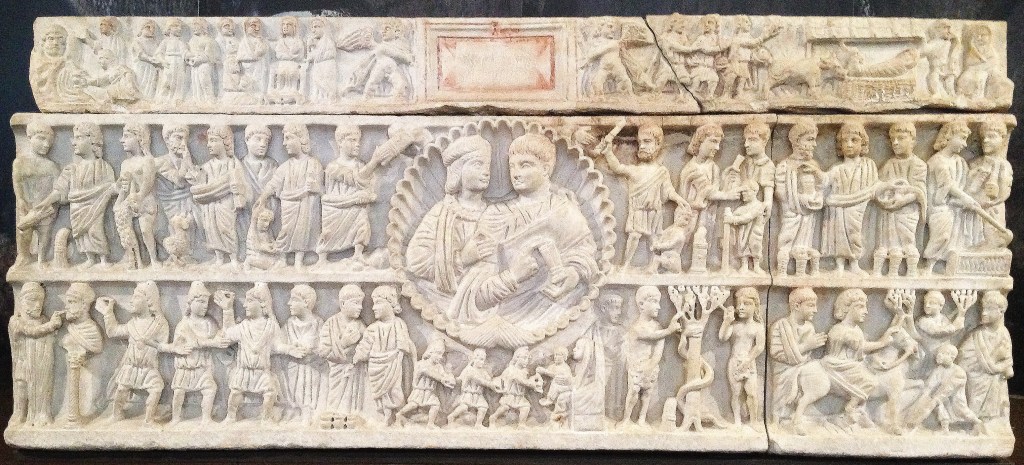
The catacomb and its surroundings were always known to the citizens. The first to describe it and record its layout was Vincenzo Mirabella (1613), but it then became a focal point for all European travelers visiting Sicily. Many of them described it and published drawings of the layout (including Jean Houel, Dominique Vivant Denon, and others). From the end of the 18th century, it was known and explored by the city’s leading scholars, such as Gaetani della Torre and Giuseppe Maria Capodieci. With the establishment of the city’s Archaeological Museum, its directors took charge of the excavations, starting with Francesco Saverio Cavallari (the discoverer of the Aldelfia sarcophagus in 1872) and then Paolo Orsi, who brought most of the underground structures to light.
S. Giovanni, plan after Mirabella (1613)Adelfia Sarcophagus
The objects found in the catacombs are currently stored and exposed at the local National Museum of Archeology “Paolo Orsi”. It is one of the largest museums in Europe in terms of size and contains the results of research carried out in the Syracuse area from the end of the 18th century onwards, with finds ranging from prehistory to the Roman era.
In 1780, Bishop Alagona inaugurated the Seminary Museum, which became the Civic Museum of the Archbishopric in 1808. After the unification of Italy, it was transformed into the National Archaeological Museum of Syracuse and opened in 1886 in a historic building in Piazza Duomo. From 1895 to 1934, Paolo Orsi directed the museum, expanding its collection with excavation campaigns in the area. Luigi Bernabò Brea, superintendent since 1941, proposed after the war the purchase of the Landolina villa for the creation of a new museum in its vast garden. The design of the sections, which began in 1961, was carried out according to a scientific order by Bernabò Brea himself and Gino Vinicio Gentili, while the design of the building was entrusted to architect Franco Minissi. The architectural structure and educational apparatus made it a truly avant-garde museum, which was inaugurated in 1988. With its various floors and 9,000 m² of floor space, it remains one of the largest archaeological museums in Europe. Over the years, the museum has undergone modifications and expansions.
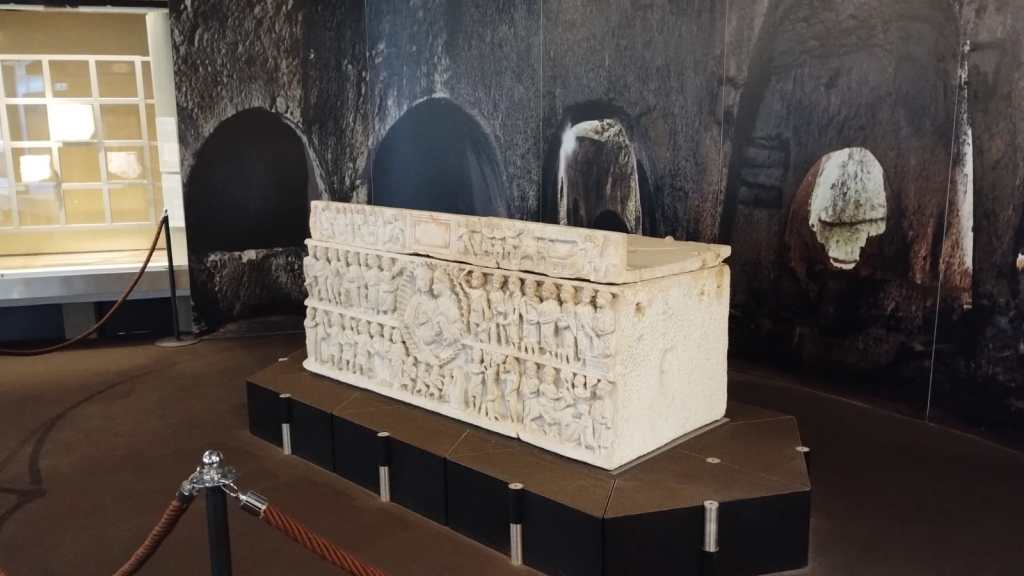
The entire F section on the first floor is dedicated to early Christian artifacts from the Syracuse area. It begins with an installation of the Adelfia rotunda from the catacombs of San Giovanni, with the sarcophagus of the same name at its center. The section mainly displays the most important Christian epigraphs of the sites and oil lamps found in the catacombs of San Giovanni, Vigna Cassia, Santa Lucia, and Cappuccini in Syracuse. The discovery of the Adelfia sarcophagus was undoubtedly one of the decisive moments in the creation of a museum in Syracuse. The section has undergone two expansions: first in 2014 for the new display of the Adelfia Sarcophagus and other finds related to the catacombs of Syracuse, and now in 2022 for a renovation to celebrate the 150th anniversary of the discovery of the sarcophagus.
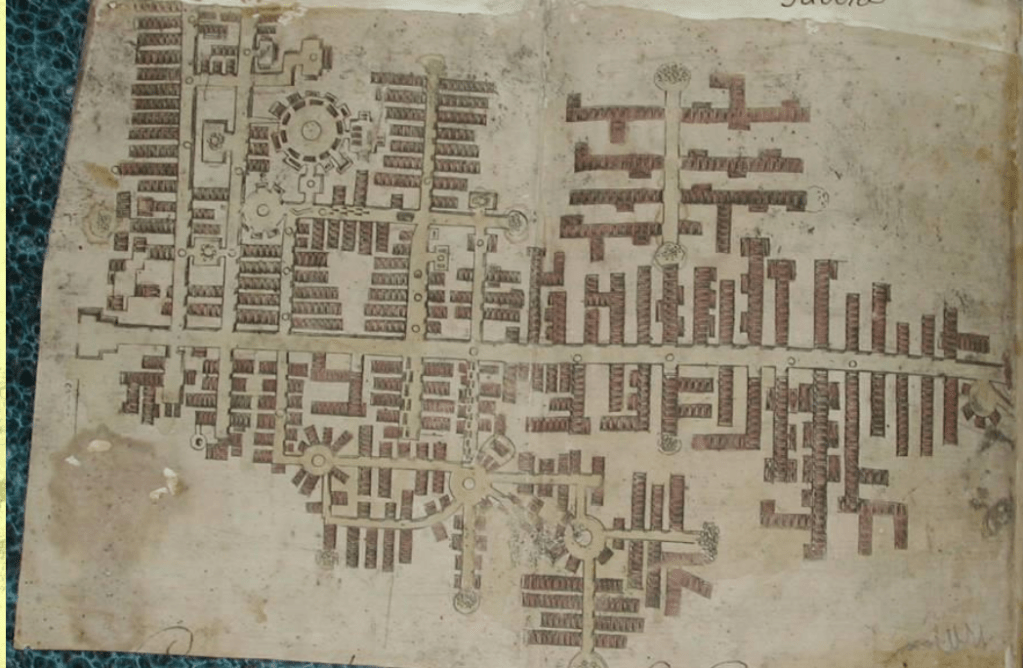
On the other hand, documents relating the catacombs throughout the centuries are stored at the Alagoniana Library and Diocesan Historical Archives of Siracusa. In the library there are abundant references and studies relating to the city’s numerous catacomb complexes, particularly in texts relating to the antiquities of Syracuse, written between the 18th and 19th centuries by various prelates of the city. These texts offer not only detailed textual descriptions of the sites and their state of preservation, but also a wealth of information on their use for scientific and religious purposes, as well as drawings of their layouts. Of particular note among the manuscripts are: Vestigij di Siracusa Antica Illustrata, C. Gaetani della Torre (1718–1805) Raccolta d’iscrizioni antiche Siracusane, C. Gaetani della Torre (1718–1805) Iscrizioni di Siracusa in numero 642, Giuseppe Maria Capodieci (1749-1828) Gli antichi Monumenti di Siracusa in 54 volumi, Giuseppe Maria Capodieci (1749-1828).
S. Giovanni after Capodieci, antichi Monumenti di Siracusa
Basic bibliography Scandurra C., Un nuovo spazio espositivo sulle catacombe siracusane: il Settore F del Museo Archeologico “Paolo Orsi”, in M. Sgarlata, D. Tanasi (edd.), KOIMESIS. Recenti esplorazioni nelle catacombe siracusane e maltesi, Parnassos Press 2016, pp. 151-184. M. Sgarlata, S. Giovanni a Siracusa, Città del Vaticano 2004. M. Sgarlata, L’architettura del sotterraneo a Siracusa nelle memorie di eruditi e viaggiatori del Settecento, in Annali del barocco in Sicilia. Ediz. illustrata. Vol. 8: Siracusa antica e moderna. Il val di Noto nella cultura di viaggio, Roma, 2007, pp. 25-36. M. Sgarlata, La raccolta epigrafica e l’epistolario archeologico di Cesare Gaetani conte della Torre, Palermo 1996.
After the summer break, the first two months of this academic year have been devoted to results dissemination. I will dedicate a separete blog post to online or on-person activities (stay tuned!), but first I would like to share the latest publications regarding the LIT! project. All in open access!
On October the 5th, the volume 32 of the Anales de Historia del Arte came out with the title Arte y Archivo. I contributed with the article “Catacumbas en museos: archivos documentales y fotográficos para la historia de la museografía” (“Catacombs in Museums: Archival Texts and Photos for the History of Museums”).
Bonus: my latest article about German researchers in the early Christian Catacombs of Malta finally saw the light this September. I wrote this article during the first months of the pandemic outbreak and I am very fond of it. It was published in the Römische Quartalschrift Band 117, Heft 1-2.
In the last issue of the online Journal of Art Historiography (Number 26, June 2022) the is the most recent output of the Project LIT!
The study and dissemination of an iconography: banquet scenes from the catacombs of Rome to the facsimile catacombs of the nineteenth century
In general, the text traces the discovery and the history of two important banquet scenes from the Roman catacombs (from the Catacombs of Callixtus and from the Catacombs of Priscilla). It focuses on the fortune of these scenes in Europe. this fortune developed in their reproductions found in various churches and chapels up to the middle of the 20th century. This overview helps in understanding how the study and reproduction of a single iconography can contribute to a general reconstruction of the development of the discipline of early Christian art history.
On the 22nd of February 2022 the scientific community celebrates the second centenary of the birth of Giovanni Battista de Rossi (1822-1894), one of the ‘founding fathers’ of Christian archaeology. He was Scriptor and then head of the Vatican Library, first secretary of the Commission of Sacred Archaeology, established by Pius IX in 1852, creator and curator of the Museo Pio Cristiano Lateranense founded in 1854. He is remembered also as founder and editor of the first specialist journal in the field, the Bullettino di Archeologia Cristiana (still existing today as Rivista di Archeologia Cristiana). He began the publication of the critical edition of all the early Christian inscriptions of Rome (ICVR) and was the author of the Roma Sotterranea Cristiana, an in-depth study of the main Roman catacombs (especially the catacombs of San Callisto) drawn up following his own important discoveries.
To celebrate the event, the Vatican State issued a special stamp where de Rossi is portayed with the ruins of the Hypogeum of the Flavi in the catacombs of Domitilla.
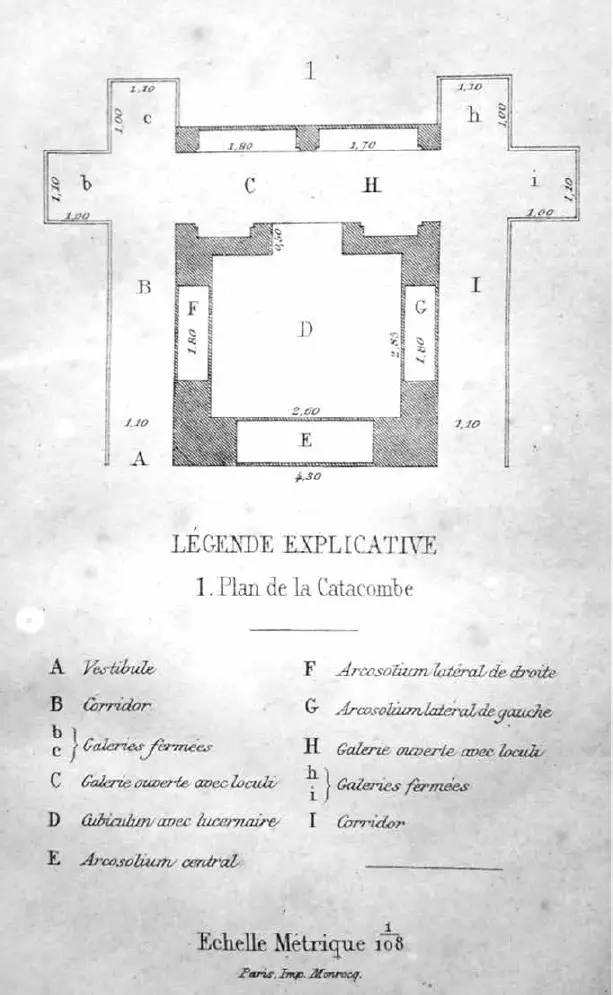
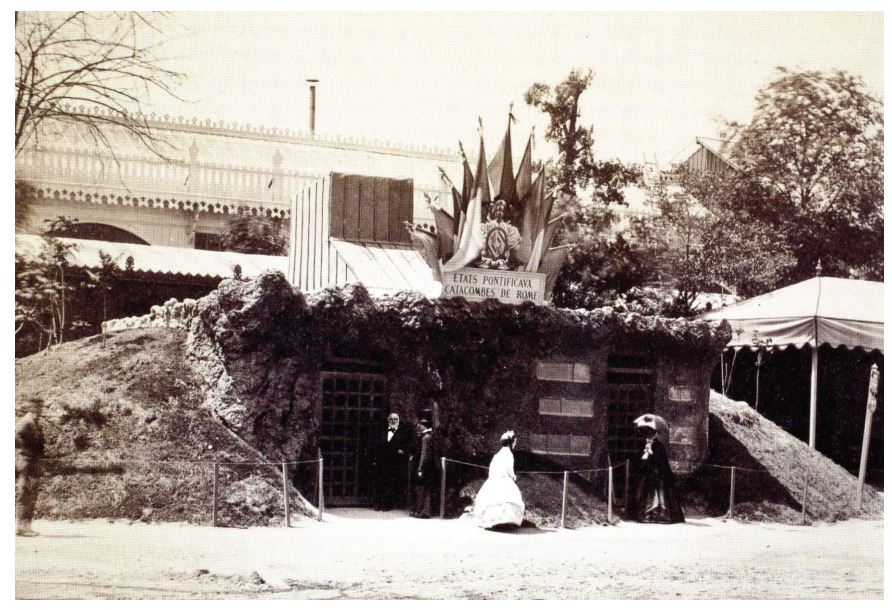
The project LIT! owns very much to de Rossi’s work. He was the one who created the first fac-simile catacombs in 1867 for the Universal Exhibition in Paris. We are therefore very happy to share the brand new article about the topic. Enjoy!
Our CONEX-Plus project LIT! has been presented on the 27th Newsletter of the Marie Curie Alumni Association (MCAA).
The MCAA is an international non-profit organization established and supported by the European Commission, but entirely run by volunteer members and with a bottom-up approach at its core.
This issue of June 2021 is dedicated to the making of a more inclusive research community. As the Editorial by Gian Maria Greco (MCAA Newsletter Editor-in-Chief) states, diversity and access are pivotal factors for the flourishing of the research endeavour. As a community of researchers, over the past few years the Marie Curie Alumni Association (MCAA) has been committed to increasing the accessibility of its communication products, services, and events.
The last section of the issue is dedicateed to out LIT! project (with a wonderful cartoon illustration!) and can be read on the online version: here. Thank you MCAA!
For a few weeks now, everyone can surf on Open Research Europe, the European Union’s revolutionary open access platform, that allows researchers in the Horizon 2020 programme to publish their research in accordance with the FAIR principles (Findability, Accessibility, Interoperability, and Reuse) and without being subject to the often very long publishing times.
Once the article has passed the prepublication checks, the preprint version is published within 10 days, enabling immediate viewing and citation. Expert reviewers are selected and invited, and their reviews and names are published alongside the article, together with the authors’ responses and comments from registered users. Articles that pass peer review are sent to major indexing databases and repositories. More info here.
Some of the results of the LIT! project will be surely disseminated via Open Research Europe in the following months. For now, however, I would love to share two researches of similar topics already published on the portal.
It is therefore clear that the platform can be used as an important tool for studies in the history of Christian archaeology. We will keep on checking and disseminating future publications on this topic!
The first part of the project was obviously dedicated to the start of the action and to the preliminary bibliographical study (identified as Work Package 2). The first three months, in fact, were dedicated to the bibliographical investigation and collection of all edited materials (from the late 19th century to the present). Every publication regarding the topic has been collected, in particular those related to the copies of the catacombs paintings set up in 1852 in the Lateran Christian Museum in Rome. This can be seen as the starting point of the artistic trend the project investigates. This research phase created the basis for the more detailed studies in the following months.
In fact, two months ago we moved on to the phase of analytical study of the individual cases (identified as Work Package 3). This involves collecting and analysing the already known cases and identified buildings. Given the period and the restrictions on mobility, the archival research has been concentrated in reduced periods of time, and documents has been read online aas well, while on-person surveys and documentation of the buildings have been postponed to the coming months.
For now, the main case that was analyses is the facsimile catacomb, which had been sent to the 1867 Universal Exposition in Paris by Pope Pius IX. The research has led to a number of unpublished findings which will soon be made available both in specialist journals (but in Green Open Access) and on this website.
The next case to study is the museum of Tusculum (Solin -Croatia), set up by the great Dalmatian archaeologist Frane Bulic in 1898, decorated in catacomb and Pompeian style. The political and cultural implications of this operation are manifold, and the links with other European scholars of the time very stimulating. Similarly, working in an unfamiliar linguistic context has allowed us to make contact with local scholars who will certainly participate in the publication of the results. This, too, will thus create an important network of international contacts.
Among the many personalities involved in the study of the Roman catacombs in the first half of the 17th century, Giovanni Severano (priest of the Oratory of San Filippo Neri) is one of the best known but at the same time least understood.
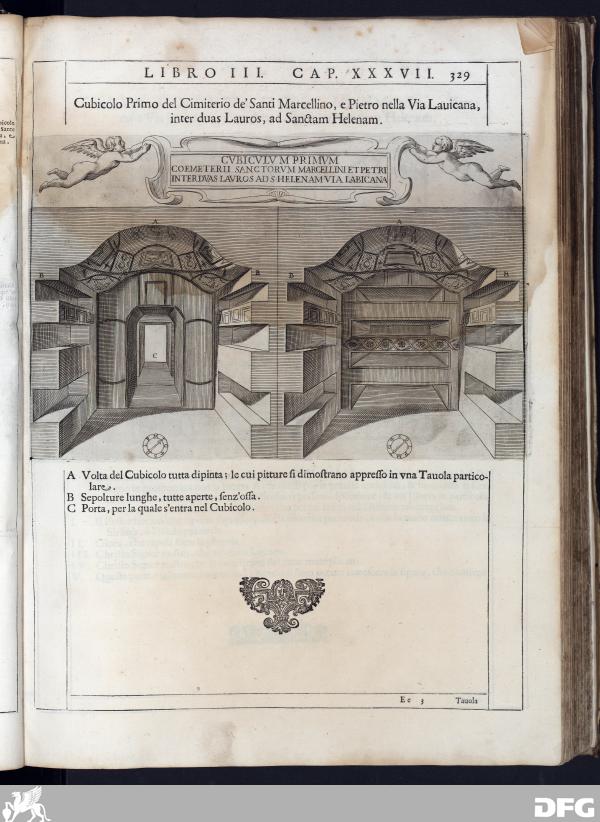
Recently, some studies have been carried out to re-evaluate his figure. Over the centuries he has in fact been considered only as the editor who completed Antonio Bosio’s Roma Sotterranea, left unfinished at the author’s death in 1629 and published by father Severano only in 1634. Extensive studies have shown that, in the process of completing Roma Sotterranea, he personally explored many areas of the Roman catacombs to confirm and expand Bosio’s descriptions. For example, there is ample evidence of his explorations of the catacomb of Saints Marcellinus and Peter on the Via Labicana. Here, he explored many areas that had not been recorded by Bosio.
Some traces of his explorations and, in particular, some drawings of Christian antiquities commissioned by Severan can be seen here.
The most up-to-date biography of Giovanni Severano can be found here.





 Catacombs rediscovery