Why were catacombs explored?

Having briefly looked at how the catacombs were explored in early 17th century, let us consider why they were explored, apart from walking to encounter new areas of the monument.
The activities that took place underground tended to be that of registering the monument and extracting finds from it.
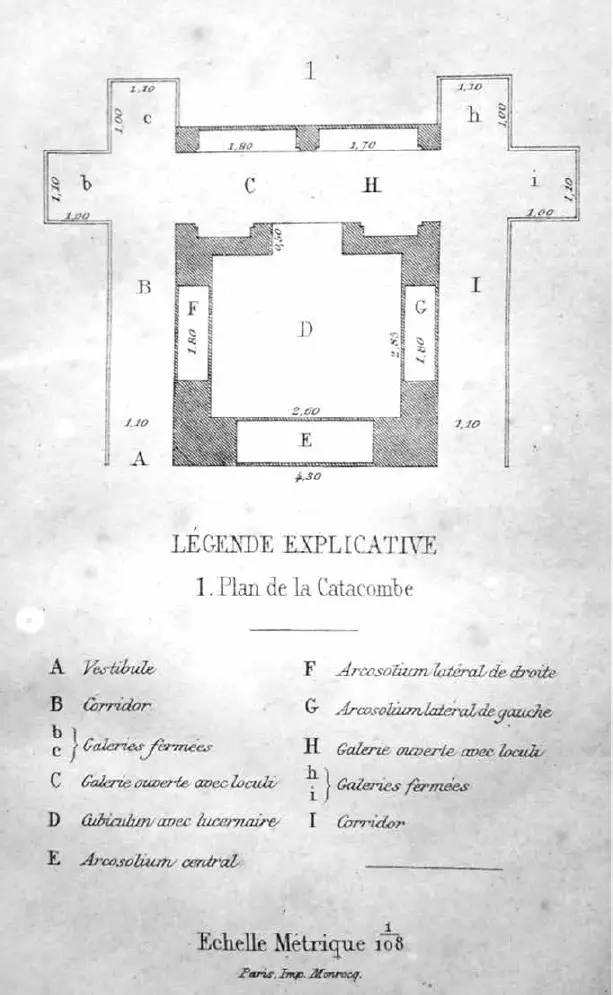
Registering the monument involved drawing the plans, an activity for which there were specialised people, of whom we know some names and some products, in particular those published in several books.

Plans of the catacombs on Via Nomentana in Rome published in 1632 in Bosio’s Roma Sotterranea


Alongside these, however, there were also more private, “homemade” maps, used by explorers for their personal exploration, which were never published but were used for underground visits. Of this maps, obviously, we have very scarce information.

Specialist artists were employed to copy the paintings seen in cemeteries. Copyists accompanied explorers on underground expeditions. The copying phase in catacombs was the most uncomfortable working situation, with insufficient light and space conditions. The subsequent stages of drawing arrangement and colouring took place in the studio.

Early 17th century copy of a painting from the Domitilla catacomb in Rome.
Vallicelliana Library of Rome

Another of the occupations of the groups of explorers was the extraction of archaeological objects, especially epigraphs, as well as anthropological remains excavated with the intention of making relics. The majority of archaeological finds ended up in the private collections of the explorers and the main collectors in Rome: sometimes explorers became a sort of merchant of antiquities for the antiquarian market. In particular, sarcophagi and inscriptions from the catacombs ended up since the beginning of the 16th century, as decorations in private houses.

The second group of objects found within the catacombs and removed from them are the anthropological artifacts, extracted from the tombs specifically to create holy relics. But that is another story….
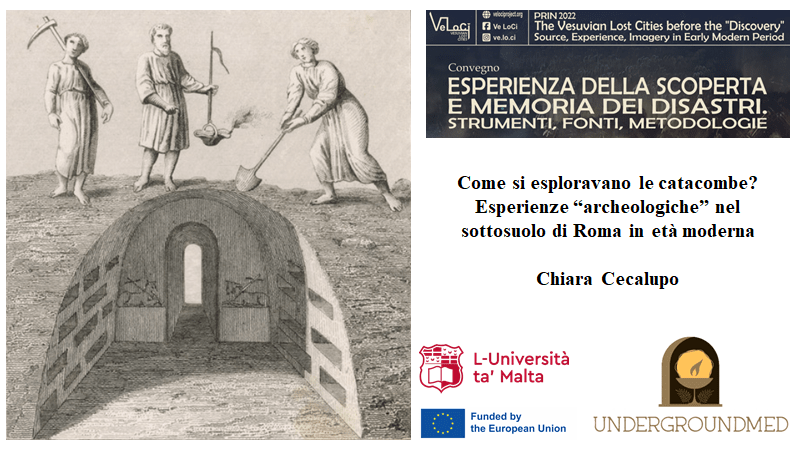
How were catacombs explored?

Exploration of Christian catacombs was a widespread and very fashionable practice in Rome between the sixteenth and eighteenth centuries. It involved Roman population, regardless of their social classes, as well as scholarly and ecclesiastical groups from outside Rome, generating a huge wave of interest in Christian catacombs that revolved in a “race” for catacomb exploration.

From a technical point of view, the ways of exploring the catacombs remain the same throughout the centuries. And the problems due to the architecture of the catacombs also remain the same: the darkness, the inconvenience of access, the labrinthic structure.
The theme is, therefore, universal and serves a reconstruction of catacomb explorations over the centuries.

An answer to the question “how were the catacombs explored?” was given during an interesting conference in Rome in November 2024 (Here is the link: https://www.velociproject.org/en/events/rome24 )

The catacombs were accessed through random openings in the countryside, or specially dug ones, from which one descended and from which one exited along with the finds recovered underground. It was therefore necessary to make them wider; hoes and spades were used, as well as ladder. To make one’s way through the tunnels without fear of losing one’s way, long ropes were used that were tied to the entrances and then uncoiled as one went along, or one could mark the points at which one turned at each fork in the road. Then of course one had to use flashlights and candles, in such quantities that they could last for days.

Once inside the catacomb, therefore, one proceeded mostly on all fours, or by crawling, or enlarged passages by excavating the tufa.

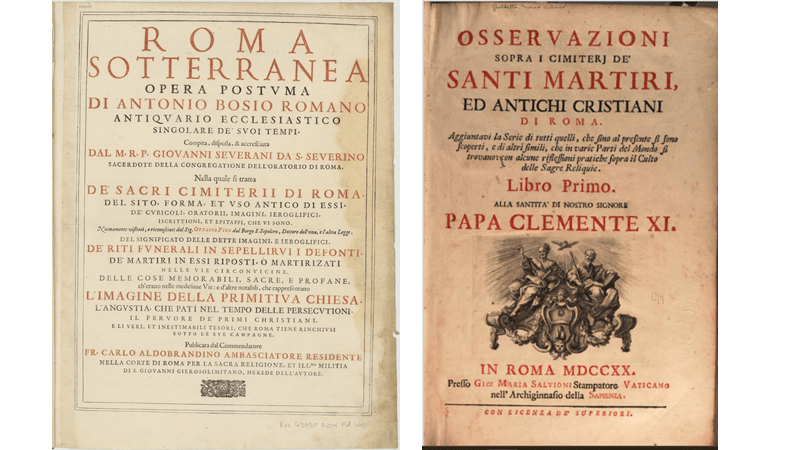
“Roma Sotterranea” (1630) and “Osservazioni sopra i cimiteri de Santi Martiri” (1720)
are the main sources of information for this topic.

Then, once inside the catacomb, one would proceed to walk around to find new areas and discover new parts of the monument, especially galleries with closed tombs.

But aside from basic exploration, what was being done in the catacomb? Coming soon…

Two 17th-century images from the Catacombs of Priscilla (Rome)

The “Cubicolo della Velata” (Cubicle of the Veiled Woman) is one of the most famous burial chamber in the catacombs of Rome, known since the 16th century and much loved by all scholars of the past. It is located in the central core of the Catacombs of Priscilla in Rome, and its name derives from the presence of a ‘Veiled’ woman painted in the bottom lunette in a praying attitude. The scenes, dated to the late 3rd century, are interpreted as the important moments in the life of the deceased: her marriage (left), motherhood (right) and her admission among the blessed (in the middle).

It was one of the very first places to be investigated by explorers in the 16th century. In fact, we have two original drawings reproducing the cubicle, preserved inside two important manuscripts in the Vatican Library.

The first, Vat. lat. 10545, f. 187r, dates from around 1590 and was executed by a draughtsman from the circle of the Flemish scholar Philip van Winghe, who is also known for having executed the first extant plans of the Roman catacombs.
The style of the copy is very simple and straightforward, almost childlike, but close to the original, a typical feature of copies of catacomb paintings in this manuscript.

The volume can be viewed in full here: https://digi.vatlib.it/view/MSS_Vat.lat.10545

The second, Vat. lat. 5409, f. 24r, belongs to the rich set of images of the Roman catacombs in the work of the Spanish Dominican Alonso Chacon, and dates to the late 1590s.
The drawing is completely different from the previous one, the original early Christian painting is copied in a very baroque manner, with reminiscences of Michelangelo and a richness that does not belong to the style of the catacomb art. In addition, the inconographic reading is also misinterpreted, creating images of Christ and Mary that do not correspond to the original work.

IThe volume can be viewed in full here: https://digi.vatlib.it/view/MSS_Vat.lat.5409

New outcome from the project LIT!

In the last issue of the online Journal of Art Historiography (Number 26, June 2022) the is the most recent output of the Project LIT!

The study and dissemination of an iconography: banquet scenes from the catacombs of Rome to the facsimile catacombs of the nineteenth century

In general, the text traces the discovery and the history of two important banquet scenes from the Roman catacombs (from the Catacombs of Callixtus and from the Catacombs of Priscilla). It focuses on the fortune of these scenes in Europe. this fortune developed in their reproductions found in various churches and chapels up to the middle of the 20th century. This overview helps in understanding how the study and reproduction of a single iconography can contribute to a general reconstruction of the development of the discipline of early Christian art history.

The whole article can be read here: https://arthistoriography.files.wordpress.com/2022/05/cecalupo.pdf

While the issue is fully available at: https://arthistoriography.wordpress.com/26-jun22/


Exposition “Una postal de las catacumbas”: Press coverage

In this post we will share links and pictures of the international press echo of the exhibition

 Una postal de las catacumbas. Exposición de tarjetas postales artísticas de las catacumbas romanas de 1890

(18 March-1 April 2022; Library of Humanities, Communication and Documentation. Campus Getafe, Universidad Carlos III of Madrid).

Update in progress

Social Media

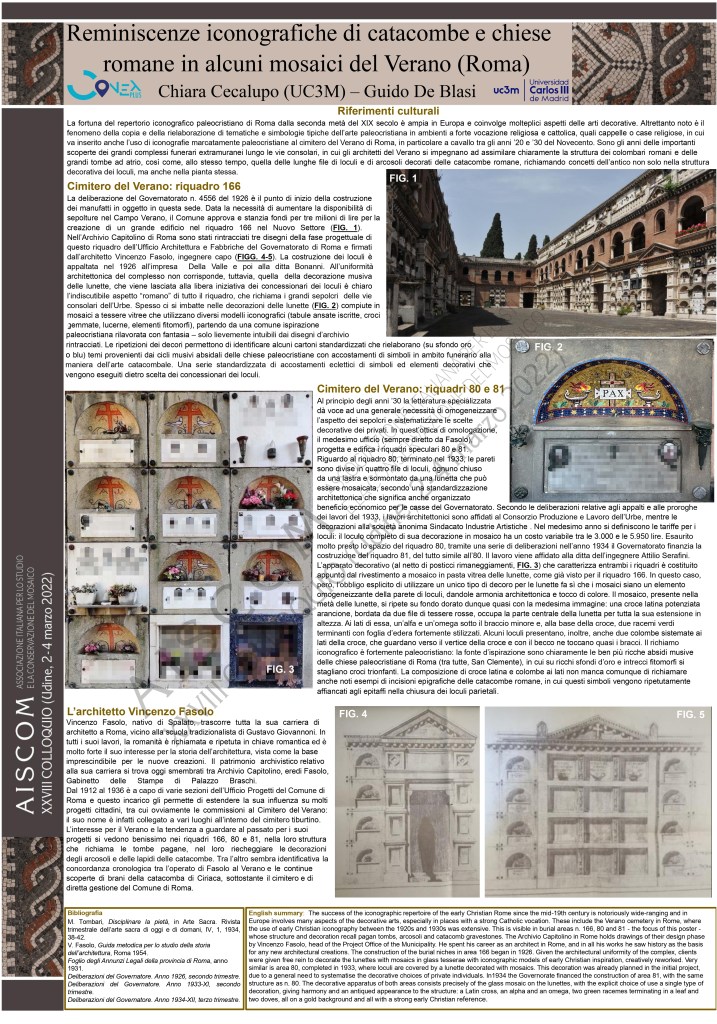
Iconographic echoes of Roman catacombs and churches in some mosaics of the Verano (Rome): the LIT! project at AISCOM 2022

One week ago wee celebrate the XXVIII AISCOM (Italian Association for the Study and Conservation of Mosaics) congress, that is still availabe on the facebook page of the association.

We exposed a poster online some results of project LIT! concerning some mosaics of the Verano Cemetery, dated between 1926 and 1933, that reproduce iconographic themes typical of the early Christian churches and the catacombs of Rome.

The poster is available today here (extended english summary below)

  • English summary

The success of the iconographic repertoire of the early Christian Rome since the mid-19th century is notoriously wide-ranging and in Europe involves many aspects of the decorative arts, especially in places with a strong religious and Catholic vocation. These include the Verano cemetery in Rome, where the use of early Christian iconography between the 1920s and 1930s was extensive. This is visible in burial areas nn. 166, 80 and 81 – the focus of this poster – whose structure and decoration recall pagan tombs, arcosoli and catacomb gravestones. The Archivio Capitolino in Rome held some drawings (figg. 4-5) of their design phase by Vincenzo Fasolo, head of the Project Office of the Municipality of Rome. Fasolo spent his entire career as an architect in Rome, and in all his works, Romanity is recalled and repeated: he saw the history of architecture as the basis for any new architectural creations.

The construction of the burial niches in area 166 began in 1926 (fig. 1). Given the architectural uniformity of the complex, private clients were given free rein to decorate the lunettes with mosaics. These decorations are made in glass tesserae with iconographic models of early Christian inspiration, creatively reworked (fig. 2). Very similar is area 80, completed in 1933, in which the loculi are covered by a lunette decorated with mosaics. This decoration was already planned in the initial project, due to a general need to systematise the decorative choices of private individuals. Once area 80 ran out of space, in 1934 the Governorate financed the construction of area 81, with the same structure as n. 80. The decorative apparatus of both panels consists precisely of the glass mosaic on the lunettes (fig. 3), with the explicit choice of use a single type of decoration, giving harmony and an antiqued appearance to the structure: a Latin cross, an alpha and an omega, two green racemes terminating in a leaf and two doves, all on a gold background and all with a strong early Christian reference.

The LIT! project at AISCOM

On the 2, 3 and 4 of March 2022 we celebrate the XXVIII AISCOM (Italian Association for the Study and Conservation of Mosaics) congress.
The congress can be followed on the facebook page of the association.

In the poster session we present a small study on some mosaics of the Verano Cemetery -the monumental cemetery of Rome. These mosaics are dated between 1926 and 1933 and are clear reproduction of the iconographic themes typical of the early Christian churches and the catacombs of Rome.

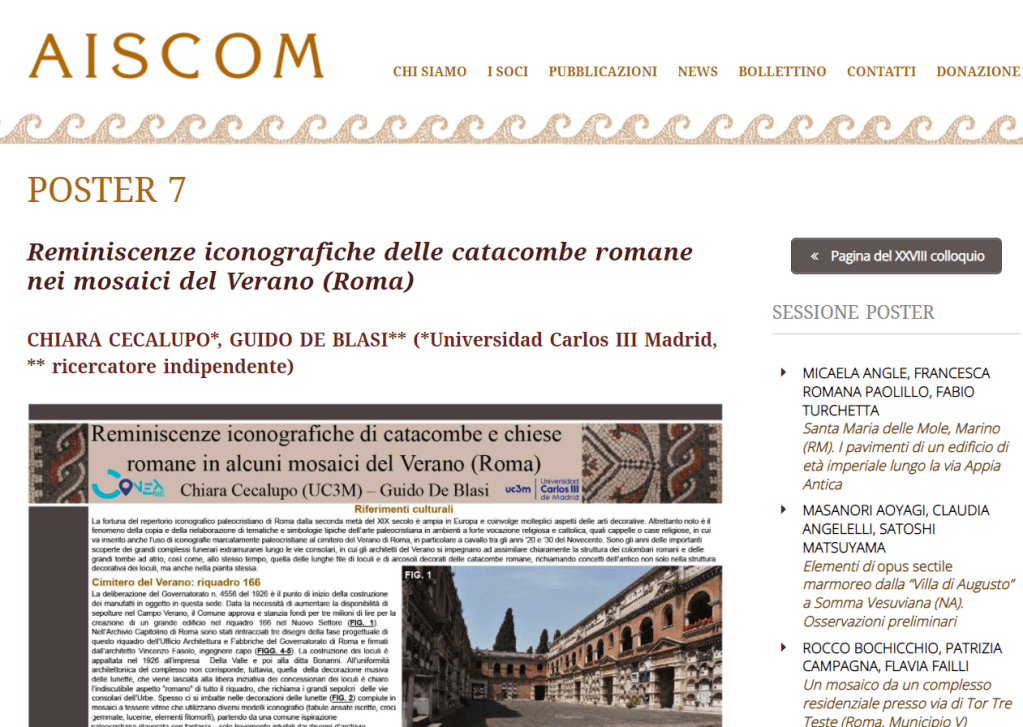
The poster can be read here (english summary available): http://www.aiscom.it/xxviii-colloquio/poster-7/

The complete poster will be available on this website next week.

February 2022: the month of Giovanni Battista de Rossi

On the 22nd of February 2022 the scientific community celebrates the second centenary of the birth of Giovanni Battista de Rossi (1822-1894), one of the ‘founding fathers’ of Christian archaeology. He was Scriptor and then head of the Vatican Library, first secretary of the Commission of Sacred Archaeology, established by Pius IX in 1852, creator and curator of the Museo Pio Cristiano Lateranense founded in 1854. He is remembered also as founder and editor of the first specialist journal in the field, the Bullettino di Archeologia Cristiana (still existing today as Rivista di Archeologia Cristiana). He began the publication of the critical edition of all the early Christian inscriptions of Rome (ICVR) and was the author of the Roma Sotterranea Cristiana, an in-depth study of the main Roman catacombs (especially the catacombs of San Callisto) drawn up following his own important discoveries.

To celebrate the event, the Vatican State issued a special stamp where de Rossi is portayed with the ruins of the Hypogeum of the Flavi in the catacombs of Domitilla.

The project LIT! owns very much to de Rossi’s work. He was the one who created the first fac-simile catacombs in 1867 for the Universal Exhibition in Paris. We are therefore very happy to share the brand new article about the topic. Enjoy!

C. Cecalupo, GIOVANNI BATTISTA E MICHELE STEFANO DE ROSSI ALL’ESPOSIZIONE UNIVERSALE DI PARIGI (1867), in Rivista di Archeologia Cristiana, 97, 2021,2, pp. 319-347.

Psss, hey! Universidad Carlos III will soon celebrate de Rossi with a special exhibition. Stay tuned…

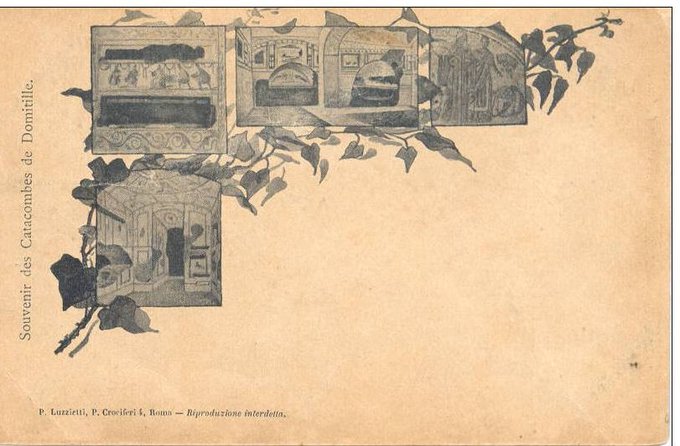
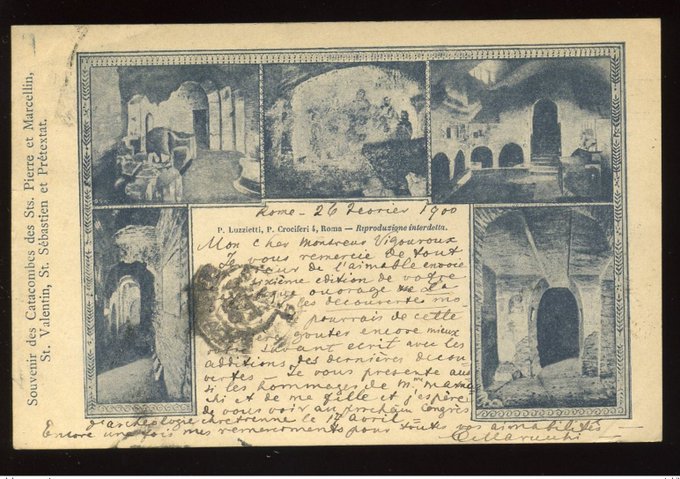
Postcards of the Roman catacombs by Pio Luzzietti

As earlier pointted out here, the postcards with pictures of the catacombs of Rome are enjoyable sources to understand the cultural impact of Roman catacombs in European culture in late 19th century.

This time, we will present three postcards issued by the famous Roman antiquarian library founded by Pio Luzzietti. The Libreria Antiquaria Pio Luzzietti had a very rich collection of historical prints and was very active in selling antique books and prints and publishing antique catalogues from about 1890 to 1930.

The founder Pio Luzzietti (1869-1927) was among the best known collectors and booksellers in Rome. He certainly had an interest in Christian archaeology, considering that he had acquired important libraries on the subject, such as Mariano Armellini’s and Enrico Stevenson’s. The bookshop was located in Via dei Crociferi 16, then in Piazza dei Crociferi 4 and finally – from 1906 – in Piazza d’Aracoeli 16-17.

The bookshop was a meeting place for Italian and foreign politicians and scholars. It is also known that the bookshop supplied prints and rare books to important institutions such as the Prints Cabinet in Rome and the museum of Castello Sforzesco.

Among all the prints, it is possible to find some postcards with scenes from the catacombs, dating before the year 1906. The language used is obviously the international one, French. But, unlike other postcards from the same period, the images printed on these catacombs are not taken from Giovanni Battista de Rossi’s Roma Sotterranea Cristiana. They are in fact artistic collages of real photographs of the underground architecture and paintings.

From this we understand that Luzzietti had original photographic material at his disposal, perhaps from libraries he had acquired.

Four postcards of the Roman catacombs by Ernesto Richter

The postcards with vedute of the catacombs of Rome published by Ernesto Richter are among the most important visual sources for the history of Roman catacombs. They were published between the end on the 19th and the beginning of the 20th century.

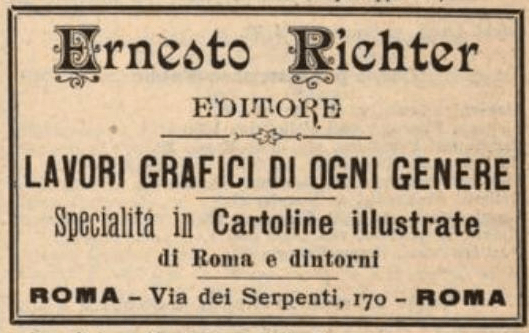
Ernesto Richter was a Roman publisher set in Via dei Serpenti 170. He was specialised in images of Rome, works of art in Roman museums, views of the Roman monuments and Roman suburbium. These images were taken by various photographers and published as postcards.

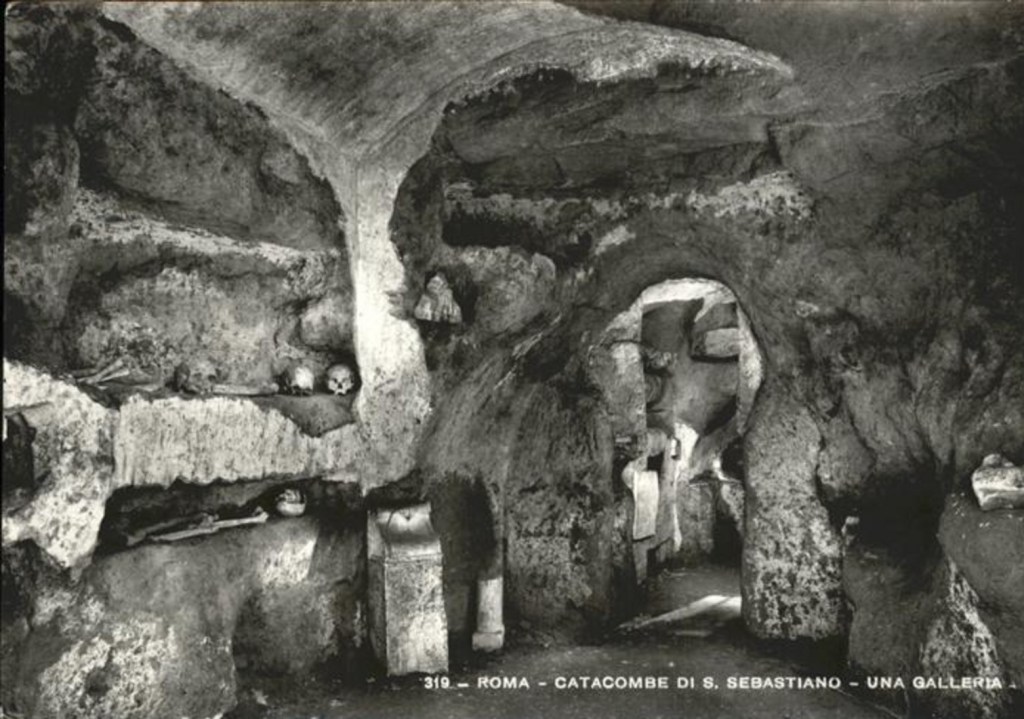
Among his work there were many postcards and illustrations of Roman catacombs, especially the most known and visited ones. Actually, the Richter postcards became usual souvenirs for travelers. as testified by all the views of the catacombs of St Callisto and St Sebastiano published by this editor.

Here are four postcards of these two catacombs. Enjoy!